DYORSwap Slippage Calculator
DYORSwap Liquidity Analysis
Based on article data (October 2025): $514 liquidity depth at +2% price movement. For reference: Uniswap handles over $1.2B daily volume.
Estimated Slippage
Recommendation: Trading amounts over $50 will likely cause price movement exceeding 10%.
Article Note: DYORSwap has only $514 liquidity depth at +2% movement.
If you're looking to trade SONIC tokens, DYORSwap is the only place to do it - but that doesn't mean it's easy or safe. Built on the Sonic blockchain, DYORSwap is Sonic's native decentralized exchange (DEX), designed to handle all trading for the SONIC token and its wrapped version, WS. Sounds simple, right? In theory, yes. In practice, users are getting stuck, locked out, and frustrated - often because they don't realize they need S tokens just to pay for gas fees after bridging in ETH.
What Is DYORSwap and How Does It Work?
DYORSwap is a decentralized exchange built directly on the Sonic blockchain, which launched in Q2 2024 as a rebrand of the old Fantom (FTM) network. Unlike Ethereum-based DEXs like Uniswap or PancakeSwap, DYORSwap runs on a single Layer 1 chain optimized for DeFi. It uses an automated market maker (AMM) model, meaning trades happen through liquidity pools instead of order books. You swap tokens directly with the pool, not another person.
The tech behind it looks impressive on paper: transaction finality in under 2 seconds, gas fees under $0.0001, and up to 10,000 transactions per second. Sonic claims to solve Ethereum’s Layer 2 fragmentation by keeping everything on one chain. That’s the promise. But right now, the execution is shaky.
Trading Volume and Liquidity: A Warning Sign
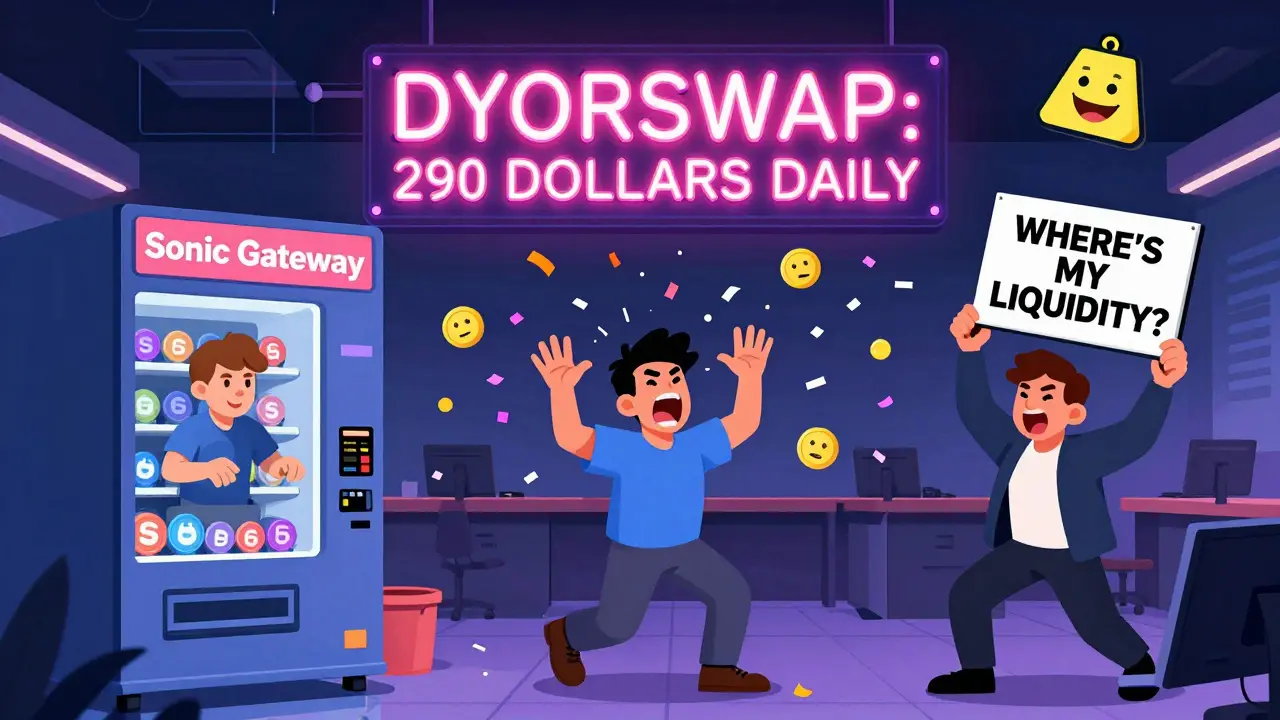
DYORSwap’s main trading pair is SONIC/WS. As of October 2025, its 24-hour trading volume was $290. That’s not a typo. $290. For comparison, Uniswap handles over $1.2 billion daily. PancakeSwap does $800 million. DYORSwap’s volume is less than 0.00000145% of the entire DEX market.
Why does this matter? Liquidity. With only $514 in depth at +2% price movement, even a $500 trade could swing the price by 10% or more. That’s not trading - that’s gambling. If you try to swap a meaningful amount of SONIC, you’ll likely lose money to slippage before the trade even finishes.
There’s also only one major pair. No ETH, no BTC, no stablecoins like USDT or USDC. Just SONIC and WS. That means you have to bridge your assets from Ethereum first, which brings us to the biggest problem: the gateway.
The Sonic Gateway: A Broken Bridge
To use DYORSwap, you need SONIC tokens. But you can’t get them directly on DYORSwap. You have to buy SONIC on a centralized exchange like Binance or KuCoin, then use the Sonic Gateway to bridge them over to the Sonic chain.
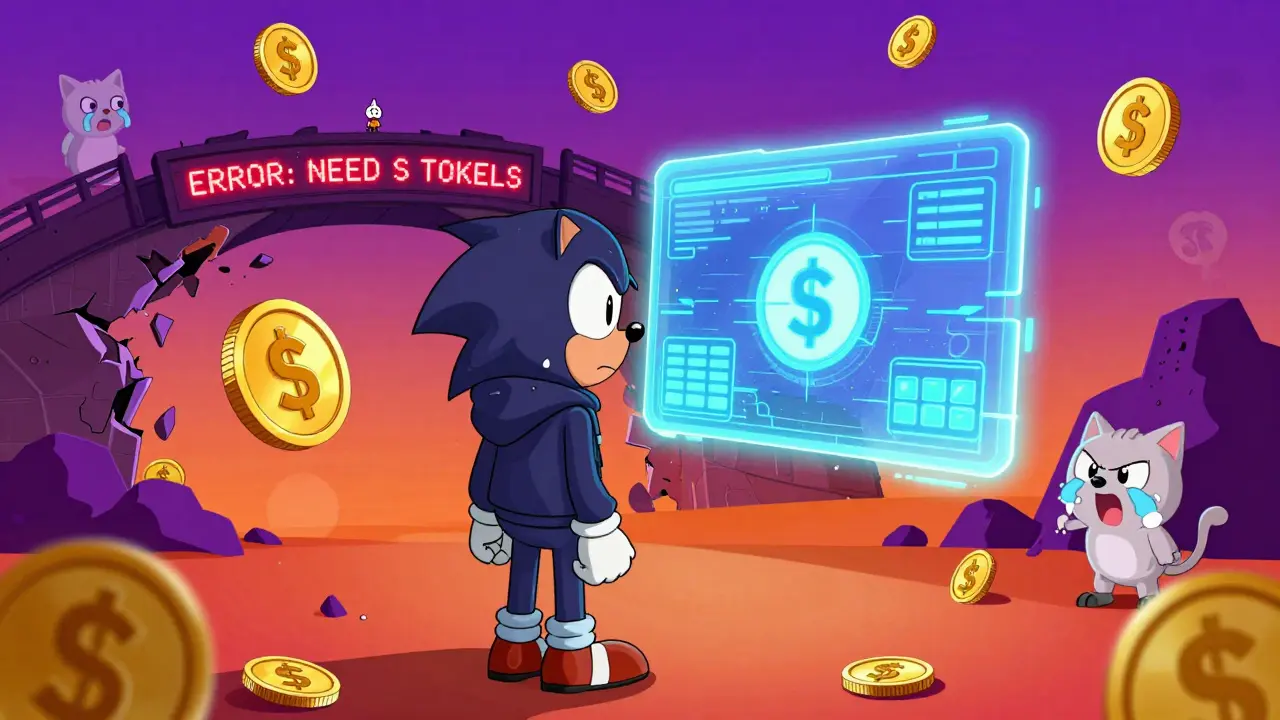
Here’s where it breaks: to pay for gas on Sonic, you need S tokens - the native coin of the Sonic blockchain. But you can’t get S tokens unless you already have them. So if you bridge ETH to Sonic without holding any S tokens, you’re stuck. Your funds arrive, but you can’t interact with them. No swaps. No withdrawals. Just locked.
Over 37 users reported this exact issue in Sonic’s Discord support channel in July 2025 alone. Reddit threads like u/CryptoNewbie2025’s post describe being caught in a loop: “I needed S to claim bridged funds, but couldn’t get S without already having S on chain.” This isn’t a bug - it’s a design flaw.
The Sonic Gateway claims to have a fail-safe: if Sonic goes down for more than 14 days, you can withdraw your bridged assets back to Ethereum. That sounds reassuring - until you realize the bridge itself fails more often than it works. One user on Reddit waited three hours for a second bridge attempt to go through after the first one timed out.
How Hard Is It to Get Started?
Onboarding to DYORSwap takes an average of 47 minutes, according to usability tests by Coincub. That’s nearly four times longer than Uniswap. Why? Because you’re not just connecting a wallet. You’re juggling three separate steps:
- Buy SONIC on a centralized exchange (Binance, KuCoin, MEXC)
- Buy S tokens to pay for gas (often requiring another purchase)
- Bridge SONIC to Sonic chain using the gateway
Each step has its own wallet setup, approval process, and potential failure point. Most users need help from a friend or a YouTube tutorial. Even the documentation is split: developers rate Sonic’s technical docs 4.1/5, but non-technical users give wallet guides only 2.3/5.
The interface itself is barebones. No limit orders. No charting tools. No price alerts. Just a basic AMM swap screen. If you’re used to trading on Uniswap or QuickSwap, you’ll feel like you’ve gone back to 2020.
Who Is DYORSwap Actually For?
DYORSwap isn’t for casual traders. It’s not for investors looking to diversify. It’s not even for most DeFi users.
It’s only for one group: people who believe deeply in Sonic’s long-term vision and are willing to tolerate chaos to support it. That’s it.
The only real advantage DYORSwap has is its fee structure. On Sonic, dApps can keep 90% of blockchain fees - a huge incentive for developers. That’s why Sonic was built: to stop the fragmentation of liquidity across Layer 2 chains. If Sonic succeeds, DYORSwap could become the central hub for all DeFi on its chain.
But right now, that’s just a theory. The market hasn’t voted for it. Liquidity is tiny. User complaints are loud. And the token price? SONIC dropped 18.2% in seven days as of October 2025. That’s not a sign of growing adoption.

Expert Opinions: Hope vs. Reality
Some analysts see potential. Crypto Insights argues DYORSwap “represents the future of DeFi infrastructure” by solving multi-chain fragmentation. But they also admit the UX is a mess.
Others are blunt. Coincub’s senior analyst Maria Chen said: “Sonic’s technical foundation is promising, but DYORSwap’s current liquidity levels make it impractical for serious trading except for dedicated Sonic ecosystem participants.”
TradingBeast gave DYORSwap a medium-risk rating of 6.8/10. CoinCodex ranked it 427th out of 450 exchanges - dead last in features and liquidity.
The bottom line? Experts agree: DYORSwap’s fate is tied entirely to Sonic’s ability to attract users. And right now, Sonic isn’t attracting users - it’s losing them.
What’s Next for DYORSwap?
The Sonic team announced a liquidity mining program for Q4 2025 - a last-ditch effort to get people to deposit tokens into DYORSwap pools. That could help. But it’s too late for many. The community’s trust is already shaken.
Some predict SONIC could hit $5.16 by 2040. That’s a 61,000x increase. Others think it’ll be $0.30 by year-end. Neither prediction changes the fact that right now, DYORSwap is a high-risk experiment with no safety net.
If you’re thinking of using it, ask yourself: Are you here to trade - or to gamble on a blockchain that hasn’t proven it can survive?
Final Verdict
DYORSwap is not a reliable exchange. It’s a technical showcase with no users. It has blazing speed and low fees - but no liquidity, no support, and a broken onboarding process.
Only use it if:
- You already have S tokens and SONIC on the Sonic chain
- You’re trading small amounts (under $50)
- You’re okay with waiting hours for a bridge to work
- You’re not using it as your primary trading platform
For everyone else? Stick with Uniswap, PancakeSwap, or another established DEX. DYORSwap isn’t ready. And until it fixes its gateway, its liquidity, and its user experience, it’s not worth the risk.




Jon Visotzky
i just tried to bridge my eth and got stuck for 3 hours. no s tokens, no way out. this thing is a trap.
they say 'decentralized' but it's just centralized chaos with extra steps.