Imagine trying to join a massive global conversation where everyone is shouting at once, but you don’t know who to listen to. That is exactly what happens when a new computer tries to connect to a cryptocurrency network. Before any transactions can be validated or blocks added, the node must first find its neighbors. This process is called peer discovery, and it is the invisible glue holding decentralized systems together.
If peer discovery fails, your node is isolated. It cannot sync with the chain, verify transactions, or participate in consensus. For developers and serious users running full nodes, understanding how this mechanism works is not just academic-it is essential for maintaining network health and security.
The Core Problem: Finding Peers in a Decentralized World
In traditional client-server architectures, like accessing a website, you simply type an address and connect to a known server. But blockchains have no central server. They rely on a peer-to-peer (P2P) network where every participant is equal. The challenge? How does a brand-new node, starting from zero knowledge, find active peers without relying on a centralized directory that could be shut down or manipulated?
This problem is critical because if an attacker controls the discovery process, they can isolate honest nodes, feed them fake data, or launch eclipse attacks. Therefore, robust peer discovery mechanisms are designed to be resilient, distributed, and difficult to manipulate.
Bitcoin’s Multi-Layered Discovery Strategy
Bitcoin uses a sophisticated, multi-tiered approach to discover peers. It prioritizes decentralization while ensuring reliability. When a Bitcoin node starts up for the first time, it typically knows nothing about the network. Here is how it finds its way:
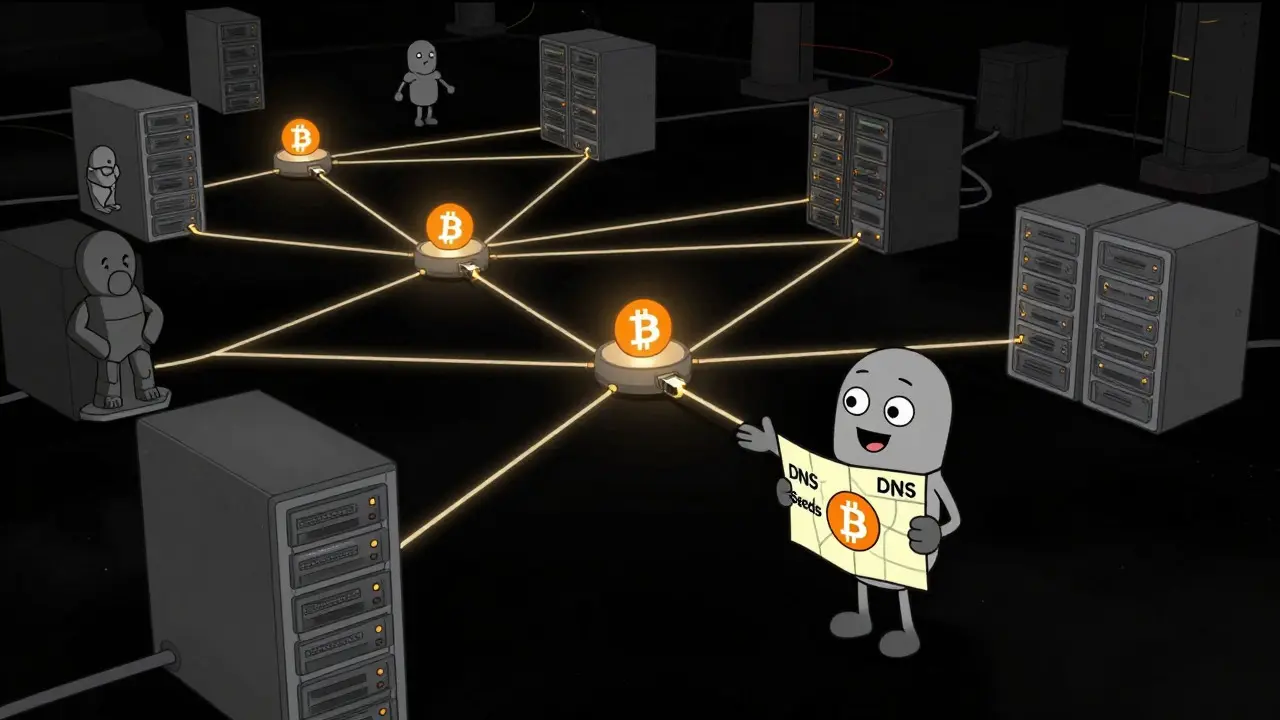
- DNS Seeds: The node queries hardcoded Domain Name System (DNS) addresses maintained by trusted community members. These servers return IP addresses of publicly available full nodes. There are two types: dynamic seeds that automatically scan the network for active nodes, and static seeds that are manually updated. Nodes usually connect on port 8333 for mainnet or 18333 for testnet.
- Hardcoded Seed Nodes: If DNS queries fail, the node falls back to a list of specific IP addresses embedded directly in the software code. These act as emergency contacts.
- Manual Configuration: As a last resort, users can manually input IP addresses obtained from friends, websites, or community forums.
Once a node connects to even one peer, the real magic begins. It immediately requests information about other known peers using getaddr messages. This creates a cascading effect: the new node connects to those peers, who then share more addresses, rapidly expanding the node's view of the network topology.
Bitcoin nodes also maintain detailed statistics for each peer, tracking availability, speed, and reliability. Over time, the node prefers connecting to proven, reliable peers over relying on DNS seeds again. This strategy distributes load across the network and minimizes dependence on central resources.
Ethereum 2.0 and the discv5 Protocol
Ethereum took a different path with its transition to Proof-of-Stake. In Ethereum 2.0, peer discovery relies on the Node Discovery Protocol version 5.1 (discv5). Unlike Bitcoin’s simpler model, discv5 is designed for high churn and complex validator relationships.
Key features of discv5 include:
- Ethereum Node Records (ENRs): Each node maintains an ENR containing networking information. These records are frequently updated to reflect changes in the network, such as subnet membership or validator status.
- Dynamic Routing Tables: Nodes build and maintain routing tables that capture comprehensive networking layer information, allowing for efficient peer lookup.
- Subnet-Based Organization: Ethereum 2.0 organizes nodes into subnets for attestation aggregation. Subnet membership is defined in the
attnetsentry of the ENR, ensuring nodes connect to relevant peers for their specific duties.
This approach allows Ethereum to handle the complexity of thousands of validators syncing and communicating simultaneously, whereas Bitcoin’s model is optimized for steady-state transaction propagation.
| Feature | Bitcoin | Ethereum 2.0 |
|---|---|---|
| Primary Method | DNS Seeds + Peer Sharing | discv5 Protocol |
| Record Type | IP Addresses | Ethereum Node Records (ENRs) |
| Consensus Model Context | Proof-of-Work | Proof-of-Stake |
| Network Organization | Flat P2P | Subnet-Based |
| Update Frequency | Low (Stable Topology) | High (Dynamic Validator Set) |
Security Implications and Attack Vectors
Peer discovery is not just about connectivity; it is a primary defense against censorship and attacks. The distributed nature of these mechanisms makes it hard for central authorities to shut down parts of the network. However, vulnerabilities exist.
Eclipse Attacks: An attacker could attempt to control all of a target node’s peer connections. By isolating the node, the attacker can feed it false information, delaying its awareness of the true blockchain state. Bitcoin mitigates this by encouraging nodes to maintain many connections and prioritize diverse sources.
Denial-of-Service (DoS): While the P2P architecture resists DoS better than centralized servers, discovery processes themselves can be targeted. Malicious actors might flood DNS seeds with invalid IPs or spam nodes with fake peer announcements. Both networks implement rate limiting and validation checks to mitigate this.
51% Attacks: In smaller networks, if an attacker gains control of majority hash power (PoW) or stake (PoS), they can manipulate consensus. While not strictly a discovery issue, poor peer distribution can exacerbate centralization risks, making discovery protocols crucial for maintaining decentralization.

Technical Challenges in Modern Networks
As networks grow, peer discovery faces new hurdles:
- NAT Traversal: Many nodes run behind firewalls or Network Address Translation (NAT) devices, making them hard to reach. Protocols must handle this gracefully, often using techniques like UPnP or hole punching.
- High Churn: In dynamic environments like Ethereum 2.0, nodes join and leave frequently. Discovery protocols must quickly adapt to changing topologies without overwhelming the network.
- Privacy: Current discovery methods often expose node IPs, potentially linking activity to physical locations. Future developments may integrate onion routing or similar technologies to enhance privacy during discovery.
Future Directions for Peer Discovery
The evolution of peer discovery will likely focus on three areas:
- Enhanced Privacy: Integrating anonymous communication layers to protect node identities from network analysis.
- Scalability: Developing more efficient protocols that can handle millions of nodes without performance degradation.
- Resilience: Improving resistance to sophisticated correlation attacks and eclipse attempts through better peer selection algorithms.
As cryptocurrency networks mature, peer discovery will remain a foundational component. Its design directly impacts the security, decentralization, and usability of the entire ecosystem. Understanding these mechanisms helps users make informed decisions about which networks to support and how to configure their nodes for optimal participation.
What is peer discovery in cryptocurrency?
Peer discovery is the process by which nodes in a decentralized blockchain network locate and connect to other participating nodes. It enables new nodes to join the network, establish connections, and participate in consensus and transaction validation without relying on a central authority.
How does Bitcoin find new peers?
Bitcoin uses a multi-tiered system starting with DNS seeds-hardcoded domain names that return IP addresses of active nodes. If DNS fails, it falls back to hardcoded seed nodes. Once connected, nodes exchange peer lists via getaddr messages, creating a cascading discovery effect.
Why does Ethereum use discv5 instead of DNS seeds?
Ethereum 2.0 uses discv5 because its Proof-of-Stake model requires dynamic management of validator sets and subnet memberships. discv5 supports frequent updates to Ethereum Node Records (ENRs) and handles high churn better than static DNS-based systems.
What is an eclipse attack in peer discovery?
An eclipse attack occurs when an attacker controls all of a target node’s peer connections, isolating it from the rest of the network. This allows the attacker to feed false information to the node, potentially delaying its sync or manipulating its view of the blockchain.
Can peer discovery be censored?
While individual DNS seeds or seed nodes can be blocked, the decentralized nature of peer discovery makes total censorship difficult. Nodes can fall back to alternative seeds, manual configurations, or previously discovered peers, ensuring network resilience against targeted shutdowns.