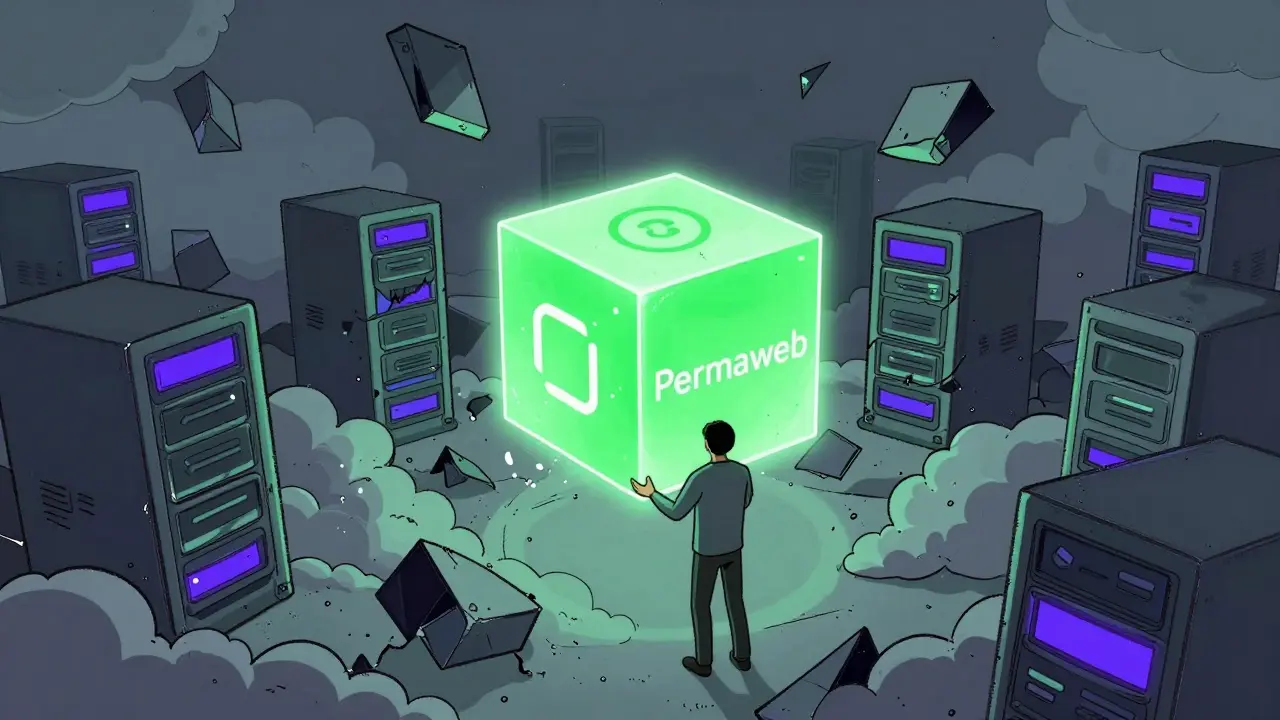
Arweave is a decentralized protocol that allows you to store data permanently on the internet for a single upfront payment. Unlike traditional cloud services where you pay monthly fees, Arweave ensures your files stay accessible forever without recurring costs. This system solves one of the biggest problems in digital history: data impermanence. When websites shut down or servers fail, valuable information disappears. With Arweave, once you upload your content, it becomes part of an immutable ledger known as the Permaweb, ensuring it remains censorship-resistant and available indefinitely.
The Problem with Traditional Data Storage
We often assume our digital lives are safe because they live "in the cloud." But that cloud is actually owned by private companies like Amazon Web Services (AWS), Google Cloud, or Microsoft Azure. These providers charge subscription fees-currently around $0.023 per gigabyte per month for AWS S3. If you stop paying, your data vanishes. Even worse, these centralized systems can be censored, hacked, or forced to delete content due to legal pressure. For journalists, historians, or developers building decentralized applications, this risk is unacceptable. You need a way to guarantee that critical records survive beyond any single company’s lifespan or political climate.
How Arweave Achieves True Permanence
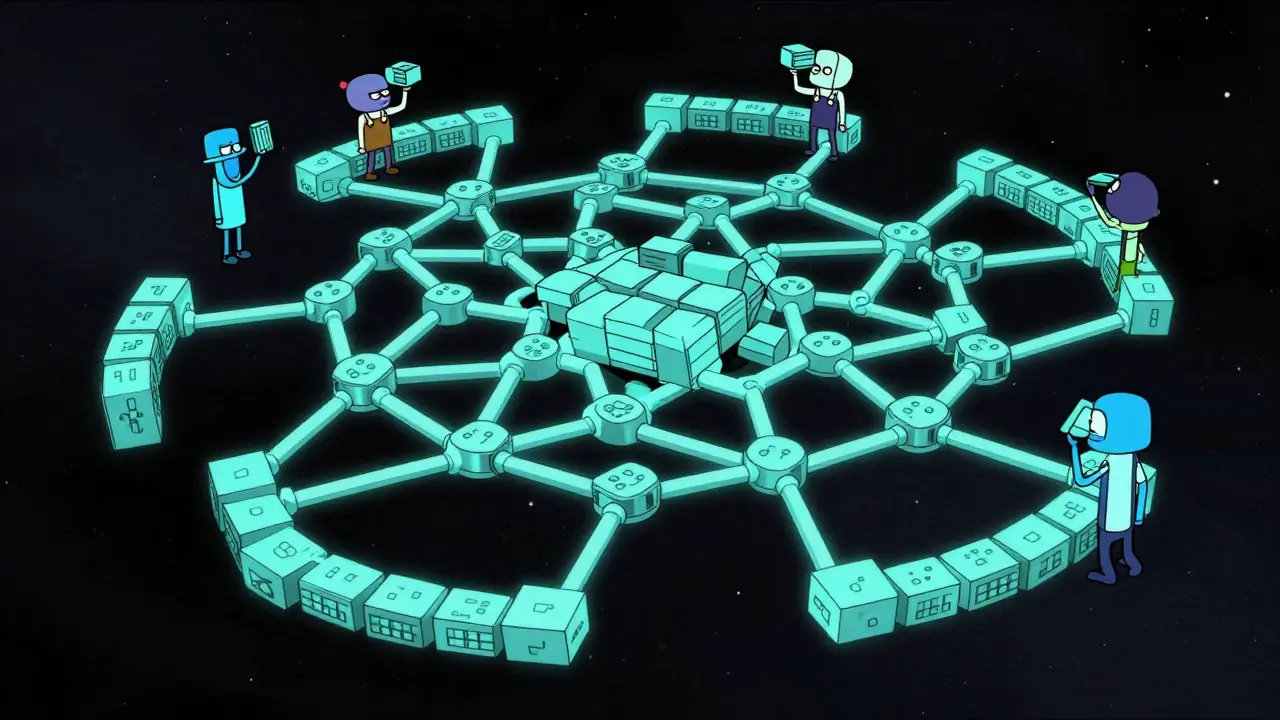
Arweave doesn’t just copy files to multiple servers; it uses a unique cryptographic structure called Blockweave. Instead of linking blocks linearly like Bitcoin or Ethereum, each new block links to two previous blocks: the immediate parent and a randomly selected older block known as the recall block. This dual-linking forces miners to maintain copies of historical data to validate new transactions. As a result, older data isn’t forgotten-it’s constantly re-verified through the mining process. The network also employs content-addressable storage, meaning every file gets a unique hash based on its contents rather than its location. This makes tampering nearly impossible while enabling efficient retrieval across the global node network.
The Economic Model Behind Forever Storage
The real magic lies in how Arweave funds itself over centuries. When you upload data, you pay a one-time fee in AR tokens. Approximately 15% of that fee covers 200 years of estimated storage costs, paid incrementally to miners who host your data. The remaining 85% goes into an endowment pool designed to grow in purchasing power as hardware prices fall. If storage costs decline faster than 0.5% annually-which has been the trend since 2018-the endowment actually gains value over time. This deflationary model means your initial payment could potentially cover thousands of years of storage, not just two centuries. Compared to competitors like Filecoin or Sia, which require continuous payments, Arweave offers true financial predictability for long-term projects.
| Feature | Arweave | Filecoin | AWS S3 |
|---|---|---|---|
| Pricing Model | One-time fee | Monthly rental | Monthly subscription |
| Data Lifespan | Permanent (200+ years) | As long as paid | As long as paid |
| Censorship Resistance | High | Moderate | Low |
| Best For | Archival records, dApps | Short-term large datasets | Enterprise web hosting |
Real-World Applications Beyond Crypto
While many associate Arweave with blockchain projects, its utility extends far beyond cryptocurrency wallets. The Internet Archive partnered with Arweave to preserve over 250,000 historical web pages, ensuring cultural heritage survives server failures. Journalists use it to publish investigative reports resistant to government takedowns. Developers deploy full decentralized applications (dApps) directly onto the Permaweb, eliminating reliance on centralized backends. Even artists mint NFTs with metadata stored permanently on Arweave instead of fragile IPFS links that often break. According to Q4 2023 analytics, 37% of Arweave usage comes from Ethereum-based projects needing reliable off-chain storage, proving its role as foundational infrastructure for web3 ecosystems.
Getting Started: Practical Steps for Users
To begin using Arweave, you’ll need three things: a compatible wallet, some AR tokens, and access to a gateway like arweave.net. First, create a wallet such as ArConnect or Drift Wallet. Next, purchase AR tokens from exchanges like Coinbase or Kraken-prices hovered around $8.50 per token in early 2024. Then, visit arweave.net and drag-and-drop your files. The platform automatically calculates the required fee based on size and current network conditions. For developers, integrating via the ArweaveJS library simplifies programmatic uploads, boasting over 2,800 GitHub stars as of late 2023. Most users report mastering basic operations within 2-3 weeks, though calculating exact costs for massive datasets can initially feel complex due to fluctuating token values.

Limitations and Considerations
Despite its strengths, Arweave isn’t suitable for every scenario. Its write-once architecture makes it poor for frequently updated data like live databases or social media feeds. Attempting to modify existing files requires uploading entirely new versions, which increases costs unnecessarily. Additionally, raw retrieval speeds may lag behind optimized CDN services unless paired with acceleration layers like AR.IO nodes. Some critics question whether the 200-year projection accounts for unforeseen technological shifts or economic collapses. However, proponents argue that the conservative design prioritizes reliability over speed, making it ideal for archival purposes rather than high-frequency transactions. Always assess your specific needs before committing sensitive or dynamic data to permanent storage.
Future Developments and Market Outlook
Arweave continues evolving to address performance bottlenecks. Planned updates include "Blockshadows," expected to boost data retrieval speeds by 400% by mid-2024. Network growth reflects rising demand: stored items increased 18.4% year-over-year through Q4 2023, reaching 450 million total pieces of information. Analysts project Arweave could capture 8-12% of the $104 billion decentralized storage market by 2027, driven by expanding web3 adoption and enterprise interest in immutable recordkeeping. Regulatory scrutiny remains minimal since Arweave operates as neutral infrastructure rather than a service provider, though data localization laws in certain jurisdictions pose compliance challenges. Long-term viability hinges on sustained miner participation and endowment growth-a mathematically sound foundation according to Zerocap’s December 2023 analysis.
Is Arweave truly permanent?
Yes, Arweave guarantees permanent storage through its endowment model and Blockweave consensus mechanism. Once uploaded, data cannot be altered or deleted, and miners are incentivized to retain copies indefinitely thanks to the growing endowment pool.
How much does it cost to store 1 GB on Arweave?
Costs vary depending on AR token price and network demand, but historically range between $0.001 to $0.005 per GB for lifetime storage. Check arweave.net’s calculator for real-time estimates before uploading.
Can I update files after uploading them?
No, Arweave supports only write-once operations. To change content, you must upload a new version with a different transaction ID. Original files remain unchanged and publicly accessible.
What happens if no miners keep my data?
The Blockweave protocol ensures miners continuously verify historical blocks containing your data. Combined with the endowment fund rewarding retention, there’s strong economic incentive to preserve all stored information.
Is Arweave better than IPFS for permanent storage?
IPFS relies on pinning services that may disappear, risking data loss. Arweave eliminates this dependency by embedding permanence into its core protocol, making it superior for critical archives requiring guaranteed availability.
Do I need technical skills to use Arweave?
Basic usage requires minimal expertise-you can upload files via arweave.net without coding. Advanced integration into apps demands familiarity with JavaScript libraries and blockchain concepts, but community resources simplify learning curves.
Where is my data physically stored?
Data resides across hundreds of independent nodes worldwide, ensuring geographic redundancy. No single entity controls access, enhancing both security and resilience against regional outages or censorship attempts.
Can governments censor Arweave-hosted content?
Extremely difficult. Since data exists simultaneously on countless devices globally and lacks central control points, blocking individual files would require shutting down entire internet segments-an impractical feat for most regimes.