You send money on an Ethereum Layer 2. It feels instant. The gas fee is pennies. But what actually stops a malicious operator from stealing your funds or corrupting the ledger? If you think the answer is "trust me," you're missing the core mechanic that makes scaling possible without sacrificing safety. Rollup security relies on two distinct cryptographic mechanisms to ensure that off-chain transactions are valid before they become permanent on the main chain: fraud proofs for optimistic systems and validity proofs for zero-knowledge systems.
This isn't just academic theory. As of early 2024, over 65% of Ethereum transactions happen on these layers. If the security model fails, billions in Total Value Locked (TVL) evaporate. Understanding how fraud proofs work-and why they differ so drastically from their ZK counterparts-is essential for anyone moving assets between Layer 1 and Layer 2.
The Core Problem: Off-Chain Execution, On-Chain Truth
Ethereum’s mainnet (Layer 1) is secure but slow. It processes about 15-30 transactions per second. To scale, we move execution off-chain. We process thousands of transactions quickly on a separate network (the Rollup). But here is the catch: if no one checks that work, the operator can cheat. They could say they processed a transaction when they didn’t, or they could double-spend.
Optimistic Rollups solve this with a simple premise: assume everything is correct until proven wrong. This is where fraud proofs come in. Instead of verifying every single transaction immediately (which would be as expensive as doing it on L1), the system posts a compressed summary of the state to Ethereum. Anyone can challenge this summary within a specific time window. If you find an error, you submit a proof showing exactly where the calculation went wrong. If you’re right, the bad batch is rejected, and you get rewarded. If no one challenges it, the state becomes final.
This model saves massive amounts of computation. However, it introduces a delay. You have to wait for the "challenge period" to pass before you can withdraw funds to Layer 1. For most Optimistic Rollups like Arbitrum or Optimism, this was traditionally seven days. That’s a long time to wait if you need liquidity urgently.
Fraud Proofs in Action: The Interactive Challenge
How does a fraud proof actually work technically? It’s not just sending a file saying "this is wrong." It’s an interactive game played on Layer 1.
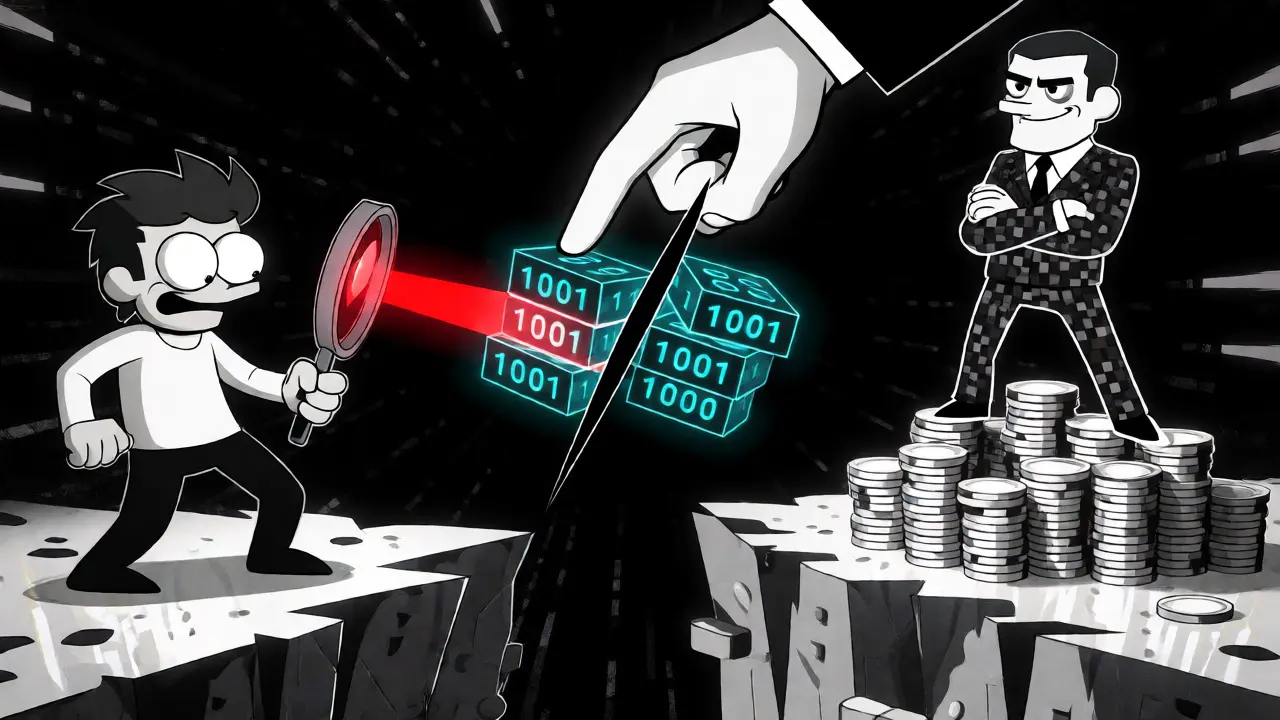
When a dispute arises, the challenger and the proposer engage in a binary search algorithm. Imagine a list of 1,000 transactions. The challenger says, "Transaction #500 is invalid." The proposer says, "No, it’s fine." The smart contract asks them to narrow it down. Did the error happen in the first half or the second half? They keep halving the range until they isolate the exact instruction that caused the divergence in state roots. Once pinpointed, the Layer 1 EVM (Ethereum Virtual Machine) executes just that one step to see who is telling the truth.
This method is gas-efficient because the L1 only runs the disputed code, not the entire batch. According to benchmarks from January 2024, verifying a fraud proof costs approximately 500,000 to 1,000,000 gas. While that sounds high, it’s negligible compared to running the whole rollup on L1. Plus, successful challengers often receive bounties paid by the slashed bond of the dishonest operator.
ZK Rollups: Validity Proofs vs. Fraud Proofs
If fraud proofs rely on people checking the work, ZK Rollups rely on math. They use validity proofs (specifically SNARKs or STARKs) to prove that a batch of transactions is correct before posting it to Layer 1. There is no waiting period. No one needs to watch the chain. The cryptographic proof itself guarantees correctness.
Think of it like this: In an Optimistic Rollup, you post a receipt and hope no one finds a mistake. In a ZK Rollup, you post a notarized document signed by a mathematical authority that says, "I guarantee this is true." Projects like zkSync Era and StarkNet use this approach. Their proofs typically take under 10 minutes to generate and verify. This allows for near-instant withdrawals compared to the multi-day wait of optimistic systems.
However, there’s a trade-off. Generating these proofs requires specialized hardware and significant computational power. A proof generation server can cost $5,000 to $15,000. This complexity has historically made development harder, though tools like Halo2 and PLONK are making it more accessible. Vitalik Buterin noted in a 2024 update that while ZK Rollups are becoming viable for general computation, fraud-proof systems remain simpler for certain applications.
Comparing Security Models: Speed, Cost, and Risk
Choosing between these models depends on what you value: speed, cost, or developer simplicity. Here is how they stack up based on current data.
| Feature | Optimistic Rollups (Fraud Proofs) | ZK Rollups (Validity Proofs) |
|---|---|---|
| Security Assumption | Honest majority of watchers; assumes someone will check errors. | Mathematical certainty; assumes cryptography holds. |
| Withdrawal Time | 7 days (standard); reduced to ~2 hours in newer implementations like Base. | Near-instant (<10 minutes). |
| Data Availability | Posts full compressed transaction data to L1 calldata. | Posts minimal data + validity proof; cheaper data costs. |
| Gas Cost for User | Lower initial cost; higher potential overhead for complex disputes. | Slightly higher base cost due to proof verification. |
| Developer Complexity | Low; compatible with existing EVM tools (Solidity). | High; requires custom circuits and specialized languages. |
The data availability difference is critical. Optimistic Rollups must publish all transaction data to Ethereum so that anyone can reconstruct the state to check for fraud. This is expensive. ZK Rollups don’t need to publish every detail because the proof verifies the outcome. With the implementation of EIP-4844 (Proto-Danksharding) expected to reduce data costs by 90%, both models benefit, but ZK Rollups gain a larger relative advantage in efficiency.
The Human Factor: Why Watchers Matter
A common misconception is that Optimistic Rollups are insecure because they rely on humans. In reality, the incentive structure aligns perfectly. If you spot a fraud, you stake a bond to challenge it. If you win, you take the proposer’s bond. This creates a decentralized market of verifiers.
However, this system breaks if no one watches. During periods of low activity or if the number of active challengers drops, the risk increases. Barry Whitehat, an Ethereum researcher, warned that short challenge periods below 48 hours significantly increase risks for low-value transactions because attackers might gamble on no one noticing. Conversely, longer periods hurt user experience. A Reddit user in December 2023 complained about losing $120 in trading opportunities due to a 7-day withdrawal wait on Arbitrum.
Newer protocols are trying to balance this. Optimism reduced its challenge period to 2 hours using a "Fault Proof Accelerator." This relies on faster, more efficient fraud proof generation. But it raises the question: do we trust the accelerator? Or do we revert to the slower, safer 7-day standard?

Cross-Rollup Interoperability and Emerging Threats
As users spread across multiple rollups (Optimism, Arbitrum, Base, zkSync), a new security frontier emerges: cross-rollup communication. If I send money from Optimism to Arbitrum, how do I know it arrived safely?
Ethereum researchers define three stages of interoperability security. Stage 0 offers only validity guarantees-meaning each rollup is secure internally, but there’s no guarantee of global ordering. Most current bridges operate at this level. Stage 1 adds local ordering guarantees, and Stage 2 provides global ordering, which is the gold standard but takes 12-24 hours to finalize.
Flashbots highlighted in late 2023 that cross-rollup attacks are emerging threats. An attacker could exploit timing differences between settlement layers. For example, if a bridge trusts a message before the source rollup has fully finalized its state on L1, a reorganization could leave the destination rollup with fake funds. Polymer Hub is implementing Stage 1 security to reduce interop finality time from 24 hours to 45 minutes, bridging the gap between speed and safety.
Practical Tips for Users and Developers
If you are using these networks today, here is how to navigate the security landscape:
- For Users: Always check the withdrawal time. If you are moving large sums, the 7-day wait on older Optimistic setups might be worth the peace of mind. For smaller amounts, newer fast-withdrawal options (using third-party liquidity providers) can bypass the wait, but they charge a fee (usually 0.1%-0.5%).
- For Developers: If you are building a new dApp, consider your audience. If you need EVM compatibility and quick launch, start with an Optimistic Rollup. If you prioritize instant finality and lower long-term fees, invest in learning ZK toolchains. Be aware that audits for ZK projects often cost more ($75k-$150k+) due to the complexity of proving systems.
- Watch for Updates: Protocol upgrades change security assumptions. When Optimism switched to fault proof accelerators, it changed the trust model. Always read the official documentation updates rather than relying on outdated tutorials.
The Future: Post-Quantum and Based Rollups
Security isn’t static. Two major trends are reshaping rollup security for the next decade.
First, quantum computing. Current cryptographic assumptions (like ECDSA signatures) could be vulnerable by 2030. The Ethereum Foundation has allocated $15 million to research post-quantum cryptography specifically for rollups. If quantum computers break the hash functions used in Merkle trees, both fraud and validity proofs could fail. We need new standards soon.
Second, "Based Rollups." These architectures leverage Layer 1 sequencing directly. Instead of a centralized sequencer on L2, Ethereum validators order the transactions. This removes the trust assumption entirely regarding censorship and ordering. UnchainedCrypto predicts that while ZK Rollups will dominate high-value transactions by 2027, Based Rollups may capture the niche for maximum decentralization.
Rollup security is a dynamic field. Whether you choose the pragmatic simplicity of fraud proofs or the mathematical elegance of validity proofs, understanding the underlying mechanism empowers you to make better decisions. The era of trusting blindly is over; now, we verify cryptographically.
What happens if no one submits a fraud proof during the challenge period?
If no one challenges the state root within the challenge window (typically 7 days for traditional Optimistic Rollups), the batch is considered final. The state root is accepted as the canonical truth on Layer 1, and users can withdraw their funds. This relies on the economic incentive that someone will always want to earn the bounty by finding an error.
Are ZK Rollups more secure than Optimistic Rollups?
They offer different types of security. ZK Rollups provide mathematical certainty via validity proofs, meaning incorrect states cannot be posted at all. Optimistic Rollups rely on social consensus and economic incentives (fraud proofs) to detect errors. ZK is theoretically stronger against "silent" failures, but Optimistic is easier to implement and audit currently.
Why do Optimistic Rollups have a 7-day withdrawal period?
The 7-day period is the "challenge window." It gives honest participants enough time to monitor the chain, detect any invalid state transitions submitted by the sequencer, and submit a fraud proof on Layer 1. Without this buffer, a malicious actor could steal funds before anyone had a chance to react.
Can I lose my funds if a fraud proof fails?
Generally, no. If a fraud proof is submitted correctly, the invalid batch is reverted, and the honest state is restored. If you were holding funds in that batch, they return to their previous valid state. However, if you interacted with a contract that relied on the invalid state, you might face temporary inconsistencies until the resolution is finalized.
How does EIP-4844 affect rollup security?
EIP-4844 (Proto-Danksharding) introduces "blobs" for cheap data storage on Ethereum. This doesn't change the logic of fraud or validity proofs, but it drastically reduces the cost of publishing data availability. Lower costs mean more rollups can afford to publish full data, enhancing the security of Optimistic Rollups by making it cheaper for verifiers to download and check the history.