Social Token Revenue Calculator
How Social Tokens Work
Unlike traditional platforms that take 10-45% in fees, social tokens allow creators to keep 90-95% of revenue. This calculator shows how your token sales compare to Patreon/YouTube.
- Patreon: 10% platform fee
- YouTube: 45% ad revenue share
- Other platforms: 15-30% fees
Results
Total Token Revenue: $0
Platform Fees Saved: $0
Net Earnings (90%+): $0
Compared to Patreon (10% fee) or YouTube (45% fee), you'd earn $0 more with social tokens.
Most online communities today are built on platforms that take more than they give. Facebook, Twitter, Discord, and YouTube profit from your time, attention, and content - but you rarely see a dime of the value you help create. That’s changing with social tokens. These aren’t just crypto coins. They’re digital ownership stakes in the communities you care about. And for the first time, the people who build, contribute, and show up every day can actually benefit when the community grows.
Ownership That Actually Matters
Before social tokens, being part of a fan group, creator community, or professional network meant you were a user - not a stakeholder. You commented, shared, and showed up. But if the community made money, it went to the platform or the creator alone. Social tokens flip that. When you hold a community token, you’re not just a member. You’re a co-owner.
Take Friends With Benefits (FWB), one of the earliest and most successful social token communities. In 2021, they launched their $FWB token and gave it to active members who contributed content, events, or code. By the end of the year, their treasury hit over $10 million. Every token holder had a say in how that money was spent - whether funding art shows, hiring writers, or hosting meetups. No board of directors. No investors pulling strings. Just the people who made it all possible.
This isn’t charity. It’s economics. When you own a piece of something, you care more about its success. People who hold social tokens don’t just post - they recruit. They promote. They show up even when no one’s watching. Because their effort has direct financial upside.
Access That’s Fair and Automated
How do you keep a community exclusive without being elitist? Traditional methods use paywalls, waiting lists, or manual approval - all slow, messy, and unfair. Social tokens solve this with smart contracts.
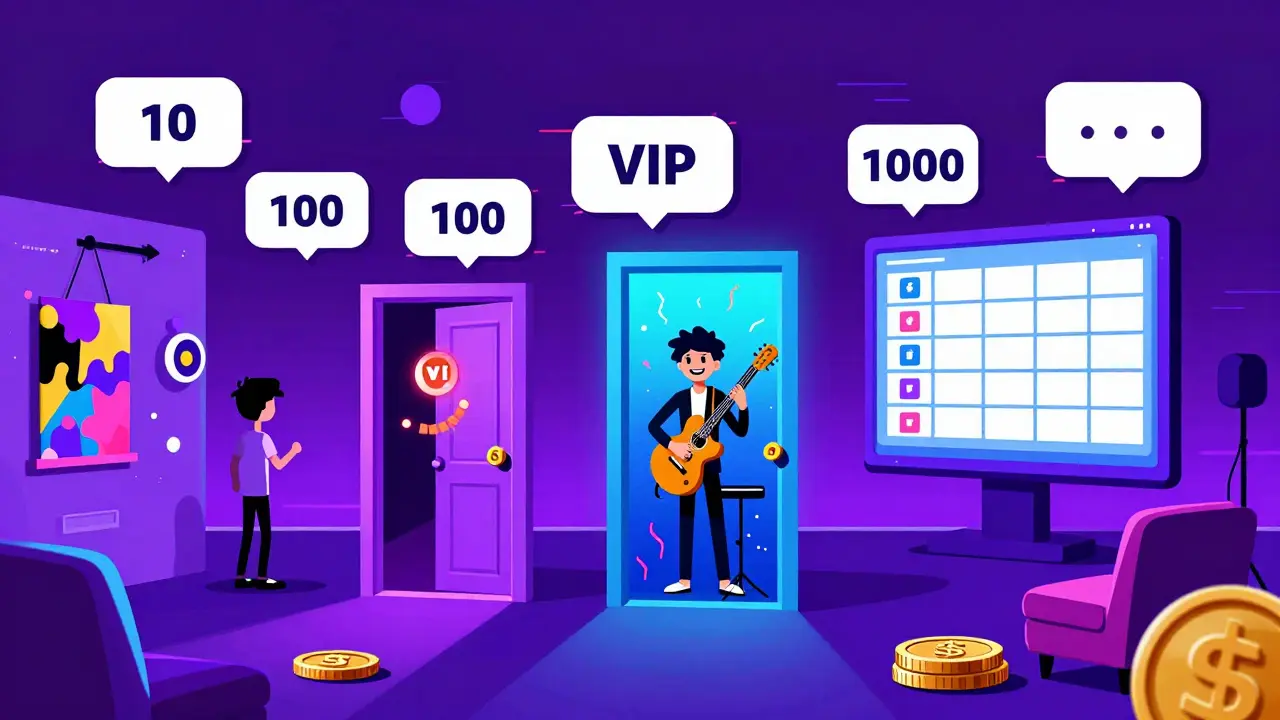
For example, the WHALE token community lets holders with 10+ tokens join private Discord channels. Holders with 100+ tokens get invited to real-world art exhibitions and receive limited-edition NFTs. No application forms. No gatekeepers. If you have the token, you get the access. The system checks your wallet automatically. No human error. No bias.
Professional groups are using this too. One legal association switched from monthly subscriptions to a token-gated Zoom system. Members needed to hold a specific token to join live sessions. Unauthorized access dropped to zero. Paid membership grew by 40% in three months. Why? Because people didn’t just pay for access - they invested in belonging. And that changes everything.
Governance That Actually Works
Most communities claim to be "democratic." But in practice, decisions are made by a handful of admins. Social tokens change that. They turn voting into something real.
At Index Coop, a decentralized finance group, members vote on new product launches, treasury allocations, and protocol upgrades. The more INDEX tokens you hold, the more voting power you have - but with a twist. They use quadratic voting, which prevents rich members from dominating. A member with 100 tokens doesn’t get 100 votes. They get 10. That keeps power distributed.
In 2021, they passed 27 proposals with an average turnout of 78%. Compare that to traditional organizations, where 5-15% turnout is normal. Why the difference? Because voting here isn’t abstract. It’s tied to your wallet. Your vote affects your wealth. So people pay attention.
BanklessDAO took it further. They hired over 200 contributors across 15 teams - writers, developers, marketers - and paid them partly in BANK tokens. These weren’t volunteers. They were employees with skin in the game. Their pay rose and fell with the token’s value. And guess what? Retention jumped. People stayed because they weren’t just working for a paycheck. They were building something they owned.
Money That Stays in the Community
Creators used to rely on Patreon, YouTube ads, or sponsorships. All of those take big cuts. Patreon takes 10%. YouTube takes 45%. Social tokens let creators keep nearly everything.
A mid-tier creator with 50,000 followers launched three tiers of tokens: $50 for Silver (exclusive content), $200 for Gold (quarterly calls), and $500 for Platinum (monthly 1:1 chats). They sold 240 tokens in the first week - $120,000 in revenue. No middleman. No ads. Just direct value exchange.
And it keeps growing. When someone resells their token on a secondary market, the original creator gets a cut. Platforms like Tensor automatically send 5-10% of every resale back to the issuer. So the creator earns not just from the first sale, but from every future trade. That’s a new kind of royalty - one that lasts forever.
One fitness community paid trainers 70% in tokens and 30% in cash. Their cash expenses dropped by 45%. Trainer retention went up 60%. Why? Because trainers weren’t just paid - they were invested. They had a reason to grow the community, not just show up for sessions.
Communities That Find Each Other
Starting a new community is hard. No one knows you exist. Social tokens fix that by creating a digital identity you can carry across platforms.
RabbitHole, a platform that rewards users for learning Web3 skills, gives out NFT badges for completing tasks - like "Completed a DeFi course" or "Joined a DAO." These aren’t just trophies. They’re keys. Holders of certain badges get invited to exclusive communities, job opportunities, or early access to new tokens.
Platforms like Collab.Land now process over 5 million token-based access checks every month. They scan wallets to see what tokens someone holds. If you have a FWB token, you might get invited to a related art DAO. If you hold a Bankless token, you get access to a crypto education group. It’s like a social graph built on real contributions, not likes or follows.
This creates network effects. One community doesn’t exist in isolation. It connects to others. A member of a music DAO might also hold a token from a podcast network. That overlap sparks collaborations, cross-promotions, and new ideas. Traditional social media isolates you. Social tokens connect you.
Why This Is Different From Loyalty Points
You might think this is just like airline miles or Starbucks rewards. It’s not. Loyalty points are controlled by a company. They can change the rules. Delete your balance. Shut down the program. Social tokens are yours. They live on the blockchain. Even if the website disappears, your tokens stay.
When Twitter changed its API in early 2023, dozens of communities moved from Twitter to Discord. But because their tokens were on the blockchain, they kept their economy intact. Members kept their access. Creators kept their revenue. The community didn’t break - it just moved.
That’s the real power. You’re not building on someone else’s land. You’re building your own. And you own the foundation.
It’s Not Perfect - But It’s Progress
Not every social token succeeds. Some fail because they’re too vague. Others collapse when the price drops and people lose motivation. Some are just hype. But the ones that work? They’re changing how communities operate.
They’re not magic. But they’re real. And they’re growing. Over $100 million in social token transactions happened by late 2021, and that number has only climbed since. More creators are launching them. More people are joining. More tools are making it easier.
This isn’t about getting rich quick. It’s about building something that lasts - with the people who make it worth building.



Mark Stoehr
this is just crypto bros repackaging pyramid schemes with fancy words