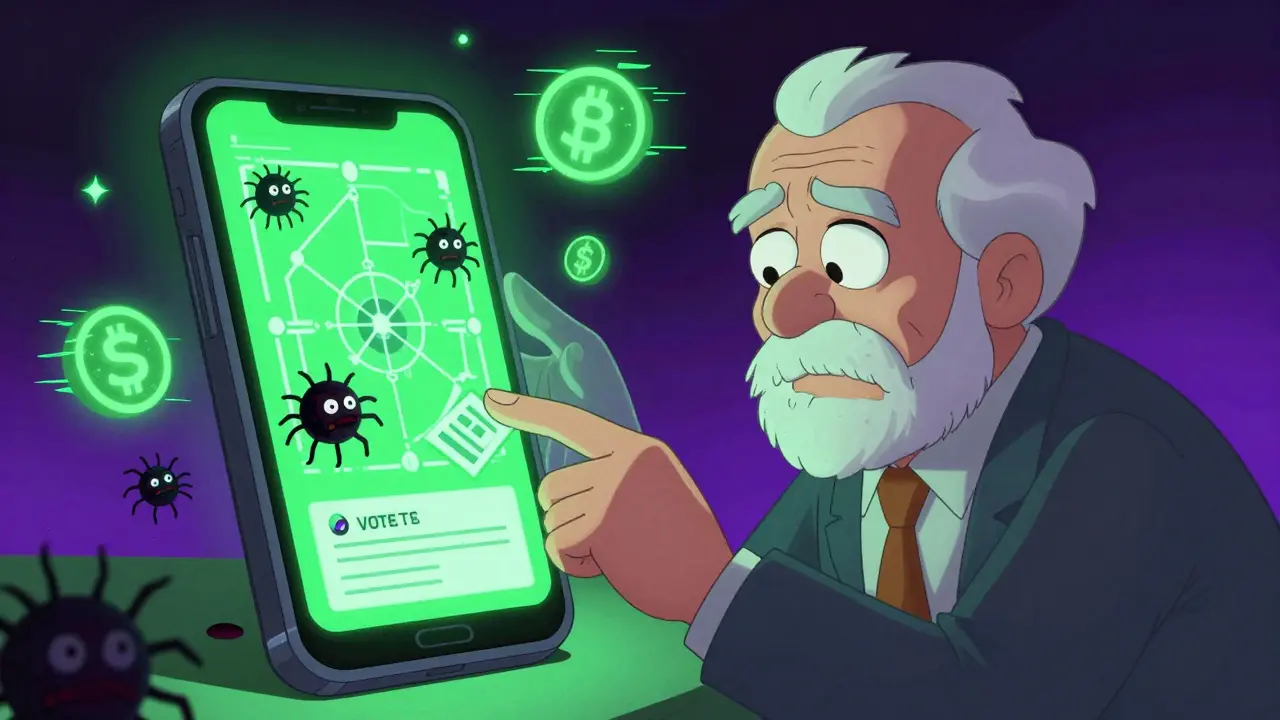
Blockchain voting sounds like a dream for democracy: tamper-proof ballots, real-time results, and votes that can’t be erased or altered. But in practice, it’s far from a simple upgrade. Despite pilot programs in a few cities and corporate elections, blockchain voting hasn’t taken off in national elections-and for good reason. The technology promises transparency, but it introduces new risks that are harder to fix than the problems it tries to solve.
Security Isn’t Just About the Blockchain
People assume that because blockchain is secure, voting on it must be secure too. That’s a dangerous myth. The blockchain only records votes after they’re cast. It doesn’t protect the device you use to vote. If your phone is infected with malware, the vote you think you’re sending could be changed before it ever reaches the chain. No amount of encryption fixes that. Malware can silently alter your selection, delete your ballot, or even send your voting data to a third party to pressure you into voting a certain way. And there’s no way to tell if your device is clean. Cybersecurity experts agree: if you can’t trust the device, you can’t trust the vote.
Foreign actors could deploy malware across millions of devices at once. Imagine a coordinated attack during a national election-voters in key districts get infected, their ballots altered, and no one notices until it’s too late. Blockchain doesn’t prevent this. It just makes the altered vote permanent.
Regulations Don’t Know What to Do With It
Most countries have clear rules for paper ballots: who can vote, how ballots are counted, how audits work. But blockchain voting? It’s a legal gray zone. In the EU, GDPR demands strict data privacy, but blockchain’s transparency clashes with that. If you can verify your vote was counted without revealing who you voted for, you need advanced cryptography. Few systems achieve that perfectly. In the U.S., no federal law governs blockchain voting, and state laws vary wildly. Election officials don’t know if they’re breaking rules by trying it.
There’s also the audit problem. If a ballot is wrong, you can’t correct it on a blockchain. It’s immutable by design. But what if someone accidentally votes twice? Or if a voter’s ID was stolen and used to cast a ballot? Paper ballots can be invalidated. Blockchain ballots can’t. That’s why many election regulators refuse to approve it. Without clear legal frameworks, no government wants to be the first to risk a disputed election.
Who Gets to Vote? Identity Is a Mess
Online voting needs to confirm you’re who you say you are. That’s harder than it sounds. Some systems try using government IDs or biometrics. But not everyone has a digital ID. Elderly voters, rural populations, and undocumented citizens are left out. And even with strong ID systems, identity theft is still possible. Someone could steal your login, your fingerprint, or your digital certificate and vote in your name.
Smart contracts can block double voting by marking a token as used after one vote. But what if someone votes from two different devices? Or uses a fake identity to register twice? Without a centralized, trusted authority to verify identities, blockchain voting systems struggle to prevent fraud. And if they do rely on a central authority, they lose the decentralization that made blockchain appealing in the first place.

Scalability and Cost Are Huge Hurdles
Running a blockchain for a small local election might work. But for a national vote with millions of participants? Current systems choke. Processing thousands of votes per second requires layer-2 solutions, specialized hardware, and constant network monitoring. Most blockchain networks aren’t built for that kind of load. And even if they were, the cost is staggering.
Traditional voting needs poll workers, paper, and trucks. Blockchain voting needs cybersecurity teams, encrypted servers, mobile apps, identity verification platforms, and ongoing maintenance. Governments have to fund both systems during the transition. Many can’t afford it. A 2025 analysis found that the upfront cost of a secure blockchain voting system can be 3-5 times higher than upgrading existing electronic voting machines. For cash-strapped municipalities, that’s a non-starter.
Most Voters Don’t Understand It
Even if the tech worked perfectly, people still wouldn’t trust it. Why? Because they don’t get it. Blockchain isn’t like using an app to order food. It’s a complex mix of cryptography, decentralization, and consensus algorithms. Most voters can’t explain how it works. And if you don’t understand how something works, you don’t trust it.
Some pilots show promising results. In one Swiss municipal vote, 78% of participants felt their votes were counted accurately. But that’s among tech-savvy volunteers who already believed in the system. What about the 40% of voters over 65? Or people with low digital literacy? They’re the ones who need the most protection-and the least likely to use a system they don’t understand.
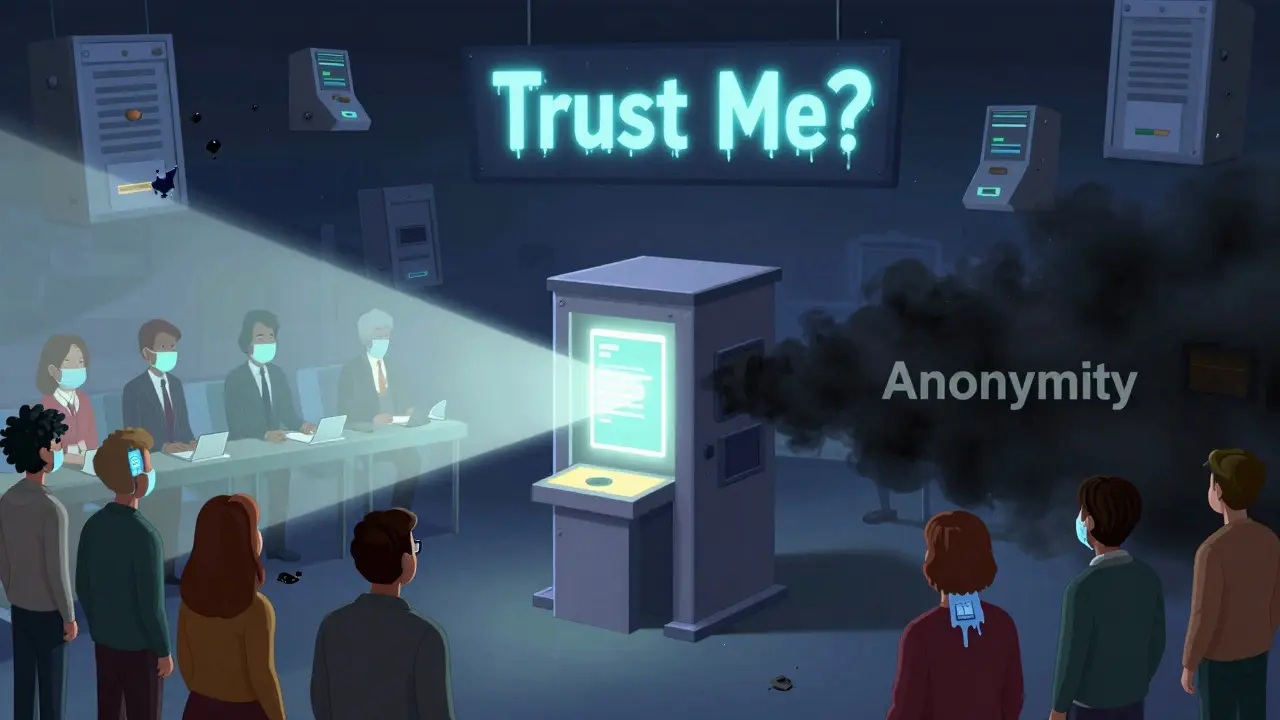
Transparency vs. Privacy: You Can’t Have Both
One of blockchain’s biggest selling points is transparency. Everyone can see the votes are counted correctly. But that’s a problem if you want to keep your vote secret. If you can verify your vote was recorded without revealing your choice, you need zero-knowledge proofs or similar advanced crypto. Only a handful of systems have this right. Most don’t.
Without strong anonymity, voters fear retaliation. A worker might be pressured to vote a certain way by their boss. A voter in a hostile community might fear social consequences. Blockchain’s transparency can become a tool for coercion, not protection. The 2025 SSRN paper found that voter trust jumped 67% in pilots where anonymity was properly enforced. But achieving that level of privacy without sacrificing auditability is still an unsolved challenge.
Existing Platforms Are Limited
Systems like Voatz, Follow My Vote, and Polyas have been tested in small elections. Polyas, for example, is used in German corporate votes and university elections. They work-sort of. But they’re not designed for national elections. They rely on trusted third parties to verify identities. They use centralized servers behind the blockchain. And they’re not open-source, so no one can fully audit their code.
Luxoft offers customizable blockchain voting tools, but only for clients who can afford high-end security consulting. These aren’t plug-and-play solutions. They’re expensive, custom-built projects that require legal teams and engineers to make them compliant. That’s not scalable. That’s not democracy.
What’s the Real Path Forward?
Blockchain voting isn’t dead. But it’s not ready for prime time. The most realistic path is gradual: start with low-stakes elections. Corporate shareholder votes. Student government elections. Small-town referendums. Use those as test beds to iron out security flaws, build public trust, and develop legal standards.
Until then, governments should focus on fixing the systems they have. Paper ballots with auditable paper trails still work. Electronic machines with verified paper backups are safer than any online system we have today. The goal shouldn’t be to replace voting with tech-it should be to make voting more accessible, secure, and trustworthy.
Blockchain might one day play a role. But right now, it’s a solution looking for a problem it can actually solve without breaking something worse.
Can blockchain voting prevent election fraud?
Blockchain can prevent ballot tampering after votes are cast, but it doesn’t stop fraud before that. Malware on a voter’s device, fake identities, or coercion can still alter outcomes. The blockchain only records what’s sent to it-it doesn’t verify the vote’s legitimacy at the source.
Why can’t blockchain voting be audited like paper ballots?
Blockchain is immutable, so you can’t correct mistakes. Paper ballots can be recounted, invalidated, or re-voted if errors occur. Blockchain votes are permanent. If a vote was cast by a hacked device or a stolen identity, there’s no way to undo it without breaking the chain’s core design.
Is blockchain voting more secure than traditional e-voting?
Not necessarily. Traditional electronic voting machines have known vulnerabilities, but they’re contained and often air-gapped. Blockchain voting moves the risk to the voter’s personal device and internet connection-two environments far harder to secure. The U.S. Vote Foundation states blockchain doesn’t solve the core security problem: protecting the vote from the moment it’s entered.
Do any countries use blockchain voting in national elections?
No country uses blockchain voting for national elections. Some pilot programs have occurred in local elections in Estonia, Switzerland, and West Virginia, but none have scaled beyond small, controlled environments. No national government has adopted it due to unresolved security and legal risks.
Can blockchain voting increase voter turnout?
It might, but not reliably. Early pilots show higher participation among tech-savvy groups. But for older, less connected, or low-income voters, the complexity and fear of digital systems can reduce turnout. Without universal access to secure devices and digital literacy, blockchain voting risks widening the participation gap, not closing it.
What’s the biggest barrier to blockchain voting adoption?
The biggest barrier isn’t technical-it’s trust. Voters, election officials, and political parties don’t trust systems they can’t fully understand or verify. Without public confidence, even a technically perfect system will fail. Building that trust requires transparency, education, and time-all things blockchain voting currently lacks.




Krista Hoefle
blockchain voting? more like blockchain voting scams. why are we even trying this? paper works. stop overcomplicating shit.