
Imagine building a financial system out of LEGO bricks. You grab a lending protocol, snap on a decentralized exchange, add a staking layer, and tie it all together with a risk manager-all without writing a single line of new code. That’s DeFi composability. It’s not just a technical feature; it’s the reason DeFi exists at all. By 2025, this modular approach has moved from a niche experiment to the backbone of the entire ecosystem, powering over 83% of the top protocols by total value locked. But as these pieces connect deeper and faster, the risks are growing too. The future of DeFi isn’t about more protocols-it’s about smarter connections.
What DeFi Composability Actually Means
DeFi composability is the ability for blockchain protocols to talk to each other like apps on your phone. A lending platform like Aave can use liquidity from Uniswap. A yield optimizer can pull staked ETH from Lido and plug it into a borrowing market on Compound. None of these protocols need to rebuild payment systems, token standards, or price feeds. They just use what’s already there. This works because of standardized interfaces. Most DeFi apps speak the same language: ERC-20 for tokens, ERC-721 for NFTs, and newer cross-chain message standards like LayerZero or Chainlink CCIP. These aren’t just technical specs-they’re the grammar of a new financial language. When you stake ETH on Lido, you get stETH, a tokenized version of your staked asset. That stETH can then be used as collateral on Aave, swapped on Curve, or locked into a yield farm on Yearn. Each step is a plug-and-play module. By November 2025, the total value locked in protocols designed for composability hit $23.5 billion. That’s not just a number-it’s proof that developers and users trust this model enough to move real capital through it. The innovation speed is insane. Where traditional banks take months to integrate a new financial product, DeFi developers can combine existing protocols in under a week. Some teams have built complex yield strategies in under 72 hours.Why It’s Faster Than Traditional Finance
Traditional finance is built on silos. If you want to create a structured note backed by bonds and crypto, you need lawyers, compliance teams, custodians, clearinghouses, and multiple technology vendors. Each one has its own system, its own rules, its own delays. Integration can take 6 to 12 months. DeFi skips all that. There’s no middleman. No paperwork. No regulatory gatekeepers. If you can write a smart contract that calls another contract, you can build a new financial product. That’s why DeFi can react in real time to market shifts. During the March 2025 Bitcoin ETF volatility spike, over 12 new structured products launched on DeFi within 48 hours-products that bundled options, lending, and automated rebalancing. In traditional finance, that would have been impossible without months of legal approvals. The efficiency gain isn’t just about speed. It’s about capital reuse. In traditional systems, your $10,000 in bonds can only be used in one place. In DeFi, that same $10,000 can be staked, lent, used as collateral, and traded-all at once. Pantera Capital found that composability boosts capital efficiency by 37% compared to isolated systems. That’s not a small edge. It’s the difference between earning 5% and 7% on the same money.The Hidden Danger: Combinatorial Risk
But there’s a dark side. The more pieces you connect, the more ways they can break together. In 2022, the Euler Finance exploit wiped out $200 million. But the damage didn’t stop there. Because Euler was used as collateral by seven other protocols, those platforms suffered cascading liquidations. Total losses across the network hit $450 million. The 2023 Terra/Luna collapse was even worse. When the algorithmic stablecoin UST lost its peg, it dragged down dozens of DeFi apps that held UST as collateral or used it for liquidity. Within 72 hours, $40 billion in value evaporated across interconnected protocols. This wasn’t a bug-it was a feature of composability. When everything is connected, a failure in one place becomes a systemic event. Chainalysis recorded $2.8 billion in losses from composability-related exploits between 2022 and 2025. These aren’t random hacks. They’re targeted attacks on the weakest link in a long chain of dependencies. A small flaw in a lesser-known oracle provider can ripple through a dozen major protocols. Even users contribute to the risk. In Q3 2025, users lost $47 million from misconfigured yield strategies. One Reddit user, u/DeFiNewbie, tried to combine leveraged yield farming with liquid staking. When ETH price dropped 18% in a day, his position got liquidated. He lost $1,843. He didn’t understand how the protocols interacted. He just clicked “maximize yield.”
The Next Evolution: Intent-Based Systems
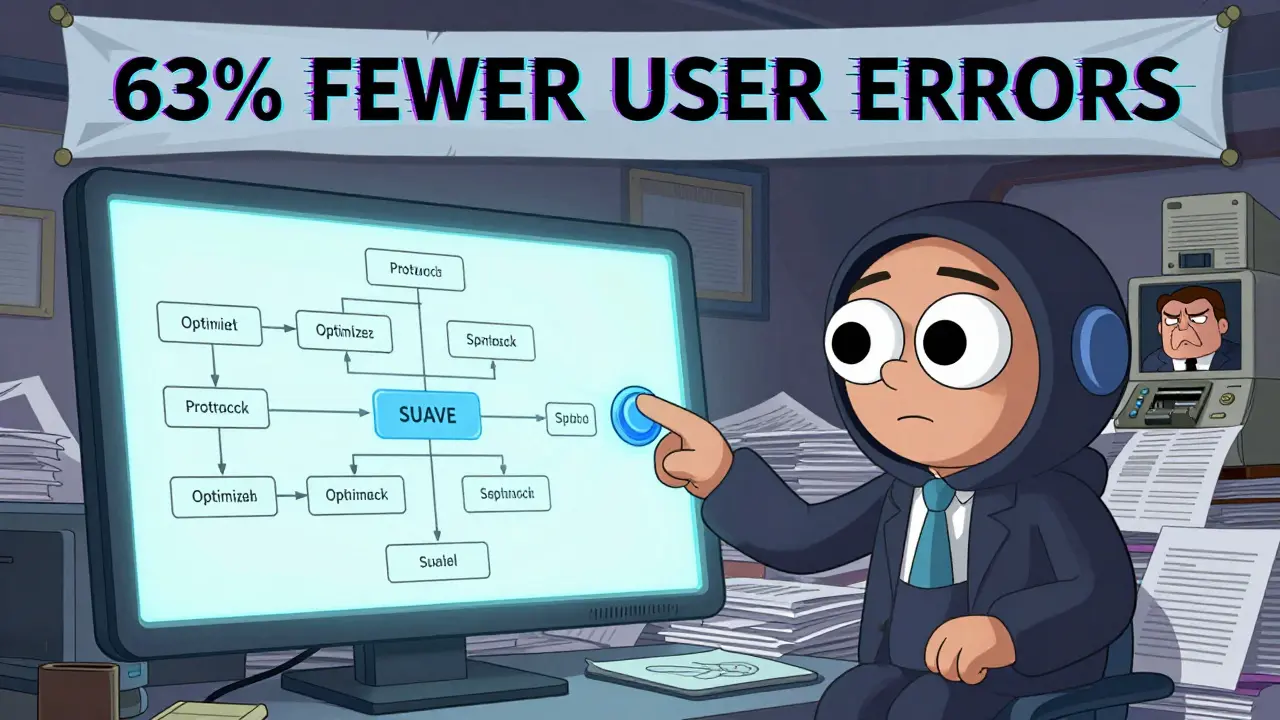
The next wave of DeFi composability isn’t about more connections-it’s about simpler ones. Enter intent-based systems. Instead of asking users to pick protocols, set parameters, and manage gas fees, these systems let users say what they want: “I want to earn the highest possible yield on my ETH with minimal risk.” Platforms like Anoma and SUAVE take that intent and automatically find the best combination of protocols. They run simulations, check for vulnerabilities, optimize gas costs, and execute the trade-all in one transaction. Optimism’s October 2025 case study showed these systems reduced user errors by 63%. That’s huge. Most DeFi failures aren’t from hacking-they’re from user mistakes. GoMining’s AI-powered composability engine found that automated yield optimization delivered 22% higher returns than manual setups. It didn’t just pick the highest APY. It avoided protocols with recent exploits, factored in liquidity depth, and timed trades to avoid high gas fees. This isn’t science fiction-it’s live on mainnet. This shift is turning DeFi from a tool for developers into something usable by regular people. The barrier isn’t technical knowledge anymore-it’s trust. If users believe the system won’t accidentally blow up their funds, adoption will explode.Real-World Assets Are the Next Fuel
The biggest opportunity for DeFi composability isn’t crypto-it’s the real world. $16 trillion in assets-real estate, bonds, commodities, invoices-are still locked in traditional systems. Moving even a fraction of that onchain could double the size of DeFi overnight. Companies like BlackRock and JPMorgan are already experimenting with tokenized treasuries. When these assets hit DeFi, they’ll plug into the same modular stack: tokenized bonds can be used as collateral on Aave, traded on Uniswap, or bundled into yield products. Deloitte reported that 41 Fortune 500 companies are now testing RWA-DeFi stacks. This isn’t speculation. It’s happening. The challenge? Making sure these assets play nice with crypto-native protocols. A U.S. Treasury bond isn’t a token that can be instantly transferred. It needs legal wrappers, custody solutions, and compliance layers. But that’s exactly where composability shines. You don’t need to rebuild the entire financial system. You just need to add a compliant gateway that speaks the same language as the rest of DeFi.Who’s Winning and Who’s Losing
The DeFi composability landscape is split into three layers:- Base Layer Protocols: Uniswap, Aave, Lido. These are the LEGO bricks. They hold 45% of the market share and are the most frequently used in combinations.
- Aggregators: 1inch, Matcha. These are the instruction manuals. They help users find the best paths between protocols. They control 32% of the market.
- Intent Layers: Anoma, SUAVE. These are the AI assistants. They automate the whole process. They’re growing fastest and now hold 23% of the market.





Shawn Roberts
DeFi is just crypto with extra steps and way more risk
But hey at least it’s fun watching people lose money lol