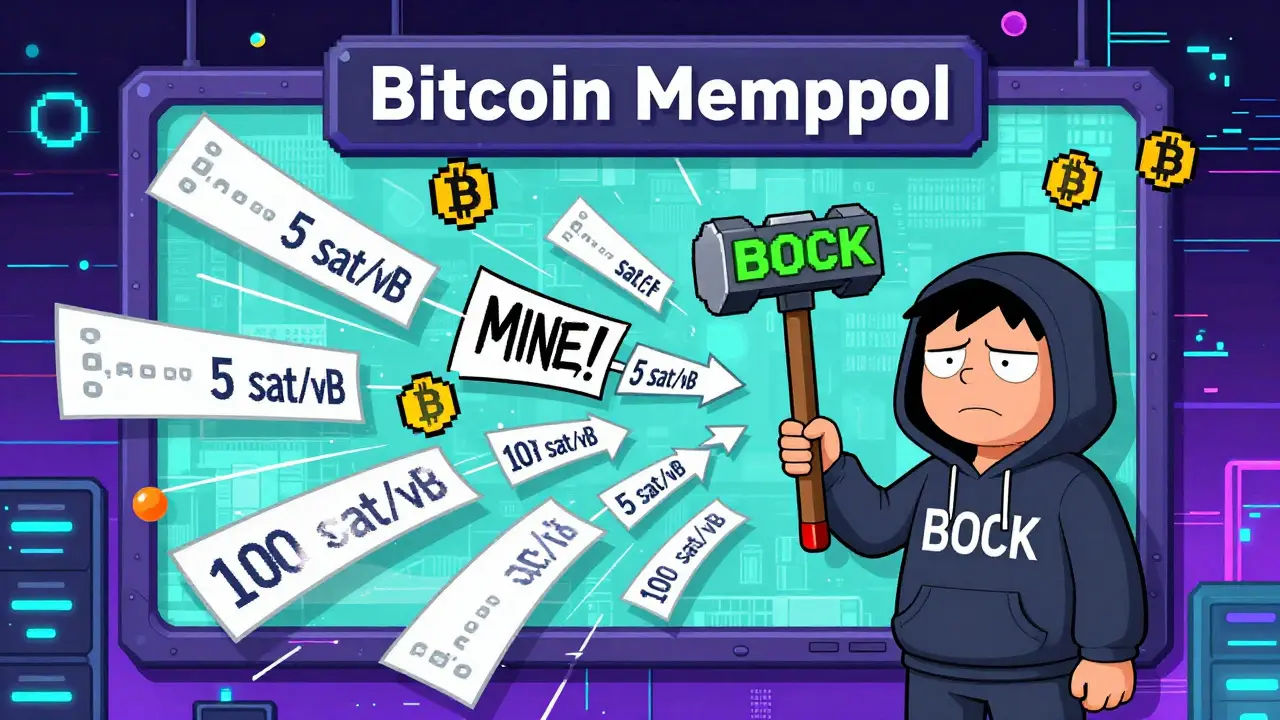
When you send Bitcoin, it doesn’t instantly show up in the recipient’s wallet. Instead, it sits in a holding area called the Bitcoin mempool-a messy, dynamic queue of transactions waiting to be confirmed. If you’ve ever waited hours for a transaction to go through, or paid way more in fees than you expected, you’ve felt the mempool’s impact. But what exactly is it? And why does it behave the way it does?
What Is the Bitcoin Mempool?
The mempool-short for memory pool-isn’t one single place. It’s actually hundreds of thousands of individual mempools, one on every full Bitcoin node across the globe. Think of it like a bunch of local bulletin boards, each posting the same list of pending transactions. When you broadcast a transaction, it doesn’t go to a central server. It gets passed from node to node, and each one adds it to its own mempool if it passes the rules. These mempools aren’t permanent storage. They’re temporary caches. Each node keeps only valid transactions that haven’t been confirmed yet. Once a miner includes your transaction in a block, it gets wiped from every mempool on the network. That’s how you know it’s confirmed. Bitcoin Core, the most common Bitcoin software, sets default limits: a mempool can hold up to 300 MB of transactions. That’s about 2,000 to 5,000 transactions depending on their size. If the mempool fills up, older or lower-fee transactions get pushed out to make room. Transactions also expire after 336 hours-two weeks-if they’re still unconfirmed. That prevents the mempool from getting clogged with dead transactions.How Transactions Enter the Mempool
Here’s how your transaction makes it into the mempool:- You create a transaction in your wallet-say, sending 0.5 BTC to a friend.
- Your wallet signs it with your private key and broadcasts it to a few nearby Bitcoin nodes.
- Each node checks: Is the signature valid? Do you own the Bitcoin you’re spending? Has this exact input been spent before? (This stops double-spending.)
- If all checks pass, the node adds your transaction to its mempool and forwards it to other nodes.
- Within seconds, your transaction spreads across the network and shows up in most mempools.
Why Fees Matter So Much
Miners don’t just pick transactions randomly. They pick the ones that pay the most. Each block has a size limit of 1 MB (or 4 MB with SegWit), so only so many transactions can fit. That creates competition. Transactions are ranked by fee rate-not total fee, but fee per virtual byte (sat/vB). A transaction with a fee rate of 50 sat/vB will jump ahead of one with 10 sat/vB, even if the latter sends more Bitcoin. That’s why a small $5 transfer can cost more than a $1,000 transfer if the small one has a higher fee rate. The minimum fee rate allowed by default is 1 sat/vB. But during busy times, you’ll rarely see anything below 10-20 sat/vB in the mempool. If you set your fee too low, your transaction can sit for hours-or days-until the mempool clears out.What Happens During Congestion
When Bitcoin gets popular-during a price surge, NFT craze, or major event-the mempool fills up fast. In early 2021, the mempool peaked at over 400,000 unconfirmed transactions. At that point, even 100 sat/vB transactions were waiting 6+ hours. During congestion, the mempool becomes a real-time market. You can watch it live on sites like Mempool.space or BitcoinFees.info. These tools show you the current fee landscape: how many transactions are waiting at each fee level, and how long they’re likely to take. Most users panic and bump their fees. But experienced users wait. They know that after the rush, the mempool empties. Transactions with 15 sat/vB that were stuck for 12 hours suddenly confirm in 20 minutes when demand drops.
How Miners Choose What to Include
Miners run their own full nodes, so they see the same mempool you do. But they don’t just take the highest-paying transactions. They use algorithms to optimize for profit. Some miners use “child-pays-for-parent” (CPFP) logic. If a low-fee transaction has a child transaction (a new one spending its output) with a high fee, the miner can include both together to get more total fees. Others use “ancestor packages,” where they bundle multiple related transactions that chain together. This helps them fill blocks more efficiently and earn more fees per block. The bottom line: miners aren’t picking transactions because they’re “fair.” They’re picking them because they’re profitable. The mempool is a free market. You pay for speed.How This Compares to Traditional Systems
In a bank, your payment goes through a single queue. If it’s busy, you wait. No transparency. No choice. You pay the same fee whether it takes 10 seconds or 10 minutes. Bitcoin flips that. You see exactly how congested the network is. You can choose to pay more now, or wait and pay less later. There’s no middleman deciding your priority. The system is open, transparent, and user-controlled. That’s why Bitcoiners call the mempool “the market for block space.” It’s the only place in finance where you can literally see supply and demand play out in real time.Tools to Monitor and Use the Mempool
You don’t need to run a full node to understand the mempool. Here are simple tools anyone can use:- Mempool.space - Live mempool visualization with fee estimates and confirmation times.
- BitcoinFees.info - Shows recommended fees for fast, medium, and slow confirmations.
- BitInfoCharts - Tracks mempool size over time to spot congestion trends.
- Wallets like Electrum or BlueWallet - Automatically suggest fee rates based on current mempool data.
getrawmempool command. It returns a full list of unconfirmed transactions, their sizes, and fee rates. But for most people, the web tools are enough.

What Happens If a Transaction Never Confirms?
If your transaction stays in the mempool longer than two weeks, it gets automatically removed. That doesn’t mean your Bitcoin is lost. It just means the transaction is gone from the network. You can resend it with a higher fee. Or wait until the mempool clears and try again with a lower fee. Most wallets will let you “replace-by-fee” (RBF) if you enabled it when you sent the original transaction. RBF lets you bump the fee without creating a brand new transaction. If you didn’t enable RBF, you’ll need to create a new transaction spending the same coins. But you’ll need to wait until the original one expires-or use a technique called “child-pays-for-parent” if you still have access to the unconfirmed output.Why the Mempool Is Essential to Bitcoin’s Design
The mempool isn’t a bug-it’s a feature. It’s what makes Bitcoin censorship-resistant. No one controls the mempool. No government or company can block your transaction. If your transaction is valid, it will spread across the network and wait its turn. It also gives users power. You’re not at the mercy of a bank’s processing schedule. You can time your transactions, adjust fees, and avoid paying extra during peaks. And because every node maintains its own mempool, the system is incredibly resilient. Even if half the nodes go offline, the other half keep relaying transactions. The mempool doesn’t break-it just shrinks.What’s Next for the Mempool?
The mempool is evolving. New tools are making fee estimation smarter. Wallets now predict confirmation times with 90%+ accuracy based on mempool data. Some developers are working on “mempool policies” that let users set custom rules-like only accepting transactions above a certain fee, or blocking large transactions during congestion. Long-term, the Lightning Network will reduce pressure on the on-chain mempool by moving small payments off-chain. But for large settlements, high-value transfers, and final settlement, the mempool will stay central. Bitcoin’s mempool isn’t perfect. It’s messy, unpredictable, and sometimes frustrating. But it’s honest. It tells you exactly what’s happening. And in a world of hidden fees and opaque systems, that’s rare.If you want to send Bitcoin without overpaying, watch the mempool. Don’t guess. Don’t rush. Wait for the right moment. That’s how the pros do it.







Barbara Rousseau-Osborn
Wow. Just... wow. You think this is complicated? Try explaining this to my mom who thinks Bitcoin is a virus. You didn't even mention how the mempool gets weaponized by miners to extract MEV. Pathetic overview. 🤦♀️