Staking Yield Calculator 2025
Projected Returns
Staking isn’t just a way to earn passive income anymore-it’s become a core part of how blockchains stay secure and grow. By 2025, over $35 billion will be locked in staking across major networks, and if you’re not choosing the right coins, you’re leaving money on the table-or worse, risking your capital. The top staking options aren’t the ones with the highest APY numbers. They’re the ones that balance real returns, network security, and ease of use. Let’s cut through the hype and show you exactly which cryptocurrencies are worth staking in 2025.
Ethereum: The Safe Bet with Institutional Backing
Ethereum is still the gold standard for staking. After switching to Proof-of-Stake in 2022, it now secures over $65 billion in staked ETH with more than 1.2 million validators. That’s not just a number-it’s a fortress. The network has survived multiple upgrades, market crashes, and regulatory scrutiny. In 2025, Ethereum’s staking yield is projected to hover between 4% and 6% APY. It doesn’t sound flashy, but here’s why it wins: Ethereum is the only major blockchain where staking is backed by institutional trust. Hedge funds, ETFs, and even banks use it.
You don’t need to run your own validator. Platforms like Coinbase and Lido let you stake as little as 0.001 ETH. Withdrawals still take 24-36 hours, but Ethereum’s Dencun upgrade in early 2025 will reduce hardware demands and improve efficiency. If you want safety, liquidity, and long-term reliability, Ethereum is your best bet. It’s not the highest yield, but it’s the most stable. And in crypto, stability is rare-and valuable.
Solana: The Speed Demon with Real Growth
If you want yield and growth, Solana is where the action is. It processes 65,000 transactions per second-over 2,000 times faster than Ethereum. Its network is fast, cheap, and increasingly used by DeFi apps and NFT platforms. In 2023, its market cap grew 500%. By 2025, it’s projected to be worth over $100 billion. Staking rewards are between 6% and 7% APY, but here’s the catch: Solana’s real return is higher because its token price has consistently appreciated.
Take a real example: one staker on Reddit locked in 50 SOL (worth $9,435 in September 2024) and earned $1,842 in staking rewards over 12 months. When you add the 40% price increase on SOL during that time, their total return was nearly 20%. That’s not theoretical-it happened. The Phantom wallet makes staking as easy as clicking a button. No technical skills needed.
Solana’s Firedancer validator client, launching in Q1 2025, is designed to fix past stability issues. After the November 2024 6-hour outage, the team rebuilt the core software from scratch. If it works as promised, Solana could hit 1 million TPS. That’s not just an upgrade-it’s a revolution. If you’re okay with a little more volatility for higher upside, Solana is the top pick for 2025.
BNB: The Hidden High-Performer
Most people look at BNB’s 7.8% APY on Binance and think it’s just another high-yield coin. But that’s not the full story. CoinLedger’s Q3 2024 report found that after adjusting for inflation and token burns, BNB’s real reward rate is 7.43%-the highest among top 5 staking coins. That’s because Binance burns BNB quarterly, reducing supply and increasing scarcity. That’s not a gimmick. It’s a proven economic model.
BNB is also deeply integrated into the Binance ecosystem. You get fee discounts, access to token sales, and priority listing on Binance Launchpad just for holding BNB. Staking it on Binance takes seconds, and withdrawals are processed same-day. The downside? You’re trusting a centralized exchange. If Binance ever faces regulatory trouble, your staked BNB could be affected. But for most retail users, the convenience and real yield outweigh the risk.
BNB’s market cap sits at nearly $150 billion. It’s not going anywhere. If you want the best balance of yield, utility, and ease, BNB is the quiet winner.
Polkadot: For the Tech-Savvy Builder
Polkadot offers 10%-12% APY, which looks amazing on paper. But here’s the catch: you need to nominate validators manually. If you pick the wrong ones, your rewards drop. The Web3 Foundation recommends nominating at least 16 validators to maximize returns. That’s not beginner-friendly. It’s a hands-on job.
But if you’re the type who likes to tinker, Polkadot is a goldmine. Its Nominated Proof-of-Stake system lets you support multiple parachains at once. That means your stake helps secure not just Polkadot, but also chains like Acala, Moonbeam, and Karura. It’s like staking across 50 blockchains at once. The network is also undergoing major upgrades to improve slashing protection and reward distribution.
Polkadot’s staking isn’t for everyone. But if you’re willing to learn, you’ll get some of the highest yields in the space-with a side of technical satisfaction.

Tron: High Yield, High Risk
Tron promises 20% APY. Sounds incredible, right? But here’s what no one tells you: Tron’s network is run by only 27 active super representatives. That’s not decentralized. That’s a club. Messari’s Q3 2024 report called it a “centralized facade.” And it’s not just theoretical-Tron’s APY dropped from 25% in 2023 to 20% in 2024 because the network couldn’t sustain the reward distribution.
Tron’s model relies on constant trading volume to fund rewards. If trading slows, your yield drops. Trustpilot reviews show 68% of complaints about staking come from Tron users who saw their returns vanish overnight. It’s tempting, but it’s a lottery ticket, not an investment.
Only consider Tron if you’re comfortable with the risk-and even then, only stake what you can afford to lose.
MoonBull: Don’t Even Think About It
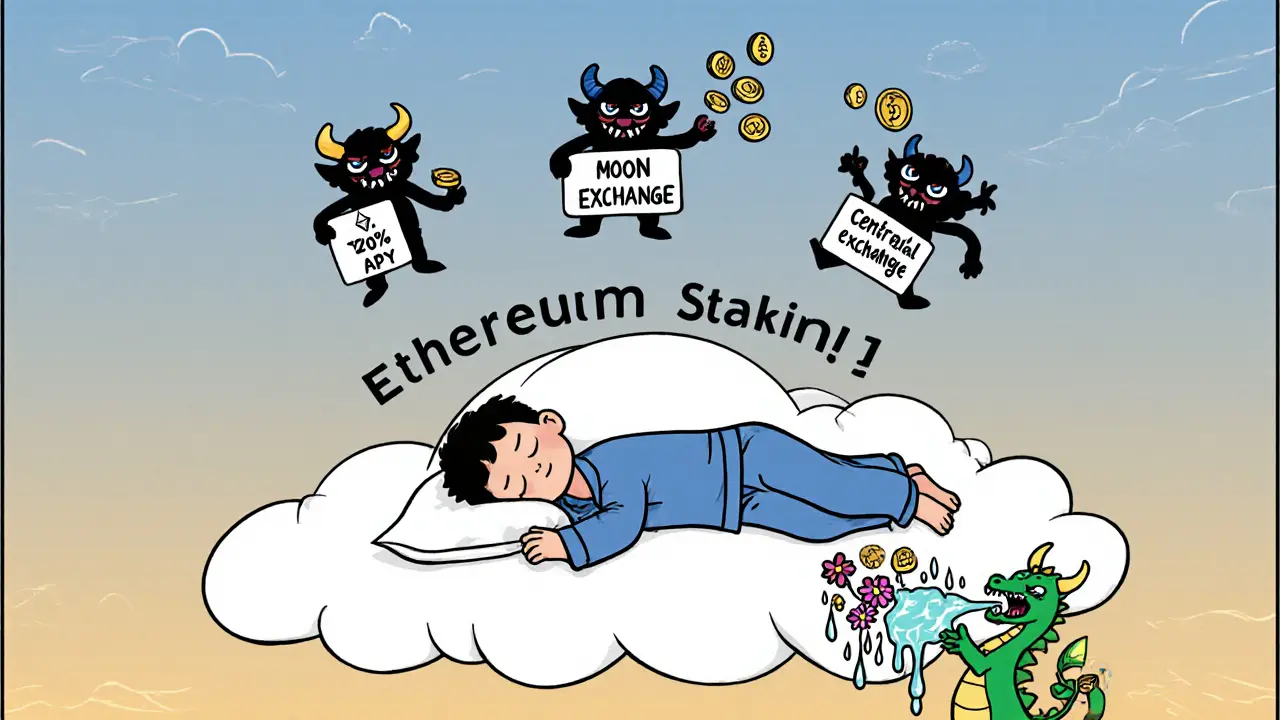
You’ll see ads screaming “95% APY with MoonBull ($MOBU)!” It sounds like free money. But MoonBull doesn’t stake. It doesn’t validate blocks. It’s a meme coin that redistributes trading fees to holders. That’s not staking. That’s a Ponzi scheme with a blockchain label.
Analytics Insight’s September 2024 report flagged it as “highly speculative.” If trading volume drops-even slightly-your rewards vanish. There’s no security, no roadmap, no team with a track record. It’s pure speculation. Avoid it. Every dollar you put into MoonBull is a dollar you could’ve earned 6% on in Solana or Ethereum.
Cardano: The Overlooked Contender
Cardano has a 4%-5% APY, which isn’t exciting. But it’s one of the most secure networks. Its code is peer-reviewed by academics. It’s built on years of research. The problem? DApps are still scarce. There’s no big DeFi ecosystem yet. Most stakers use it for long-term holding, not yield.
Delphi Digital’s 2024 report says Cardano’s staking relevance will lag behind Ethereum and Solana through 2025. It’s safe, but slow. If you believe in its long-term vision and don’t mind waiting, Cardano is a solid pick. But if you want growth now, look elsewhere.
How to Start Staking in 2025
Here’s how to actually do it without getting burned:
- Choose your coin based on your risk tolerance: Ethereum for safety, Solana for growth, BNB for balance.
- Use a trusted platform: Coinbase, Phantom, or Binance for beginners. Polkadot.js if you’re advanced.
- Never stake on an exchange unless you trust it. Centralized platforms can freeze your assets.
- Check withdrawal times. Ethereum takes 1-2 days. Solana takes hours. Know what you’re signing up for.
- Don’t chase APY. Real yield matters more than headline numbers. BNB’s 7.43% real return beats Tron’s 20% any day.
What’s Changing in 2025?
Two big things will reshape staking this year:
- Liquid staking derivatives (LSDs) like stETH and rsETH are growing fast. They let you stake ETH and still trade it. Lido’s stETH now controls over 32% of all staked ETH. This is the future.
- Regulation is coming. The SEC now says staking services are investment contracts. Coinbase paid $100 million to settle this. Expect more crackdowns on centralized platforms. Non-custodial staking (where you keep control of your keys) will become the norm.
Staking in 2025 isn’t about getting rich quick. It’s about building wealth slowly, securely, and sustainably. The best coins aren’t the ones with the flashiest ads. They’re the ones with strong networks, real demand, and transparent economics.
If you’re new, start with Ethereum on Coinbase. If you’re ready to grow, stake Solana with Phantom. If you want the best yield without risk, go with BNB. Everything else is noise.
Is staking crypto safe in 2025?
Staking is safer than it was in 2021, but it’s not risk-free. Ethereum and Solana are the most secure due to their size, code audits, and validator diversity. Avoid staking on unknown tokens or centralized platforms without a strong reputation. Always use non-custodial wallets when possible, and never stake more than you can afford to lose.
What’s the best crypto to stake for beginners?
Ethereum via Coinbase or Lido. You can stake as little as $10, no technical setup needed, and you’re backing the most secure blockchain in the world. Solana via Phantom wallet is a close second-it’s just as easy and offers better price growth potential.
Do I need to lock my crypto for a long time?
It depends. Ethereum requires a 24-36 hour withdrawal period. Solana has an 8-12 hour cooldown. BNB and Cardano allow same-day withdrawals on most platforms. Always check the unstaking rules before you stake. The longer the lock-up, the higher the yield-but also the higher the risk if the network fails.
Can I lose money staking crypto?
Yes. You can lose money if the coin’s price drops faster than your staking rewards. You can also lose rewards if you stake on a poorly run validator or a centralized platform that gets hacked or shut down. Never stake on unknown tokens like MoonBull. Stick to established networks with proven track records.
Is staking better than holding?
Staking gives you passive income while you hold. If you believe in a coin’s long-term value, staking is better than just holding because you earn rewards on top of potential price gains. For example, staking Solana in 2024 gave users both 7% APY and 40% price appreciation. Holding alone would’ve missed the yield.
What’s the difference between APY and real reward rate?
APY is the headline number you see on a website. Real reward rate adjusts for inflation, token burns, and supply changes. BNB’s APY might be 7.8%, but its real reward rate is 7.43% because Binance burns tokens regularly, making each BNB more valuable. Tron’s 20% APY looks great, but if the token supply keeps growing, your real return could be near zero. Always look for real yield, not just the number on the screen.
Next Steps
If you’re just starting, open a Coinbase account and stake 0.1 ETH. That’s under $400. Set it and forget it. In a year, you’ll have earned 4-6% and gained experience. If you’re more experienced, try staking 5-10 SOL through Phantom. Track your returns over 6 months. Compare them to BNB on Binance. See which one feels right for your risk level.
Don’t chase 50% yields. Don’t trust influencers selling “guaranteed returns.” The best staking opportunities are quiet, steady, and backed by real technology. In 2025, the winners won’t be the loudest. They’ll be the most reliable.





Akash Kumar Yadav
Ethereum? Please. We all know the US government is manipulating the validators to keep control. Real freedom means staking on chains that aren't tied to Wall Street. BNB is the only honest play here - Binance doesn't bow to the Fed. 🇮🇳🔥