Remember when sending a simple ETH transfer cost $50? Or when you had to wait 10 minutes just to confirm a trade on a DeFi app? That wasn’t a glitch-it was the norm on Ethereum before Layer 2 solutions took over. Today, those same transactions cost less than a penny and finish in under a second. The shift didn’t happen by accident. It was built-layer by layer-on top of Ethereum to fix what the original blockchain simply couldn’t handle.
Why Layer 1 Wasn’t Enough
Ethereum was designed to be secure and decentralized, not fast. It processes about 25 transactions per second. That’s fine for sending money or minting an NFT now and then. But when thousands of people try to swap tokens, stake ETH, or buy a rare digital sneaker all at once? The network clogs up. Gas fees spike. Transactions stall. Users get frustrated. By 2023, it was clear: Ethereum needed help. That’s where Layer 2 comes in. Think of it like adding express lanes to a highway. Instead of every car (transaction) squeezing onto the main road (Ethereum), most of them take a faster side route. These side routes-called Layer 2s-handle hundreds or even thousands of transactions off-chain, then bundle them into one single proof that gets posted back to Ethereum. The result? Speed and cost improvements so dramatic, they changed how people use blockchain.How Layer 2s Achieve Lightning Speed
Layer 2 solutions don’t just tweak Ethereum-they rebuild how transactions flow. The two biggest methods are zk-Rollups and Optimistic Rollups. zk-Rollups, used by Polygon zkEVM and StarkNet, bundle hundreds of transactions into a single cryptographic proof. This proof is tiny and can be verified quickly by Ethereum. Because the math guarantees everything is correct, the system doesn’t need to wait for disputes. That means near-instant finality-often under 2 seconds. Polygon, for example, processes blocks every 2.1 seconds, compared to Ethereum’s 12-second blocks. Optimistic Rollups, like Arbitrum and OP Mainnet, assume transactions are valid unless someone challenges them. This takes a little longer-usually 7 days for a challenge window-but it’s still way faster than waiting on Ethereum. And because most users never challenge, transactions settle in minutes, not hours. Other Layer 2s, like Avalanche Subnets, use custom consensus rules that allow them to run parallel chains with their own validators. This lets them hit over 4,500 TPS. Even older models like state channels (used by Lightning Network on Bitcoin) let users open a direct connection, trade back and forth, then close it with one final on-chain transaction.The Cost Difference Is Staggering
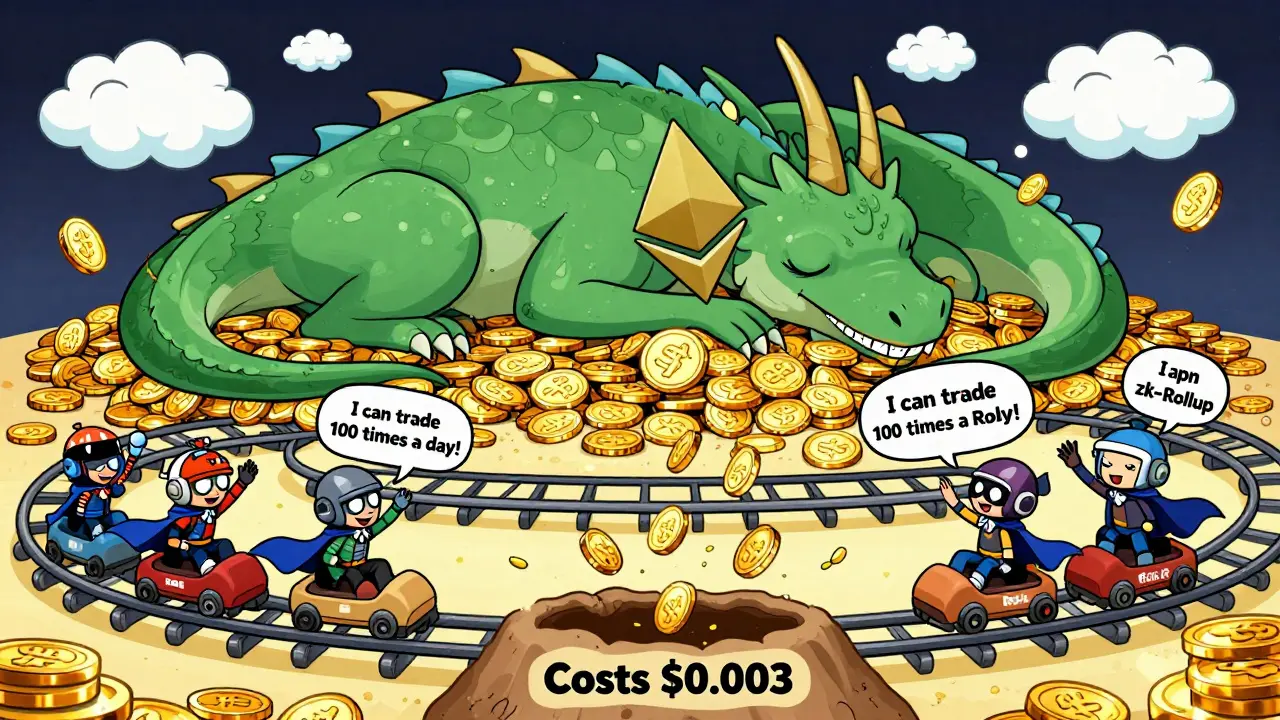
On Ethereum mainnet, a simple token swap can cost anywhere from $5 to $100, depending on network traffic. During peak NFT drops or DeFi launches, it’s not uncommon to see $200 gas fees. That’s not just expensive-it’s exclusionary. Most people can’t afford to interact with DeFi at that price. Layer 2s changed that. On Polygon, a swap costs around $0.001. On Arbitrum, it’s $0.005. On OP Mainnet? About $0.003. That’s not a 50% reduction. It’s a 99% drop. For users, this means you can now:- Trade tokens multiple times a day without worrying about fees eating your profits
- Mint and sell NFTs without paying hundreds in upfront costs
- Play blockchain games that require dozens of micro-transactions per minute
- Participate in yield farming with small amounts of capital
Top Layer 2 Solutions in 2026
Not all Layer 2s are the same. Here are the leaders as of early 2026, and what makes them stand out:| Layer 2 | Transaction Speed | Average Cost per Tx | Security Model | Best For |
|---|---|---|---|---|
| Polygon zkEVM | 2.1 sec/block | $0.001 | zk-Rollup | DeFi, NFTs, high-frequency trading |
| Arbitrum One | Under 1 min | $0.005 | Optimistic Rollup | General DeFi, dApps, user-friendly |
| OP Mainnet | Under 1 min | $0.003 | Optimistic Rollup | DAOs, social apps, gaming |
| Avalanche Subnets | Up to 4,500 TPS | $0.002 | Custom consensus | Enterprise, private chains, institutional use |
| Immutable X | Under 1 sec | $0.0005 | zk-Rollup | NFT gaming, marketplaces |
Why This Matters Beyond Crypto
Layer 2s aren’t just making crypto cheaper-they’re making blockchain usable for real-world applications. Game developers no longer need to choose between a smooth experience and decentralization. Artists can sell NFTs without charging buyers $10 just to mint. Supply chain companies are testing blockchain tracking without the cost of Ethereum’s gas. In education, universities are using Layer 2s to issue tamper-proof diplomas. In healthcare, patient records are being hashed and stored on-chain without ever breaking privacy or draining budgets. None of this would be possible if every action still cost $50. The real win? Users don’t even notice they’re on a blockchain. They just see fast, cheap, reliable apps. That’s the goal: make Web3 feel like Web2, but without giving up control.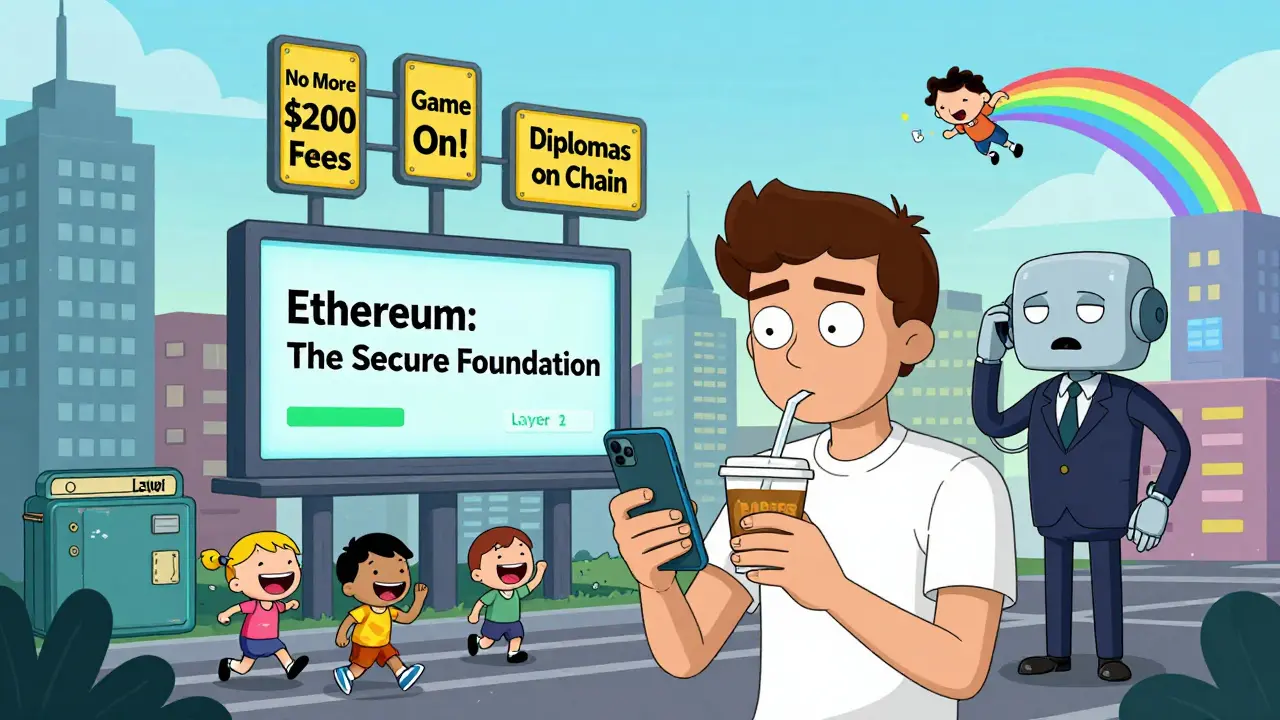
What to Watch in 2026
The next wave of Layer 2 innovation is focused on three things:- Interoperability: Moving assets between Layer 2s without going back to Ethereum first. Projects like LayerZero and Across are making this seamless.
- Modular scaling: Instead of one big Layer 2, you’ll see chains that can plug into multiple Layer 1s and Layer 2s at once.
- Zero-knowledge everywhere: zk-Rollups are getting faster and cheaper to build. More apps will use them because they’re now as easy as Optimistic ones.
How to Start Using Layer 2s Today
If you’re new to Layer 2s, here’s how to get started:- Get a wallet like MetaMask or Coinbase Wallet.
- Add a Layer 2 network. In MetaMask, click the network dropdown, then "Add Network" and search for "Arbitrum" or "Polygon".
- Bridge some ETH from Ethereum to your chosen Layer 2. Most wallets have a built-in bridge. It costs about $1-$3 and takes 5-15 minutes.
- Start swapping tokens, buying NFTs, or playing games on the Layer 2. You’ll instantly feel the difference.
Are Layer 2s safe?
Yes, if you use well-established ones. Layer 2s like Arbitrum, Polygon zkEVM, and OP Mainnet inherit Ethereum’s security. They don’t replace it-they protect it. zk-Rollups use math to guarantee correctness. Optimistic Rollups use economic incentives to catch fraud. Both are far safer than centralized exchanges. Avoid obscure or new Layer 2s with little usage or audit history.
Can I still use Ethereum if I’m on a Layer 2?
Absolutely. Layer 2s are built on top of Ethereum. You can move your assets back and forth using bridges. But most users stay on Layer 2 for daily use because it’s faster and cheaper. You only go back to Ethereum if you’re sending to someone who isn’t on a Layer 2, or if you’re withdrawing to a centralized exchange.
Do Layer 2s have their own tokens?
Some do, but not all. Polygon has MATIC, Arbitrum has ARB, and OP Mainnet has OP. These tokens are used for governance and sometimes staking, but you don’t need them to use the network. You still pay fees in ETH or stablecoins like USDC. Don’t confuse token value with network utility.
Is it better to use Polygon or Arbitrum?
It depends. Polygon zkEVM is faster and cheaper, ideal for high-volume trading and NFTs. Arbitrum is more mature, has better developer tools, and supports more DeFi apps. If you’re new, start with Arbitrum-it’s the most user-friendly. If you’re trading or gaming heavily, try Polygon. Both are safe and widely used.
Will Layer 2s replace Ethereum?
No. Ethereum is the foundation. Layer 2s are the express lanes. Without Ethereum, Layer 2s have no security. Without Layer 2s, Ethereum can’t scale. They work together. Think of Ethereum as the highway’s rules and safety system, and Layer 2s as the cars that actually move the traffic. You need both.