
Iran doesn’t ban cryptocurrencies - it controls them. While many countries struggle with whether to allow digital assets, Iran has chosen a different path: regulate everything, tax everything, and monitor every transaction. The result? A crypto market that’s both thriving and tightly shackled, where ordinary citizens use Bitcoin and Ethereum to survive inflation, while the state collects mining profits and tracks every digital coin that moves.
Legal Mining: A State-Run Operation
Cryptocurrency mining became legal in Iran in 2019 - but only under strict conditions. The government didn’t just say “go ahead.” It built a system to take control. Today, miners must get a license from the Ministry of Industry, Mine and Trade. They can’t just plug in rigs in their basements. They have to use government-approved hardware, pay electricity rates tied to export prices (not the cheap, subsidized rates locals get), and sell every coin they mine to the Central Bank of Iran (CBI) through the National Iranian Money Changer Association (NIMA).That’s not a suggestion. It’s the law. The CBI gets first dibs on all mined cryptocurrency. This isn’t about energy conservation - though that’s the public excuse. It’s about revenue. In 2025, Iran issued over 1,000 official mining licenses. But experts estimate 95% of mining still happens illegally. Why? Because the cost of compliance - the high electricity bills, the bureaucracy, the mandatory sales to the state - makes it unprofitable for most. So miners keep running underground, using stolen power, dodging inspectors.
The Ministry of Energy has cracked down hard. In 2025 alone, authorities shut down around 100 illegal mining farms and seized more than 250,000 mining devices. They even launched a public reporting system, encouraging neighbors to turn in unlicensed operations. But enforcement is uneven. Power outages still plague cities, and the grid remains under stress - not because of mining, but because of mismanagement. The state wants the profits from crypto, not the chaos.
Trading and Holding: Legal, But Only Through the State
Buying, selling, and holding cryptocurrency is legal - if you do it through the right channels. Since January 2025, the Central Bank of Iran has been the sole regulator of all digital asset activity. No exchange can operate without a CBI license. No individual can trade without being verified under strict KYC rules. All transactions must be recorded and reported. The goal? Transparency. The reality? Control.Iran’s biggest exchange, Nobitex, handles about 87% of all crypto volume in the country. It’s not just popular - it’s the only one that’s fully compliant. Other platforms either shut down or operate in gray zones. If you want to buy Bitcoin with Iranian rials, you have to go through a licensed broker who uses CBI-approved bank accounts. No anonymous wallets. No peer-to-peer trades without documentation. Even converting crypto to cash requires proof of identity and a paper trail.
For most Iranians, crypto isn’t a speculative investment. It’s a survival tool. With inflation hitting 40%+ in 2025, the rial keeps losing value. People turn to Bitcoin, Ethereum, and stablecoins like USDT and DAI to protect their savings. But the government doesn’t want them holding foreign-backed assets. That’s why, in July 2025, after Tether froze Iranian-linked USDT addresses, Iranian exchanges pushed users to switch to DAI on the Polygon network. DAI is decentralized, harder to freeze, and still pegged to the dollar. It became the new lifeline.

The Capital Gains Tax: Crypto Is Now a Speculative Asset
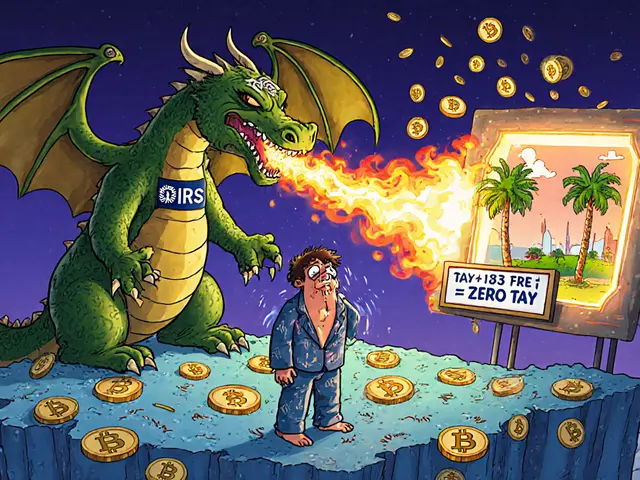
In August 2025, Iran took a major step: it taxed cryptocurrency profits. The Law on Taxation of Speculation and Profiteering officially classified crypto trading as speculation - just like gold, real estate, or forex. If you bought Bitcoin for 50 million rials and sold it for 80 million, you now owe tax on the 30 million profit.This wasn’t just about revenue. It was about legitimacy. By taxing crypto, the government acknowledged it’s real - and it’s here to stay. The tax applies to both individuals and businesses. Compliance began in Q3 2025, with phased reporting requirements. Traders now have to file quarterly returns, and exchanges are required to report transaction data to tax authorities.
It’s not easy to evade. The CBI has direct access to all crypto transaction records. If you’re trading on a licensed platform, they see everything. Even if you use a foreign exchange, the CBI can track your rial deposits and withdrawals - and cross-reference them with your crypto activity. The message is clear: you can trade, but you can’t hide.
Sanctions, Stablecoins, and the Battle for Financial Sovereignty
Iran’s crypto use is deeply tied to international sanctions. Western banks cut off Iranian institutions from SWIFT. Foreign companies won’t deal with Iranian entities. So Iran turned to crypto - not just for citizens, but for trade.In May 2023, Iran allowed companies to pay for imports using cryptocurrency. That was the first official signal: crypto could bypass sanctions. Since then, Iran has quietly partnered with Russia on a gold-backed stablecoin for cross-border payments. It’s not publicized, but insiders confirm it’s being tested. The goal? Reduce reliance on the U.S. dollar and create a new financial pipeline.
But it’s risky. The U.S. and EU monitor crypto flows closely. TRM Labs found that only 0.9% of Iranian crypto transactions involve illicit activity - mostly weapons procurement or sanctions evasion. That’s low. But it’s enough for Western regulators to target Iranian exchanges and freeze wallets. That’s why Iranian users fled USDT in mid-2025. They didn’t want to lose their money overnight. DAI, built on Polygon, became the alternative. It’s open-source, not controlled by any single company, and harder to block.
Still, Iran’s strategy works - for now. Between January and July 2025, Iran saw $3.7 billion in crypto flows. That’s an 11% drop from 2024, but still massive for a country under sanctions. The government doesn’t stop it - it channels it. Every dollar that moves through NIMA, every coin sold to the CBI, every tax paid - it all feeds the state’s coffers.

What This Means for Ordinary Iranians
For most people, crypto isn’t about wealth. It’s about dignity. A teacher in Shiraz uses Bitcoin to send money to her sister in Turkey. A small business owner in Tabriz buys parts from China using DAI because banks won’t process the payment. A family in Mashhad keeps half their savings in Ethereum because the rial loses 3% of its value every month.They don’t care about regulation. They care about survival. And the government knows it. That’s why they don’t shut it down. They regulate it, tax it, monitor it - but they let it run. Because if they banned crypto, they’d face a public uprising. People would lose their savings. Businesses would collapse. The economy would bleed faster.
The irony? Iran is one of the few countries where crypto is both a tool of resistance and a tool of control. The same technology that lets people escape inflation also lets the state track them. The same coins that bypass sanctions also fund the regime’s revenue.
What’s Next? Tighter Control, Not Ban
The trend is clear: Iran isn’t moving toward banning crypto. It’s moving toward total integration. Expect more licensing requirements. More mandatory reporting. More state-owned crypto platforms. The CBI is already working on a digital rial - a central bank digital currency (CBDC) - that will likely replace crypto for everyday use. But that’s years away.In the meantime, crypto will keep flowing. Miners will keep mining. Traders will keep trading. The state will keep taking its cut. And ordinary Iranians? They’ll keep using Bitcoin and DAI to keep their lives from falling apart.
There’s no freedom here. But there’s resilience. And in Iran, that’s the only kind of freedom that matters.
Is cryptocurrency legal in Iran?
Yes, cryptocurrency mining and trading are legal in Iran - but only under strict government control. All miners must be licensed, pay high electricity rates, and sell their coins to the Central Bank of Iran. Traders must use CBI-approved exchanges and follow KYC rules. Unlicensed activity is illegal and heavily punished.
Can I buy Bitcoin in Iran?
Yes, but only through licensed exchanges like Nobitex. You must verify your identity and use Iranian rial accounts approved by the Central Bank. Peer-to-peer trades without documentation are risky and can lead to legal trouble. Most Iranians use Bitcoin to protect savings from inflation, not for speculation.
Do I have to pay taxes on crypto profits in Iran?
Yes. Since August 2025, Iran taxes cryptocurrency profits as speculative income, just like gold or real estate. If you make a profit from trading, you must report it quarterly. Exchanges are required to share transaction data with tax authorities. Failure to report can result in fines or legal action.
Why did Iranian users switch from USDT to DAI?
In July 2025, Tether froze Iranian-linked USDT wallets due to U.S. sanctions. This cut off access to a major stablecoin. Iranian exchanges and users quickly moved to DAI, a decentralized stablecoin on the Polygon network, because it’s harder for any single company to freeze. DAI became the new default for preserving value and liquidity.
Is crypto mining profitable in Iran?
For licensed miners, barely. They must pay export-price electricity rates and sell all coins to the government at set prices - leaving little profit. Most miners operate illegally to avoid these costs. Even then, rising hardware prices and power shortages make mining harder. Only large-scale, off-grid operations with cheap power still make money.
Can I use crypto to pay for imports in Iran?
Yes. Since May 2023, Iranian companies have been allowed to use cryptocurrency to pay for imports. This was a direct response to banking sanctions. While not widely publicized, crypto is quietly used to buy machinery, medicine, and parts from countries like China and Russia. The Central Bank monitors these transactions closely.
What happens if I mine crypto without a license?
You risk having your equipment seized, your home raided, and fines imposed. In 2025, authorities dismantled over 100 illegal mining farms and confiscated more than 250,000 devices. The Ministry of Energy encourages citizens to report unlicensed operations. While enforcement varies, the penalties are real - especially if you’re using public power.





Harshal Parmar
Man, I just read this whole thing and I’m kinda in awe. Iran’s approach is wild but kinda brilliant in a twisted way. They didn’t try to fight crypto-they bent it to their will. Miners gotta sell to the state? That’s like forcing every farmer to sell their wheat to the government, but instead of bread, it’s Bitcoin. And yet people still mine illegally? That’s the human spirit right there. No matter how tight the leash, folks find a way to keep running. I love that they switched to DAI after Tether froze accounts. Smart move. Decentralized money isn’t just a tech thing-it’s a survival tactic. The state taxes it, tracks it, controls it… but can’t stop it. That’s the real story.