![What Is Pi [IOU] (PI)? Understanding the Difference Between IOUs and Real Pi Coin](/uploads/2026/07/what-is-pi-iou-pi-understanding-the-difference-between-ious-and-real-pi-coin.webp)
Have you ever seen a price chart for Pi on an exchange like Bitget or OKX showing values over $100, only to check your mobile app and see zero ability to withdraw those coins? That disconnect is exactly what defines the current state of the Pi Network, a cryptocurrency project that launched in 2019. The confusion stems from two very different assets trading under similar names: the actual Pi coin mined on the closed mainnet and the Pi [IOU] tokens listed on centralized exchanges.
If you are trying to understand whether you can cash out your mining rewards, or if you are looking at speculative charts online, this distinction is critical. As of mid-2026, the market has settled into a clearer pattern, but the risks remain high for anyone treating these instruments as identical.
The Core Difference: Real Pi vs. Exchange IOUs
To grasp why prices vary so wildly between community expectations and exchange listings, we need to look at what each asset actually represents. The Pi Network describes itself as the first digital currency you can mine on your phone without draining battery life. Users, known as Pioneers, have been tapping a button daily for years to accumulate balances in their official wallets.
However, for most of its existence, Pi has operated on a closed mainnet. This means the coins exist on the blockchain, but they cannot be freely transferred to external wallets or sold on public exchanges. Because there was no legal way to move real Pi off the network, some centralized exchanges decided to create their own version of the token.
This is where Pi [IOU] comes in. An IOU stands for "I Owe You." When exchanges like Hotcoin, Biconomy, or early versions of OKX listed PI/USDT pairs starting in late 2022, they were not listing the real Pi coin from the blockchain. Instead, they were creating an internal accounting entry-a promise that if and when real Pi becomes tradable, they might swap this IOU for the actual coin. Crucially, these listings happened without authorization from the Pi Core Team.
| Feature | Real Pi Coin (Mainnet) | Pi [IOU] (Exchange Token) |
|---|---|---|
| Issuer | Pi Network Core Team | Centralized Exchanges (e.g., Hotcoin, Bitget) |
| Blockchain Status | On-chain (Closed Mainnet) | Off-chain (Internal Ledger) |
| Withdrawability | Locked within ecosystem until open mainnet | Tradable for USDT/Fiat on specific exchanges |
| Backing | Cryptographic proof of work (mobile mining) | Speculative promise of future conversion |
| Risk Level | Project adoption risk | Counterparty/Exchange bankruptcy risk |
Why Did IOU Prices Spike and Then Crash?
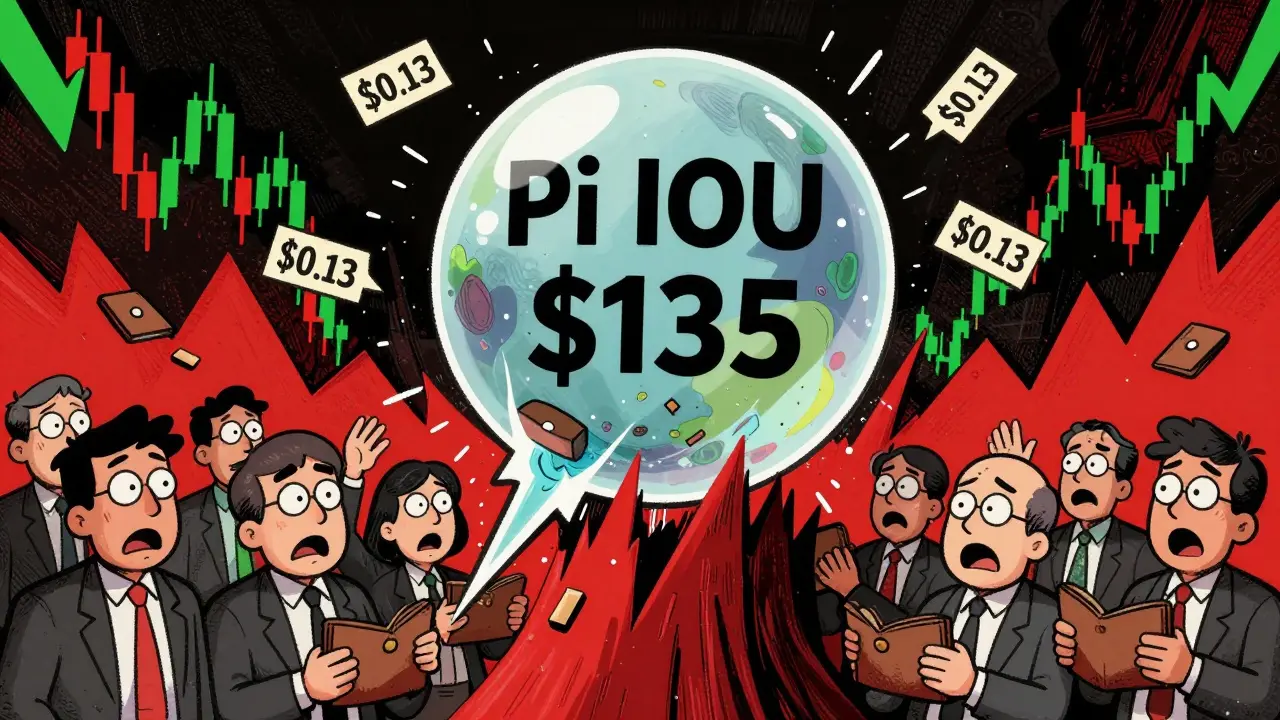
The history of Pi IOU pricing is a cautionary tale about liquidity and speculation. In early 2023 and into 2024, certain exchanges saw Pi IOU prices soar to absurd heights. Community discussions on Reddit noted instances where the IOU traded around $135 per PI. At that valuation, the fully diluted market cap would have rivaled Bitcoin’s, despite Pi having no utility outside its closed app ecosystem.
These spikes were driven by thin liquidity. A few large buyers could push the price up significantly because there were very few sellers willing to hold onto the speculative IOU. However, as reality set in, the bubble burst. By June 2026, the price had converged with more realistic valuations. Data from major trackers shows:
- OKX: Quoted PI at approximately $0.1283 USD on June 24, 2026, with a 24-hour volume exceeding $11.4 million.
- Bybit: Listed PI at $0.1357 USD with modest daily volatility.
- Kraken: Showed a spot price of $0.13 USD, aligning with the broader market consensus.
- CoinGecko/CoinMarketCap: Aggregated prices hovered between $0.129 and $0.135 USD.
This drop of over 99% from the peak IOU highs illustrates that the earlier prices were purely speculative artifacts. They did not reflect the value of the underlying technology or user base. Today, both IOU markets and emerging mainnet-linked markets trade in the same low-cent range, suggesting the market has corrected itself to reflect current utility levels.
How Trading Pi IOU Works in Practice
If you decide to engage with Pi IOU markets, it is essential to understand the mechanics. Since IOUs are not on-chain tokens, you do not send them to a personal wallet address. Instead, they live entirely within the exchange’s system.
- Account Verification: You must complete KYC (Know Your Customer) checks on platforms like LBank, WEEX, or MEXC.
- Deposit Funds: Most traders deposit USDT (Tether) to buy PI IOU.
- Execute Trade: You place a market or limit order on the PI/USDT pair. For example, on LBank, you would select the spot trading page and sell PI for USDT if you wish to exit.
- Withdrawal: To get real money, you convert your USDT to fiat via the exchange’s over-the-counter (OTC) service and withdraw to your bank card.
Note that you cannot withdraw the PI IOU itself to another exchange or a private wallet. If the exchange delists the pair, your IOU balance may become worthless. This happened with HTX (formerly Huobi), which explicitly announced the delisting of its PI IOU pair in February 2025, replacing it with a new listing intended to represent mainnet PI. Always check if the ticker you are trading is labeled as IOU or Mainnet.

Risks Every Investor Must Consider
Trading Pi IOU carries unique risks that differ from standard cryptocurrency investments. First, there is counterparty risk. Because the IOU is an internal ledger entry, its value depends entirely on the solvency and honesty of the exchange issuing it. If the exchange goes bankrupt or decides not to honor the conversion to real Pi later, you lose everything. There is no smart contract guaranteeing redemption.
Second, there is regulatory uncertainty. The Pi Core Team has repeatedly warned users on social media that they do not endorse these exchange listings. They emphasize that the only authentic way to participate is through the official app. This lack of official support means IOU holders have no recourse if disputes arise regarding the validity of their claims.
Finally, consider liquidity traps. While daily volumes on major venues like OKX exceed $11 million, smaller exchanges may have much lower liquidity. During periods of high volatility, slippage can be severe, meaning you might receive significantly less than the displayed price when selling large amounts.
The Path Forward: Open Mainnet and Utility
The long-term viability of any Pi-denominated instrument depends on the transition from a closed to an open mainnet. Until then, the ecosystem remains experimental. The Pi Network focuses on building peer-to-peer apps where users can potentially spend Pi for goods and services. However, widespread adoption is still in its infancy.
Experts suggest that true value will only emerge when Pioneers can freely transfer their mined coins to exchanges and merchants. Until that infrastructure is fully live and verified, IOUs will likely remain speculative derivatives rather than reflections of intrinsic value. For now, treat Pi IOU as a high-risk trade, not a savings account.
Can I sell the Pi I mined on my phone using IOU exchanges?
No. The Pi you mined in the official app is locked in the closed mainnet. IOU tokens on exchanges are separate speculative instruments created by those exchanges. You cannot transfer your mined Pi to an exchange to sell it as an IOU unless and until the Pi Network officially opens the mainnet and establishes direct partnerships with those exchanges.
Is Pi [IOU] the same as real Pi coin?
No. Real Pi coin exists on the Pi Network blockchain and is issued by the Pi Core Team. Pi [IOU] is an off-chain liability issued by centralized exchanges. It represents a promise to potentially provide real Pi in the future, but it is not the actual cryptocurrency.
Which exchanges list Pi IOU?
As of mid-2026, Pi IOU or mixed-listings can be found on exchanges such as Hotcoin, Biconomy, LBank, OKX, Bitget, and MEXC. However, listings change frequently. Some exchanges, like HTX, have migrated away from pure IOU models. Always verify the specific ticker details on the platform.
Why did the price of Pi IOU drop from $100+ to $0.13?
The initial high prices were driven by extremely low liquidity and speculative hype on unauthorized exchange listings. As more realistic market forces took over and larger volumes entered the market, the price corrected to reflect the current lack of utility and limited supply availability, settling around $0.13 in 2026.
Does the Pi Core Team support IOU trading?
No. The Pi Core Team has explicitly stated that they do not authorize or support these IOU listings. They warn users that these tokens are not redeemable for real Pi on the official mainnet and advise focusing on the official app ecosystem instead.