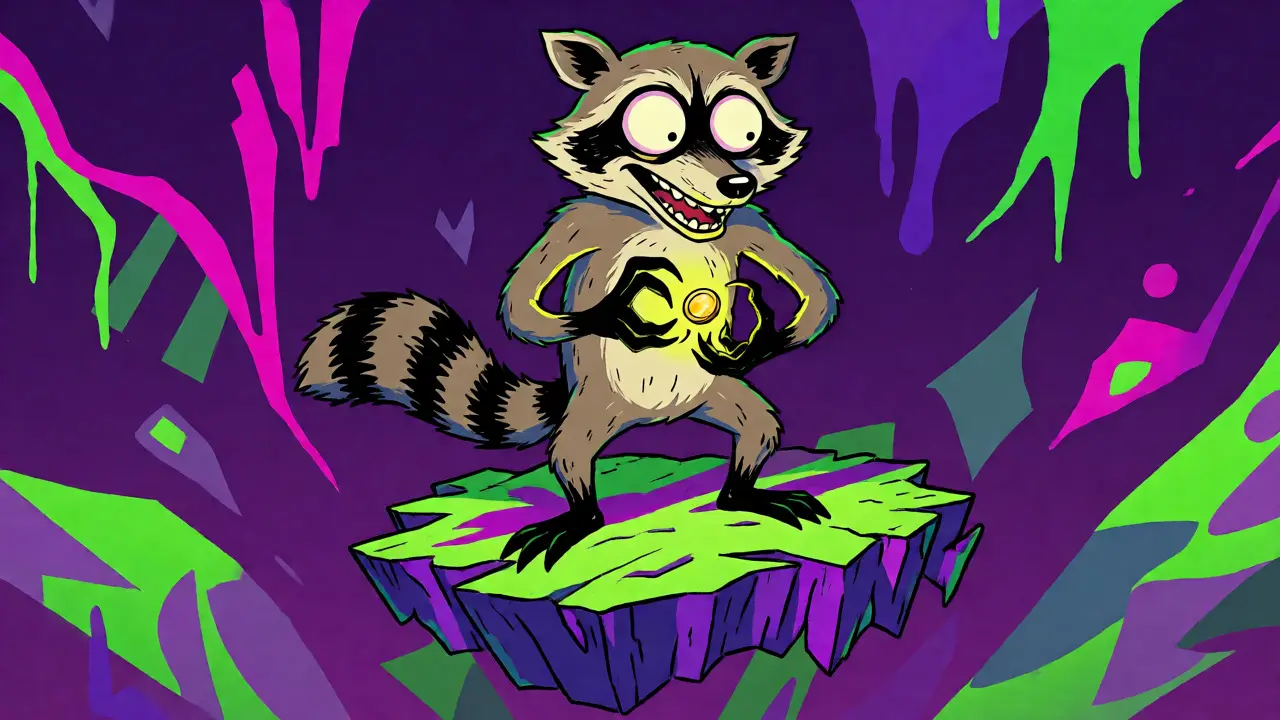
Imagine buying a lottery ticket for less than a penny. That’s essentially what holding Raccoon (ROON) feels like right now. It is a micro-cap cryptocurrency that launched in 2024 on the The Open Network (TON), riding the wave of Telegram-integrated digital assets. But unlike Bitcoin or Ethereum, which aim to change finance, Raccoon aims to be a humorous, community-driven meme with no complex utility attached. If you are wondering whether this tiny token has any real value or if it’s just another ghost town on the blockchain, you need to look past the cute raccoon logo and examine the cold, hard data.
| Metric | Value / Status | Context |
|---|---|---|
| Blockchain | TON (The Open Network) | Leverages Telegram's massive user base potential |
| Max Supply | 100,000,000 ROON | Fixed supply; no inflation mechanism |
| Market Cap | ~$5,000 - $6,000 USD | Extremely low; ranks below #5,000 globally |
| All-Time High | $0.0092 USD (June 2024) | Peak hype during the TON memecoin boom |
| Current Price | ~$0.000023 - $0.00014 USD | Down over 99% from peak |
| Daily Volume | $1.50 - $15.00 USD | Very thin liquidity; high slippage risk |
The Anatomy of a Micro-Cap Meme Token
At its core, Raccoon is a standard fungible token issued on the TON blockchain. For those unfamiliar, TON is the Layer-1 network closely tied to the messaging app Telegram. This connection sparked a frenzy in mid-2024 when developers rushed to launch tokens that could potentially integrate with Telegram bots and mini-apps. Raccoon emerged during this gold rush, positioning itself not as a utility project but as a pure speculative asset. The tokenomics are refreshingly simple: there is a maximum supply of exactly 100 million units. There are no staking rewards, no governance voting rights, and no burn mechanisms documented by major aggregators like CoinGecko or Bitget.
You might ask, "If it does nothing, why does it exist?" In the world of crypto, attention is currency. Raccoon relies entirely on social sentiment. However, the data suggests that this attention has faded quickly. While some platforms report a circulating supply of 100 million tokens, others list the circulating supply as zero. This discrepancy often happens with very small projects where liquidity pools are empty or trading activity is so sporadic that automated trackers fail to capture real-time movements. For an investor, this ambiguity is a red flag. You cannot accurately calculate market capitalization if half the data providers think nobody holds the coin.
Price History: From Spike to Silence
Let’s look at the numbers because they tell a cautionary tale. In June 2024, Raccoon experienced a brief moment of glory. According to data from CriptoFacil and Binance Square, the token surged by 84% in a single week. At its peak, one ROON cost approximately $0.0092. Investors who bought early saw paper gains, but the party ended abruptly. By March 2025, the price had crashed to an all-time low of roughly $0.000025. That is a drawdown of nearly 99.7%. If you had invested $100 at the peak, it would have been worth about 30 cents by the spring of 2025.
This pattern is classic for memecoins on emerging chains. The initial pump attracts retail traders looking for quick flips, followed by a long period of stagnation. As of July 2026, the price hovers around $0.000146 according to Crypto.com, which is higher than the 2025 lows but still miles away from its highs. The daily trading volume tells the rest of the story. On decentralized exchanges like STON.fi, the primary venue for ROON trades, daily volume often drops to between $1.50 and $15.00. To put that in perspective, top-tier cryptocurrencies trade billions daily. With such thin volume, selling even a moderate amount of ROON can crash the price further due to slippage.
Where to Buy and Sell Raccoon
If you still want to speculate on Raccoon, your options are limited. You won’t find it on Coinbase or Kraken. Instead, you need to look at two types of platforms:
- Decentralized Exchanges (DEXs): The most active market is the ROON/TON pair on STON.fi. This requires a TON-compatible wallet, such as Tonkeeper. You will need to swap TON coins directly for ROON.
- Centralized Exchanges (CEXs): Platforms like Bitget, Bybit, and Crypto.com list ROON. These offer a simpler interface where you can buy with dollars or other stablecoins. However, be aware that some CEXs may delist ultra-low-cap tokens if volume remains negligible for too long.
Buying through a CEX is easier for beginners, but DEXs give you direct custody of your tokens. Given the low liquidity, always check the order book before placing a market order. A large sell order relative to the available buy orders can cause significant price impact.
The Risks of Anonymous Development
One of the biggest concerns with Raccoon is the lack of transparency regarding its team. Major data aggregators do not list named founders or a registered corporate entity. This anonymity is common in the DeFi space, but it increases risk. Without a public roadmap or regular development updates, it is hard to know if anyone is actively maintaining the project. Is the team working on new features? Are they marketing the token? Or did they simply mint the tokens and move on?
Furthermore, there is no information about token allocation. Who holds the majority of the 100 million supply? If insiders hold 80% of the tokens, they could dump their holdings at any time, wiping out retail investors. Unlike established projects with audited financials and vesting schedules, Raccoon operates in a black box. You are betting purely on the hope that a community will form around the brand without any official backing or communication.
Is Raccoon Worth Your Money?
So, should you buy Raccoon? It depends entirely on your risk tolerance. If you view crypto as a savings account, look elsewhere. Raccoon is a high-risk, high-volatility asset suitable only for money you can afford to lose completely. The market cap is under $6,000, meaning it takes very little capital to move the price. This makes it susceptible to manipulation. A single whale buying or selling can swing the price by double digits.
On the other hand, if you are a speculator hunting for the next 100x gem, the low market cap offers theoretical upside. If the TON ecosystem grows significantly and Raccoon manages to capture even a fraction of the attention that larger memes like Dogecoin command, the percentage returns could be substantial. But remember, for every winner, there are thousands of losers. Raccoon currently sits in the latter category, showing signs of fatigue rather than momentum.
What blockchain is Raccoon (ROON) built on?
Raccoon (ROON) is built on the The Open Network (TON) blockchain. This allows it to interact with the Telegram ecosystem, although it does not currently have deep integration features beyond being a tradable asset.
Does Raccoon (ROON) have a fixed supply?
Yes, Raccoon has a maximum supply of exactly 100,000,000 tokens. There are no mechanisms for minting new tokens or burning existing ones, making it a deflationary-neutral asset in terms of supply mechanics.
Why is the circulating supply reported differently across sites?
Some data providers report 0 circulating supply while others report 100 million. This discrepancy arises because ROON has extremely low trading volume. Automated trackers may fail to detect wallets holding the token if they haven't transacted recently, leading to conflicting data between platforms like CoinPaprika and CoinMarketCap.
Can I stake Raccoon (ROON) for rewards?
No, there are no documented staking programs for Raccoon. It is a simple transferable token without smart contract functions for yield generation, governance voting, or locking mechanisms commonly found in DeFi protocols.
Where is the best place to buy Raccoon?
The most liquid market is typically the ROON/TON pair on STON.fi, a decentralized exchange on the TON network. Centralized exchanges like Bitget and Bybit also list ROON, offering easier onboarding for users who prefer not to manage non-custodial wallets.