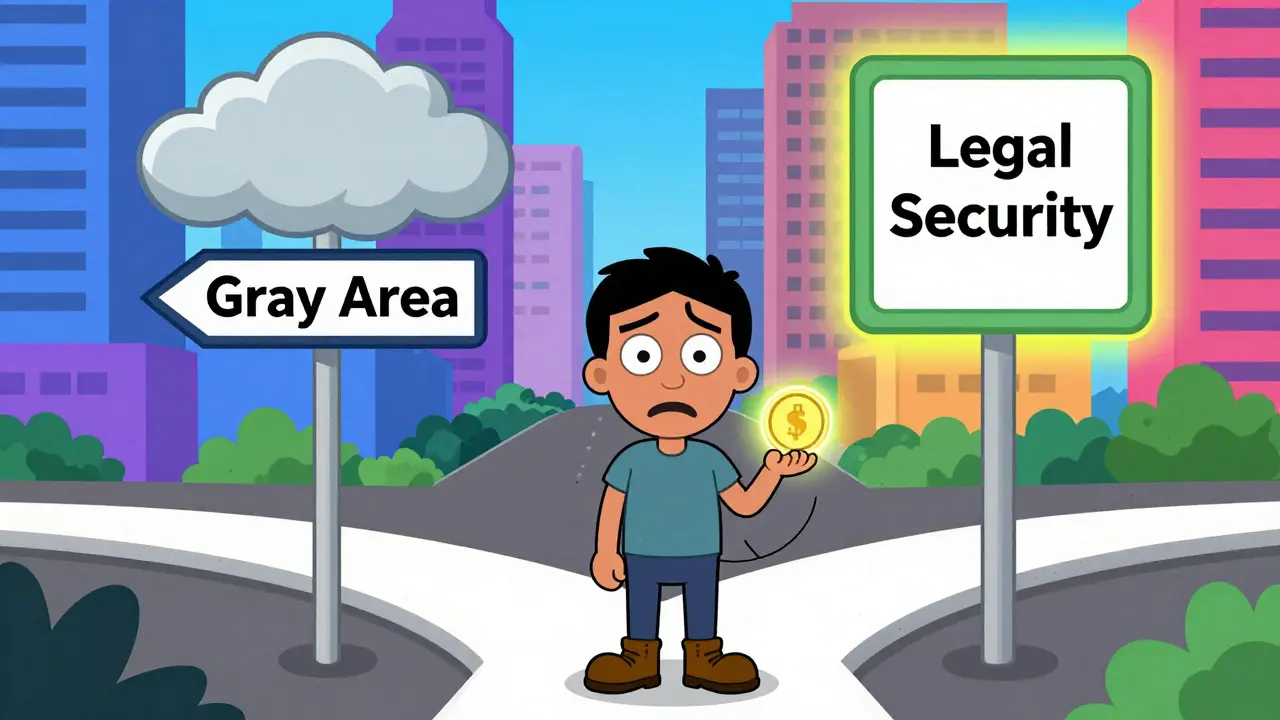
If you've ever tried to use Bitcoin or USDT in Lagos or Abuja, you know the answer used to be a confusing mix of "yes," "no," and "maybe." For years, Nigeria operated in a legal gray area where the government frowned upon crypto but couldn't stop millions of people from using it. However, as of April 2026, the game has completely changed. crypto payments Nigeria is no longer a guessing game thanks to a comprehensive shift in legislation that treats digital assets as formal securities. While you can't use crypto to pay your government taxes or official bills-the Naira is still the only legal tender-using it for business, trading, and personal payments is now firmly recognized and regulated.
The Big Shift: From Gray Area to Legal Security
The real turning point happened in March 2025. President Bola Ahmed Tinubu signed the Investments and Securities Act (ISA) 2025 is a landmark piece of legislation that officially recognizes cryptocurrencies and other digital assets as securities under Nigerian law . Before this, the Central Bank of Nigeria (CBN) had a rocky relationship with crypto, even banning banks from facilitating transactions for a few years. That era of "cat and mouse" is over.
Now, the government isn't trying to kill the industry; they're trying to organize it. By classifying crypto as a security, the state has moved the conversation from "Is this legal?" to "Who is licensed to do this?" This change has given a massive boost to the legitimacy of the sector, though it means the honeymoon phase of unregulated growth is finished.
Who is Actually in Charge?
It's not just one office calling the shots anymore. Nigeria has moved to a multi-agency oversight system to make sure things don't go off the rails. If you're running a payment service or just using one, these are the players you need to know:
- Securities and Exchange Commission (SEC) is the primary regulator responsible for licensing crypto exchanges and Virtual Asset Service Providers (VASPs)
- Central Bank of Nigeria (CBN) maintains control over monetary policy and ensures that crypto activity doesn't crash the national financial system
- Nigerian Financial Intelligence Unit (NFIU) focuses on the "dirty" side of things, tracking anti-money laundering (AML) and terrorism financing
This coordination means that if a platform is SEC-licensed, it's generally safe to use. In late 2023, the CBN even reversed its old ban, allowing banks to once again provide accounts and services to licensed crypto businesses. This is why you're seeing much smoother transitions from your bank app to your crypto wallet than you did three years ago.

The Rules for Payment Providers (VASPs)
You can't just start a crypto payment app in your bedroom and call it a day. Under the ISA 2025, anyone acting as a Virtual Asset Service Provider (VASP) is an entity that facilitates the exchange, transfer, or custody of virtual assets for users must register with the SEC. This isn't a formality; it's a rigorous vetting process.
Established platforms like Quidax and Busha were among the first to get their ducks in a row. For those who ignore these rules, the penalties are brutal. A company failing to register faces an initial fine of ₦10 million, with an additional ₦1 million added for every month they remain non-compliant. The SEC also has the power to simply shut down any platform that refuses to follow the rules.
| Feature | Pre-2025 Era | Post-ISA 2025 Era |
|---|---|---|
| Legal Status | Gray area / Restricted | Recognized as Securities |
| Bank Access | Mostly Banned | Allowed for SEC-Licensed VASPs |
| Taxation | Largely Ignored | Formalized under NTAA 2025 |
| Primary Regulator | CBN (Restrictive) | SEC (Regulatory/Supportive) |
The 2026 Tax Reality: No More Free Rides
If you're making money with crypto, the government wants a piece. As of January 1, 2026, the Nigerian Tax Administration Act (NTAA) 2025 is the law that established a comprehensive tax framework for digital asset transactions is in full effect. The good news? You aren't taxed just for holding your coins. If you bought Bitcoin at $20k and it's now at $60k, you don't owe anything until you sell or exchange it for a profit.
Once you do hit that "sell" button, here is how the math works:
- Individuals: Profits are taxed on a sliding scale, but the cap is 25%.
- Small to Mid-Sized Companies: If you earn between ₦25 million and ₦100 million annually, you pay a 20% corporate income tax.
- Large Corporations: Companies earning over ₦100 million pay a 30% tax rate.
- VAT: Companies charging fees for crypto transactions must add a 7.5% Value Added Tax (VAT).
Compared to some countries where crypto taxes are a nightmare, Nigeria's approach is surprisingly progressive. It provides a clear path for businesses to operate legally without being wiped out by taxes.

Practical Use: Peer-to-Peer (P2P) and Remittances
Despite the laws, the heart of Nigeria's crypto scene is still P2P trading. Nigeria actually ranks first globally in P2P transaction volume. Why? Because it's the fastest way to send money home (remittances) or save against the inflation of the Naira. Between July 2024 and June 2025, the country saw a staggering $92.1 billion in crypto value flow through its markets.
For the average person, the process is simple: you use a licensed exchange to swap your Naira for a stablecoin like USDT, and then send that to whoever needs it. However, be careful. The government is using its new powers to crush Ponzi schemes. They now have enhanced access to telecom records to track down scammers. If a "crypto investment platform" promises you 50% returns in a week, it's almost certainly a scam, and the EFCC (Economic and Financial Crimes Commission) is now better equipped to find the people behind it.
What This Means for You Right Now
If you are a consumer, your options are expanding. Licensed local platforms are becoming more integrated with bank apps, making it easier to move money. The downside is that international exchanges might start pulling back if they find the Nigerian licensing process too expensive or slow. You might notice a few global apps becoming unavailable unless they decide to play by the SEC's rules.
For business owners, the advice is simple: get licensed. The era of "flying under the radar" is over. With the NTAA 2025 and ISA 2025, the government has a clear map of where the money is moving. Operating a licensed VASP not only protects you from those ₦10 million fines but also allows you to partner with traditional banks to scale your business.
Is it illegal to own Bitcoin in Nigeria?
No, owning Bitcoin is not illegal. It is recognized as a security under the Investments and Securities Act (ISA) 2025. However, it is not "legal tender," meaning you cannot force a government agency or a shop to accept it as official payment for a debt or tax.
Do I have to pay tax on my crypto holdings?
You are not taxed for simply holding crypto. Tax liability only kicks in when a "taxable event" occurs, such as selling your crypto for Naira or exchanging one coin for another at a profit. For individuals, this is taxed on a sliding scale up to 25%.
Can my bank block my crypto transactions?
While the CBN previously banned banks from facilitating crypto, the 2023 VASP Guidelines changed that. Banks are now allowed to provide services to crypto businesses that are licensed by the SEC. If you use a licensed platform, your bank is much less likely to block the transaction.
What happens if a crypto exchange isn't licensed by the SEC?
Unlicensed exchanges operate illegally under the ISA 2025. They face heavy fines starting at ₦10 million and can be shut down by the SEC. For users, these platforms carry a higher risk as they lack regulatory oversight and consumer protection.
Are NFTs regulated in Nigeria?
It depends. Investment-focused NFTs are covered under the SEC's oversight and the ISA 2025 framework. However, NFTs created purely for art or collectibles generally remain outside the scope of these specific security regulations.



Amanda Faust
most people miss the point that classifying crypto as securities is basically a play to bring in institutional capital which usually kills the decentralized vibe but hey thats how the world works