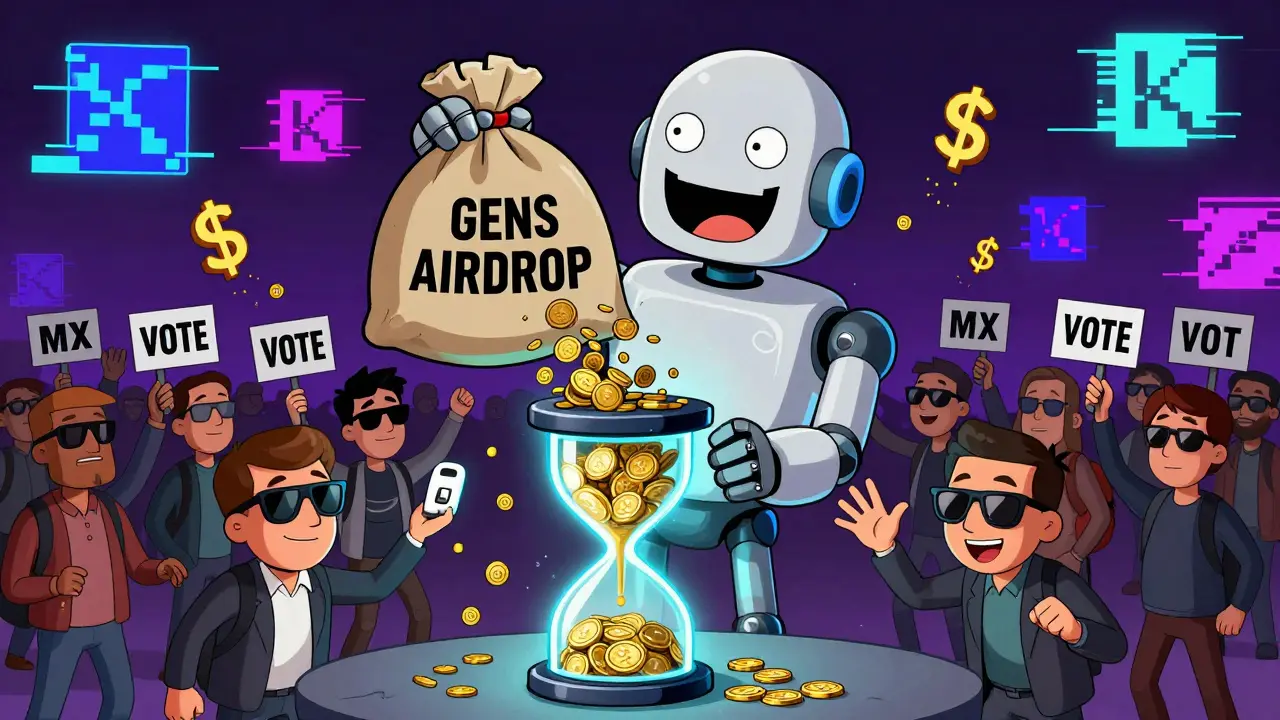
Back in early 2022, Genshiro (GENS) handed out over 2.1 million tokens across two major exchanges - MEXC and Gate.io. If you got in early, you might’ve thought you hit the jackpot. Today, those same tokens are worth less than a penny. Here’s what actually happened with the Genshiro airdrop, why the price crashed, and whether there’s any chance of more free tokens in the future.
How the Genshiro Airdrop Actually Worked
This wasn’t your typical airdrop where you just hold a coin and get rewarded. Genshiro’s distribution was built around active participation. On MEXC, you had to use your MX tokens to vote. You needed at least 10 MX to cast a vote, and you could vote up to 500,000 MX worth. The tokens you used for voting got locked during the voting window - which lasted less than seven hours - then unlocked right after. That meant you could vote multiple times if you had enough MX, but you couldn’t move those tokens until the event ended.The reward pool on MEXC was 885,000 GENS. At the time, the reference price was set at $0.063 per token. That meant the total value of the airdrop was around $55,755. But here’s the catch: that $0.063 wasn’t the market price. It was just a number used to calculate how much each voter got. You didn’t pay for it, but you had to spend MX to qualify.
Gate.io ran a separate campaign, handing out 1,277,825 GENS tokens for free. No voting. No locking. Just sign up, meet basic requirements, and get tokens. That was the bigger giveaway. Together, these two campaigns distributed over 2.1 million GENS - a huge chunk of the total supply.
What Happened to the Price?
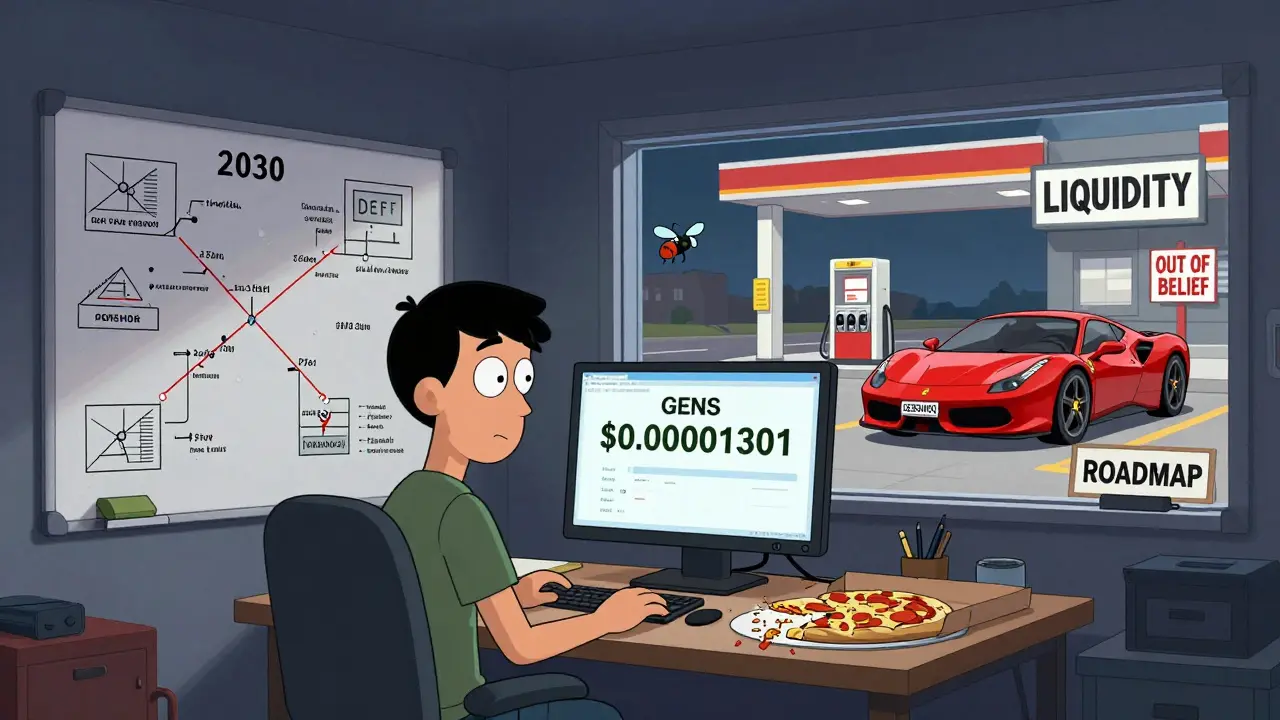
Fast forward to September 2025. GENS was trading at $0.00001301. That’s a 99.98% drop from the $0.063 reference price used during the MEXC airdrop. If you got 10,000 GENS in that airdrop, you’d have had $630 worth of tokens back then. Now? You’ve got about 13 cents.That’s not just bad luck. That’s a collapse. And it’s not because the market crashed - Bitcoin and Ethereum bounced back. GENS didn’t. The problem wasn’t the market. It was the project.
Genshiro is built on Kusama, the experimental test network for Polkadot. It’s designed as a full DeFi platform - lending, borrowing, yield farming, cross-chain swaps, all in one. The tech looks solid. Eight core components. Smart contracts. DAO governance. Oracle feeds. Layer-2 scaling. It’s got everything you’d want in a next-gen DeFi app.
But having great tech doesn’t mean people will use it. And they didn’t. Liquidity stayed low. Trading volume dried up. The team kept building - they published a roadmap through 2030 with clear milestones for 2025, 2026, and 2027 - but no one showed up. No big partnerships. No media buzz. No influencers pushing it. Just silent development in a corner of the crypto world.
Why the Airdrop Strategy Backfired
The MEXC airdrop wasn’t designed to grow the user base. It was designed to filter it. By requiring MX tokens to vote, they made sure only people already active on MEXC - likely experienced traders - got the tokens. That’s smart for avoiding bots. But it also meant they missed out on attracting new users who didn’t hold MX.Gate.io’s free offering was better for reach, but without any follow-up engagement - no tutorials, no incentives to use the platform, no rewards for trading on Genshiro - those tokens just sat in wallets. People didn’t even know what to do with them.
Airdrops should be the start of a journey, not the end. Genshiro gave out tokens but didn’t give people a reason to stick around. No staking rewards. No liquidity mining. No simple way to swap or lend. Just a token with no clear use case beyond speculation.
Is There a New Airdrop Coming?
As of January 2026, there’s no official announcement about a new Genshiro airdrop. The team hasn’t posted anything on Twitter, Telegram, or their website about upcoming distributions. But here’s what we do know:- The roadmap is still active. Development continues on cross-chain upgrades and risk management tools.
- The Kusama ecosystem is slowly gaining traction again after years of neglect.
- With GENS trading at $0.00001301, the token is essentially free. That makes it a potential candidate for a new incentive program - if the team wants to spark adoption.
If they launch another airdrop, it’ll likely be tied to one of their 2025 milestones: maybe rewarding users who interact with new DeFi products, or giving tokens to those who provide liquidity on Genshiro’s own pools. But don’t wait around hoping for it. There’s no guarantee.
Should You Still Care About Genshiro?
If you’re looking to make money - no. The price has lost 99.98% of its value. That’s not a recovery story. That’s a graveyard.If you believe in the tech - maybe. The architecture is one of the most advanced in the Kusama ecosystem. Cross-chain DeFi is still underdeveloped. If Polkadot and Kusama take off again in 2026-2027, Genshiro could be one of the few platforms ready to handle it. But that’s a five-year bet, not a quick flip.
Right now, Genshiro is a ghost town with a brilliant blueprint. The airdrop was the spark. The flame died. Whether it can be reignited depends entirely on the team’s ability to turn technical promise into real-world use. So far, they’ve built a Ferrari - but no one’s been able to find the gas station.
What to Do If You Still Have GENS
If you’re sitting on GENS from the 2022 airdrop:- Don’t panic-sell. At this price, you’re not losing much more than a coffee.
- Check if you can stake it anywhere. Some smaller DeFi platforms might let you lock GENS for yield - even if it’s 1% APR.
- Follow Genshiro’s official channels. If they announce a new product or liquidity incentive, you’ll want to be first in line.
- Don’t buy more. The token’s value isn’t tied to demand. It’s tied to belief. And right now, the market doesn’t believe.
What This Teaches Us About Airdrops
The Genshiro airdrop isn’t just a story about one token. It’s a lesson for the whole crypto space.Airdrops aren’t free money. They’re marketing tools. And if you hand out tokens without giving people a reason to use them, you’re just distributing digital clutter.
The best airdrops - like Uniswap’s in 2020 - rewarded users who actually used the platform. They didn’t just give tokens. They gave access. They gave power. They gave a reason to stay.
Genshiro gave tokens. That’s it. And that’s why the price collapsed.
Was the Genshiro airdrop free?
On Gate.io, yes - it was completely free. On MEXC, you had to vote using MX tokens, which meant locking up your existing assets to qualify. So while you didn’t pay cash, you did risk your MX tokens during the voting period. Neither required you to buy GENS upfront.
How many GENS tokens were distributed in total?
Over 2.1 million GENS tokens were distributed across two major campaigns: 885,000 through MEXC and 1,277,825 through Gate.io. These were the only two documented public airdrops.
What was the price of GENS during the airdrop?
MEXC used a reference price of $0.063 per GENS to calculate rewards, but that wasn’t the market price. The actual market price at the time was likely lower. Today, as of late 2025, GENS trades around $0.00001301 - a drop of nearly 99.98%.
Can I still get GENS tokens today?
You can buy GENS on exchanges like MEXC, Gate.io, or other smaller platforms that list it. But there’s no active airdrop running right now. Any future airdrop would be announced officially on Genshiro’s website or social media channels.
Is Genshiro still being developed?
Yes. The team continues development according to its public roadmap, with planned upgrades for 2025-2030 focused on cross-chain functionality, risk management, and new DeFi products. But development doesn’t equal adoption. The platform still has very low usage compared to its potential.



Raju Bhagat
bro this is the exact reason i stopped trusting airdrops after the uni fiasco