
Why blockchain forensics tools matter now more than ever
Every day, billions of dollars move through cryptocurrency networks. Most of it is legal. But a small fraction-sometimes millions at a time-gets used for scams, ransomware, darknet markets, and money laundering. That’s where blockchain forensics tools come in. They don’t just track coins; they follow the trail. And right now, two names dominate this space: Chainalysis and Elliptic.
If you’re a compliance officer, a law enforcement agent, or even a crypto exchange operator, you need to know how these tools work. Not because they’re flashy, but because they’re the reason some criminals get caught-and why legitimate businesses don’t get shut down.
Chainalysis: The investigator’s go-to tool
Chainalysis built its reputation on solving big cases. Remember the Silk Road? The FBI seized over $1 billion in Bitcoin thanks to Chainalysis Reactor. That wasn’t luck. It was pattern recognition at scale.
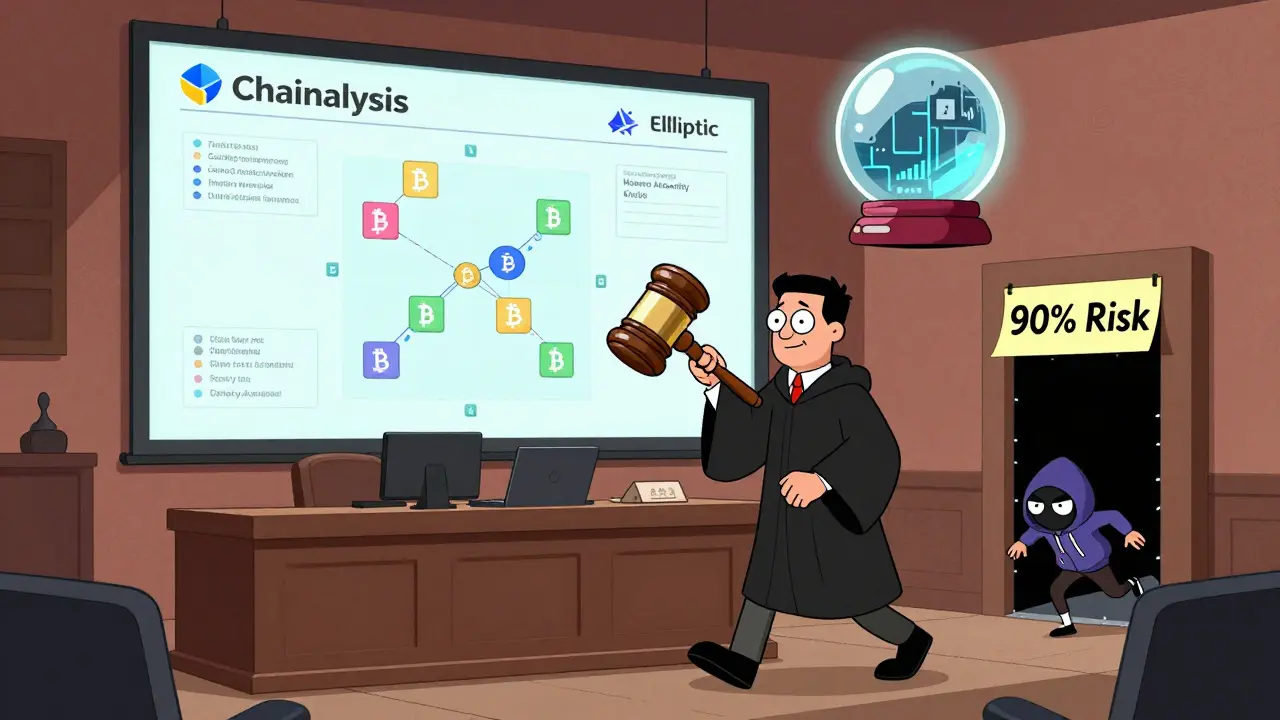
Chainalysis Reactor gives investigators a visual map of crypto flows. You click on an address, and it shows you every transaction linked to it-across Bitcoin, Ethereum, and dozens of other chains. It groups wallets into clusters, so instead of tracking 50 separate addresses, you see one entity: maybe a darknet vendor, maybe a mixer service, maybe a ransomware gang.
Its real-time tool, Chainalysis KYT, scans transactions as they happen. It doesn’t just say ‘this looks suspicious.’ It gives a risk score: 87% chance this address received stolen funds. That’s critical for exchanges that need to block bad actors before they deposit.
Chainalysis covers 85% of the crypto market value. That’s huge. But it doesn’t mean it covers everything. Privacy coins like Zcash? Limited. New DeFi protocols? Catching up. Still, for government agencies and large banks, Chainalysis is the default. Why? Because it’s been in court. It’s been tested. Its reports hold up.
Elliptic: The predictor with deeper coverage
Elliptic doesn’t just react-it tries to predict. While Chainalysis excels at digging through past transactions, Elliptic watches what’s coming next.
It monitors over 100 cryptocurrencies, not just the top ones. That includes Zcash, Horizen, and other privacy coins that many tools ignore. Why does that matter? Because criminals love privacy coins. If your tool can’t track them, you’re blind to half the threat.
Elliptic’s big innovation? Analyzing transactions before they hit the blockchain. Yes, you read that right. It uses node-level data to flag risky transfers even before they’re confirmed. That’s a game-changer for exchanges that need to stop bad money before it lands in their system.
It also has a smarter way to handle mixers and decentralized exchanges. Most tools struggle with these because they’re designed to hide trails. Elliptic has built rules based on billions of data points-like how often a mixer sends funds to known scam addresses, or which DeFi pools are commonly used in laundering.
Its training programs are deeper too. Many users say Elliptic’s certification courses helped their teams actually understand crypto risk-not just click buttons. That’s rare in this industry.

Side-by-side: What each tool does best
| Feature | Chainalysis | Elliptic |
|---|---|---|
| Cryptocurrencies covered | 85% of market value (focus on major coins) | 100+ coins, including privacy-focused assets |
| Real-time monitoring | Yes (KYT) | Yes, with pre-blockchain analysis |
| Privacy coin tracking | Basic | Advanced, specialized detection |
| Visualization & investigation | Industry-leading network maps | Strong, but less intuitive for complex cases |
| Predictive risk scoring | Standard risk alerts | First in industry to predict risks before they occur |
| Government adoption | Widest-used by FBI, Europol, IRS | Strong, but fewer high-profile law enforcement cases |
| Training & certification | Good | Industry-leading, hands-on programs |
Who uses these tools-and why
Law enforcement agencies pick Chainalysis because it’s been proven in court. Its reports are detailed, auditable, and accepted as evidence. When a suspect is arrested, prosecutors don’t want to guess-they want a visual map of every transaction, timestamped and traced back to a wallet.
Financial institutions? They care about compliance. If you’re a bank or a crypto exchange, you need to prove you’re not letting dirty money in. Chainalysis KYT gives you automated alerts. Elliptic gives you those alerts plus a deeper understanding of how new risks emerge.
For crypto-native companies-DeFi protocols, NFT marketplaces, wallet providers-Elliptic often wins. Why? Because they deal with more obscure tokens. If you’re running a DEX that supports 50 different coins, you can’t afford to miss one.
Even regulators use both. The EU’s MiCA rules require crypto firms to monitor transactions. The U.S. Treasury’s FinCEN guidelines demand AML systems. Chainalysis and Elliptic are the only two tools that can meet those standards at scale.
The hidden costs of using these tools
These aren’t plug-and-play apps. They’re enterprise systems. Setting them up takes weeks, sometimes months. You need engineers to integrate APIs. You need compliance staff trained to interpret alerts. You need to fine-tune rules so you don’t get flooded with false positives.
One exchange in Texas spent six months onboarding Chainalysis. Their team had to map every wallet type they accepted, set risk thresholds for each, and train 12 people just to monitor alerts. They still get 300+ alerts a week. Only 12 are real threats. That’s the cost of precision.
Elliptic’s training programs help-but they’re not free. Their certification courses cost thousands per user. Smaller firms struggle with that. That’s why some startups use cheaper alternatives like TRM Labs or CipherTrace. But those tools don’t have the same depth of data or legal credibility.
And don’t forget: these tools need constant updates. New blockchains pop up. New mixers get created. New privacy techniques evolve. If your tool isn’t keeping pace, you’re vulnerable.
What’s next for blockchain forensics
Both companies are doubling down on AI. Chainalysis is building tools to track cross-chain swaps-like when someone moves Bitcoin to Ethereum, then to Solana, then to a mixer. That’s the new frontier.
Elliptic is working on behavioral modeling. Instead of just flagging addresses, it’s learning how criminals act over time. Does a wallet send small amounts daily to avoid detection? Does it wait 72 hours before moving funds? Those patterns matter more than any single transaction.
Soon, these tools won’t just detect crime-they’ll help prevent it. Imagine a wallet that gets flagged before it even receives stolen funds. Or a DeFi protocol that auto-freezes suspicious liquidity pools. That’s where the industry is heading.
For now, if you need to trace crypto, you’re choosing between two giants. Chainalysis gives you the power of proven investigations. Elliptic gives you the foresight to stop threats before they spread. Neither is perfect. But together, they’re the only reason the crypto world hasn’t collapsed under its own chaos.
Frequently Asked Questions
Can blockchain forensics tools track anonymous cryptocurrencies like Monero?
Monero is designed to be untraceable, and no tool can fully de-anonymize it. But Chainalysis and Elliptic can still flag suspicious activity around Monero-like when it’s swapped for Bitcoin on a centralized exchange, or when it’s sent to known mixer addresses. They can’t see the Monero trail, but they can see where it enters and exits the broader system.
Are these tools used by criminals to avoid detection?
Yes, in a way. Criminals study how Chainalysis and Elliptic work. That’s why they use mixers, privacy coins, and chain-hopping techniques. But the tools evolve faster. What worked last year doesn’t work now. The cat-and-mouse game continues, but the tools have a clear edge in data volume and machine learning speed.
Do I need both Chainalysis and Elliptic, or is one enough?
Most organizations pick one. Large exchanges and banks usually choose Chainalysis for its government credibility and ease of reporting. Crypto-native firms with diverse token portfolios often prefer Elliptic for broader coverage and predictive features. Using both is expensive and rarely necessary unless you’re a major regulator or a global exchange handling all asset types.
How accurate are the risk scores from these tools?
Risk scores are estimates, not facts. A 90% score means the system has seen similar patterns linked to crime in the past. But false positives happen-especially with legitimate services like gambling sites or remittance platforms. That’s why human review is always required. The tools flag, humans decide.
Can small crypto businesses afford these tools?
Not easily. Both tools are priced for enterprises. Monthly fees start at $10,000 and go up based on volume and features. Smaller businesses often use third-party compliance providers that bundle blockchain analytics into their services. Or they rely on exchange-provided screening-like when Coinbase or Kraken blocks suspicious deposits on your behalf.
What happens if a tool misses a transaction?
If a tool misses a transaction, it’s usually because it’s on a new or obscure chain, or the transaction used a novel obfuscation technique. That’s why both companies constantly update their databases. But no tool is 100% perfect. That’s why regulators require layered defenses-not just one software, but also KYC, transaction limits, and manual audits.
Next steps if you’re evaluating these tools
If you’re a compliance officer, start by asking: What assets do we handle? If it’s mostly Bitcoin and Ethereum, Chainalysis is the safe bet. If you support Zcash, DeFi tokens, or new Layer 2 chains, Elliptic gives you more coverage.
Ask for a demo-not just a presentation. Run a real transaction through their system. See how it clusters addresses. See how long it takes to trace a path. See if the interface feels intuitive or like a maze.
And don’t skip the training. These tools are only as good as the people using them. A poorly trained analyst will miss red flags. A well-trained one will spot a laundering scheme before it becomes a headline.







Akhil Mathew
Chainalysis is solid, no doubt, but Elliptic’s pre-blockchain analysis is a game-changer for DeFi platforms. I’ve seen exchanges get burned by missing a wash trade because their tool only looked at confirmed txs. Elliptic caught it before it even hit the chain. That’s next-level stuff.
Also, their training modules? Way more practical than Chainalysis’s PowerPoint-heavy stuff. Real hands-on labs, not just theory.