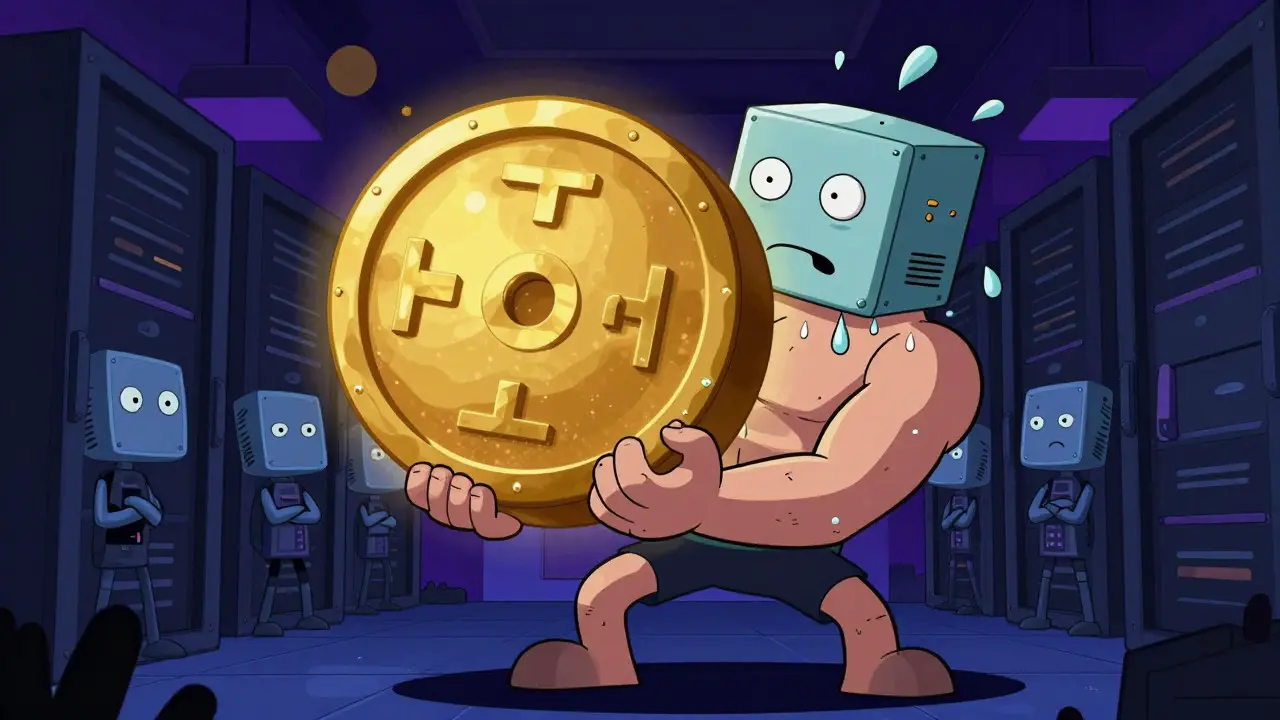
Zero-knowledge proofs (ZKPs) are the magic trick of modern cryptography. They let you prove a statement is true without revealing any information other than that fact. But there is a catch: proving things mathematically is expensive. The computational cost of generating these proofs can be the difference between a scalable blockchain and a network that grinds to a halt. If you are building on ZK technology or trying to understand why your transaction fees spike during peak load, understanding this cost structure is essential.
This article breaks down where the computation goes, why it is so heavy, and how different proof systems handle the load. We will look at the hardware requirements, the time factors, and the trade-offs developers face when choosing a protocol.
What Drives the Computational Expense?
At its core, a zero-knowledge proof is a mathematical argument. The prover must demonstrate that they know a secret input (like a private key or a password hash) that satisfies a specific condition, without showing the secret itself. This process involves three main phases: circuit construction, witness generation, and proof generation.
The heaviest lift usually happens in the final phase. To create a valid proof, the system performs complex elliptic curve pairings or polynomial commitments. These operations require significant CPU power and memory bandwidth. Unlike simple hashing algorithms that run in milliseconds, ZKP generation can take anywhere from seconds to minutes depending on the complexity of the logic being proven.
Consider a simple example: proving you are over 18 years old. In a traditional database, you just check a date field. In a ZKP system, you must construct a logical circuit representing the age constraint, generate a 'witness' (your actual birthdate), and then run a sophisticated algorithm to encrypt that witness into a compact proof. The more complex the logic-say, verifying a smart contract execution-the longer this process takes.
Zk-SNARKs vs. Zk-STARKs: The Cost Trade-off
Not all zero-knowledge proofs are created equal. The two dominant families today are zk-SNARKs (Succinct Non-Interactive Arguments of Knowledge) and zk-STARKs (Scalable Transparent Arguments of Knowledge). They solve the same problem but with very different computational profiles.
zk-SNARKs are known for their small proof sizes and fast verification times. However, they often require a trusted setup, a one-time ceremony where parameters are generated securely. The computational cost here is split: the prover does heavy lifting to create a tiny proof, while the verifier spends almost no resources checking it. This makes zk-SNARKs ideal for blockchains where storage space is limited, like Ethereum Layer 2 solutions.
zk-STARKs, on the other hand, are transparent. No trusted setup is needed, which eliminates a major security risk. But this transparency comes at a price. STARK proofs are significantly larger in size, and generating them requires more random access memory (RAM) and computational cycles. The verifier also has to do more work to check a STARK proof compared to a SNARK proof. For applications where trust assumptions matter more than raw speed, STARKs are the preferred choice.
| Feature | zk-SNARKs | zk-STARKs |
|---|---|---|
| Proof Size | Small (~200 bytes) | Large (~10 KB - 1 MB) |
| Verification Time | Fast (milliseconds) | Slower (tens of milliseconds) |
| Prover Hardware | High CPU/GPU load | High RAM + CPU load |
| Trusted Setup | Required | Not Required |
| Quantum Resistance | Low (relies on elliptic curves) | High (based on hash functions) |
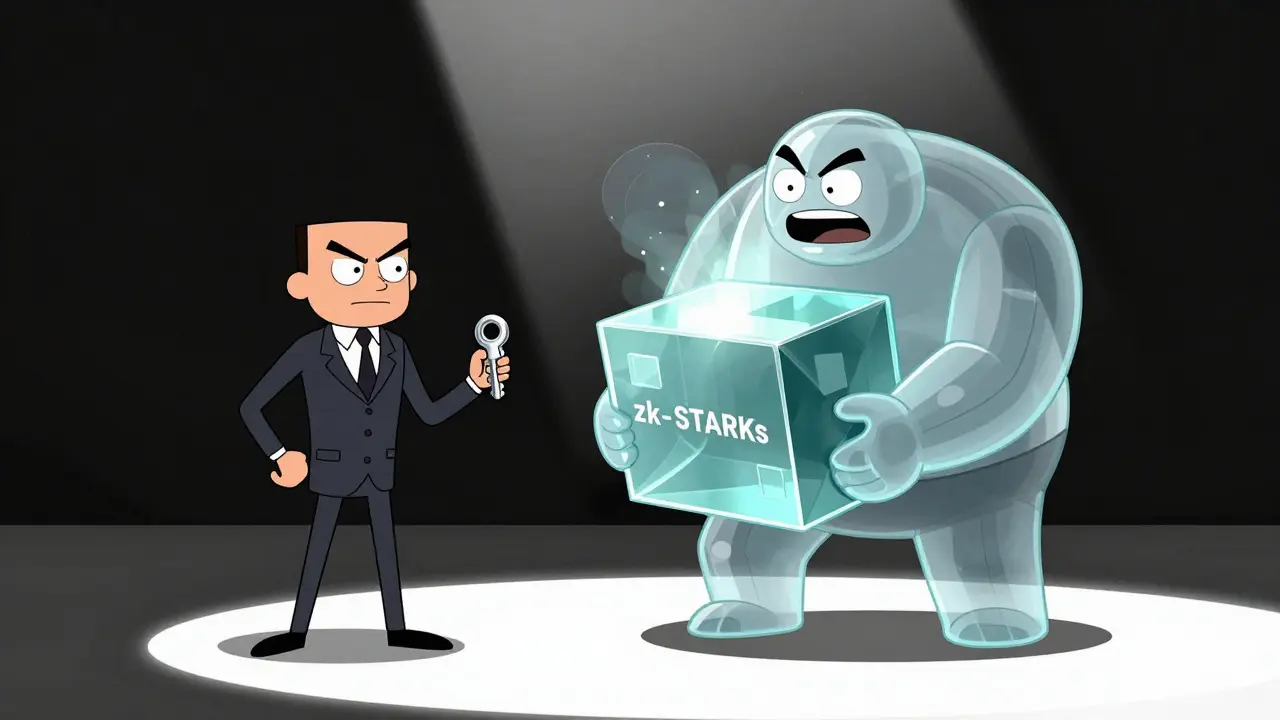
Hardware Requirements for Provers
If you plan to run a ZK node or operate a sequencer for a ZK rollup, your hardware choices matter. The prover is the bottleneck. While verifiers can run on standard cloud instances, provers need muscle.
For zk-SNARKs, high-core-count CPUs are critical. The pairing operations parallelize well across multiple cores. Many production environments use servers with 32 to 64 cores dedicated solely to proof generation. GPU acceleration is also emerging, with NVIDIA cards increasingly used to offload specific matrix multiplication tasks involved in the proof generation pipeline.
For zk-STARKs, memory becomes the primary constraint. The algorithms involve large polynomial evaluations that require substantial RAM to keep in cache. A single complex STARK proof might require several gigabytes of RAM during generation. If you under-provision memory, you will see performance drop sharply as the system starts swapping to disk, which kills throughput.
A rule of thumb for developers: benchmark your specific circuit. A simple arithmetic operation might generate a proof in 50ms on a mid-range laptop. A full EVM state transition proof could take several seconds on a high-end server. Always test with your exact workload before scaling up infrastructure.
Impact on Blockchain Scalability
In the context of blockchain, computational cost translates directly to fees and latency. ZK rollups aggregate thousands of transactions into a single batch. The prover must generate one massive proof covering all those transactions. As the batch size grows, the computational cost increases non-linearly. Doubling the number of transactions doesn't just double the time; it can quadruple it due to the nature of polynomial commitments.
This creates a tension. Larger batches mean lower fees for users because the fixed cost of posting the proof to the main chain is spread across more transactions. But larger batches also mean longer wait times for users, as the prover needs more time to compute the proof. Network operators must find the sweet spot: batches large enough to be economically viable, but small enough to provide acceptable user experience.
Furthermore, the verifier's cost matters for the base layer. If the mainnet (like Ethereum) has to verify every ZK proof, the gas cost depends on the proof size and the complexity of the verification code. Smaller proofs (SNARKs) save gas on the mainnet, even if they are harder to generate off-chain. This is why many projects accept the higher off-chain computational burden to save on on-chain verification costs.
Optimization Strategies and Future Trends
The good news is that the ecosystem is moving fast to reduce these costs. Several optimization strategies are currently in play:
- Circuit Optimization: Writing efficient circuits reduces the number of constraints. Fewer constraints mean less computation. Tools like Circom and Halo2 allow developers to optimize their logic at the source.
- Parallelization: Breaking the proof generation process into independent chunks allows multiple machines to work together, drastically reducing wall-clock time.
- Specialized Hardware: ASICs (Application-Specific Integrated Circuits) designed specifically for ZK computations are being developed. These chips promise to cut energy consumption and increase throughput by orders of magnitude compared to general-purpose CPUs.
- Recursive Proofs: Techniques like recursion allow a proof to verify another proof. This enables unbounded computation to be compressed into a constant-size proof, shifting the complexity from the verifier to the prover in a manageable way.
Looking ahead, we expect the gap between SNARK and STARK performance to narrow. New algorithms are constantly emerging that borrow strengths from both worlds. For instance, some hybrid approaches aim to achieve STARK-like transparency with SNARK-like efficiency. Keeping an eye on academic publications and open-source benchmarks is crucial for staying current.
Frequently Asked Questions
Is the computational cost of ZK proofs decreasing?
Yes, steadily. Over the last five years, the time required to generate a standard proof has dropped by roughly 50% per year due to software optimizations and better hardware utilization. While the fundamental math hasn't changed, the engineering around it has improved significantly.
Which is more expensive: generating or verifying a ZK proof?
Generating a proof is exponentially more expensive than verifying it. Verification is designed to be lightweight so that anyone with a basic computer can check the validity of a transaction. Generation requires powerful hardware to ensure only the correct party can produce the proof efficiently.
Do I need a GPU to run a ZK node?
Not necessarily. Most ZK nodes can run effectively on high-performance CPUs. GPUs offer a speed boost for specific types of calculations, particularly in zk-SNARK implementations, but they add cost and complexity. For most startups, a strong CPU-based server is sufficient to begin.
How does proof size affect blockchain gas fees?
On chains like Ethereum, data posted to the blockchain costs gas. Since ZK proofs are posted as data, a larger proof means higher gas fees. This is why zk-SNARKs, with their tiny proof sizes, are popular for Layer 2 scaling-they minimize the on-chain cost despite their heavier off-chain generation requirements.
Can quantum computers break zero-knowledge proofs?
It depends on the type. zk-SNARKs rely on elliptic curve cryptography, which is vulnerable to quantum attacks. zk-STARKs rely on hash functions, which are considered more resistant to quantum threats. As quantum computing advances, the industry is likely to shift toward post-quantum secure variants of these protocols.




Patrick Pat
So we're burning through server farms just to prove I'm not a bot? The irony is thick enough to cut with a knife. I guess that's the price of 'trustless' these days.