You might be looking for a place to trade crypto, but you've hit a confusing wall. The search term "Elk Finance (Elastos)" suggests these are the same thing, or perhaps one is a feature of the other. They aren't. In fact, mixing them up could cost you time, fees, or even your capital if you deposit into the wrong wallet.
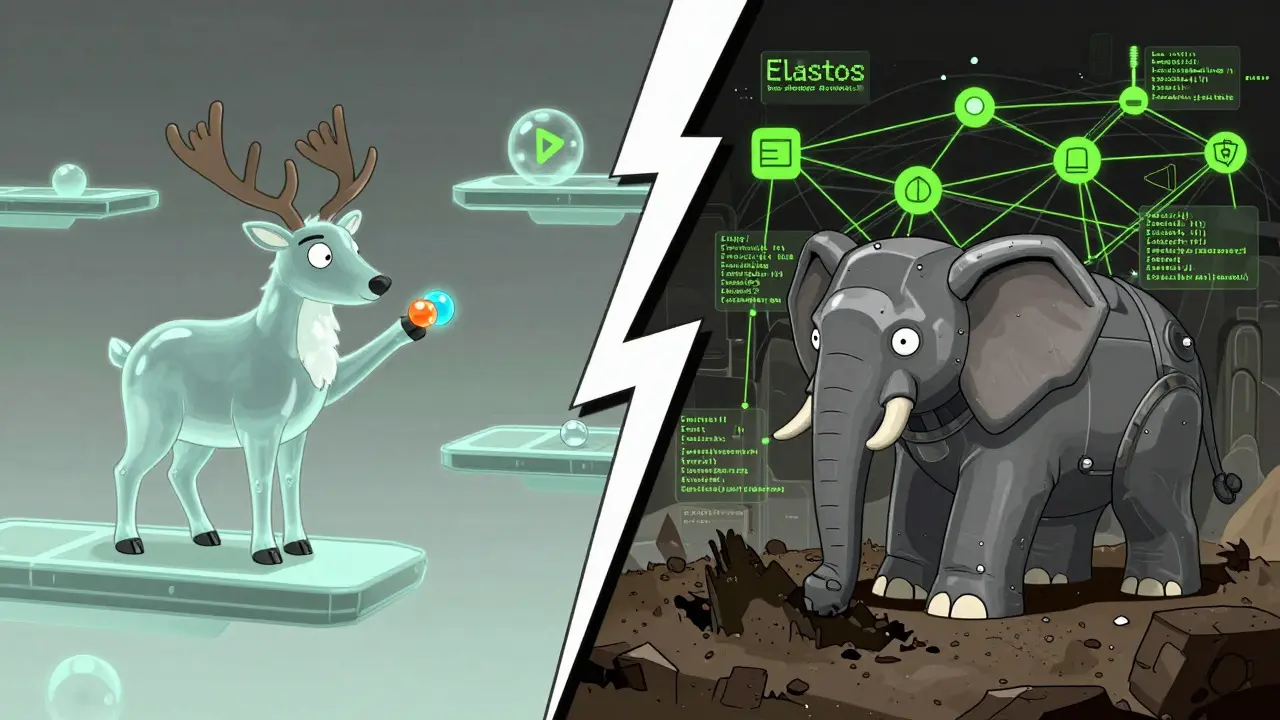
Elk Finance is a decentralized finance (DeFi) protocol focused on cross-chain liquidity. It’s not a traditional centralized exchange like Coinbase or Binance. Meanwhile, Elastos is a completely separate blockchain project aiming to build a decentralized internet infrastructure. Confusing the two is common because both start with "El" and operate in the broader web3 space, but their goals, tokens, and user experiences are worlds apart.
Quick Summary: What You Need to Know
- Elk Finance (ELK) is a DeFi platform for swapping assets across 14+ blockchains. It uses its own token, ELK, and a stablecoin for liquidity pools.
- Elastos (ELA) is a Layer-1 blockchain ecosystem designed for a "smartweb." Its token, ELA, was launched in 2018 and merge-mines with Bitcoin.
- There is no single "Elk Finance Exchange" that hosts Elastos. If you want to buy ELA, you go to HTX or BCEX. If you want to use Elk Finance, you connect a wallet to their DApp.
- Both projects face adoption challenges, but they solve different problems: Elk handles liquidity fragmentation; Elastos attempts to rebuild internet infrastructure.
Decoding the Names: Why the Confusion Exists
Let’s clear the fog first. When people search for "Elk Finance (Elastos)," they are often trying to find a specific trading pair or assuming a partnership that doesn’t exist at the core level. Elk Finance is a decentralized network aimed at enhancing cross-chain liquidity by connecting multiple blockchain ecosystems. Think of it as a bridge builder. Its primary job is to make sure that if you hold an asset on Polygon, you can easily swap it for an asset on BNB Chain without jumping through ten hoops or paying exorbitant gas fees. Elastos, on the other hand, is a comprehensive blockchain-powered decentralized internet ecosystem that leverages Bitcoin's security through merge mining. Founded by Chen Rong, a former Microsoft engineer, Elastos isn't just about moving money. It’s about creating an operating system where data ownership belongs to users, not corporations. It’s a much heavier, more ambitious infrastructure play.
The key distinction? Elk Finance is a service you use to move value between chains. Elastos is a platform you might build applications on. One is a tool; the other is a foundation.
Elk Finance: The Cross-Chain Liquidity Engine
If you’re interested in using Elk Finance, you need to understand how it actually works. It’s not a place where you sign up with an email address and verify your ID. It’s a DeFi application. To use it, you need a compatible wallet (like MetaMask or Trust Wallet) connected to the relevant blockchains.
Here’s what makes Elk distinct in the crowded DeFi space:
- Multi-Chain Support: It currently supports 14 different blockchains. This breadth allows users to access liquidity that is usually siloed within single networks.
- Exclusive Asset Pooling: Elk uses its native ELK token alongside a proprietary stablecoin to create deep liquidity pools. This means tighter spreads when you swap.
- Liquidity Provider Protection: A major pain point in DeFi is impermanent loss. Elk implements mechanisms designed to ensure liquidity providers receive no less than their initial investment, which is a significant selling point for risk-averse traders.
Market performance has been steady. Recent data shows ELK outperforming the broader market during downturns, suggesting strong community holding patterns. However, like all DeFi protocols, smart contract risk remains. You are trusting code, not a company with insurance.
Elastos: Building the Decentralized Internet
Now, let’s look at Elastos. If Elk is a utility belt, Elastos is trying to build a new house. Launched in February 2018, the project raised funds via ICO and started trading at $38. It hit an all-time high of $89.19 shortly after launch before correcting to $18 by July 2018-a typical volatile arc for early-stage crypto projects.
The technical architecture of Elastos is complex. It rests on four pillars:
- Blockchain Infrastructure: Separates functionality between main and side chains.
- Runtime: Allows decentralized apps to run outside the Elastos OS.
- Carrier Service: Provides peer-to-peer decentralized internet functionality for storage and compute rental.
- SDK: Connects applications to the "smart web."
A critical feature here is Merge Mining. Elastos merge-mines with Bitcoin. This means Bitcoin miners also mine ELA tokens. For every two minutes of mining, new tokens are produced. The Elastos Foundation takes 30% of newly minted coins, while miners get 70%. This ties Elastos’ security directly to Bitcoin’s massive hash rate, providing a robust layer of protection against attacks.
Where do you buy ELA? You won’t find it on Elk Finance. You’ll find it on centralized exchanges like HTX (formerly Huobi) and BCEX. Trading pairs typically include BTC, ETH, and USDT.
Comparing the Two: A Side-by-Side Look
To help you decide which project fits your needs, here is a direct comparison of their attributes.
| Feature | Elk Finance (ELK) | Elastos (ELA) |
|---|---|---|
| Primary Function | Cross-chain liquidity & swaps | Decentralized internet infrastructure |
| Token Type | Utility/Governance (DeFi) | Platform Token (Layer-1) |
| Consensus Mechanism | Depends on underlying chains | Merge Mining with Bitcoin |
| Launch Date | Recent DeFi Era (Post-2020) | February 2018 |
| Key Use Case | Swapping assets across 14+ chains | Running dApps, DID, Decentralized Storage |
| Availability | DApp Interface | HTX, BCEX Exchanges |
| Risk Profile | Smart Contract Risk | Adoption & Technical Complexity |
Which One Should You Use?
Your choice depends entirely on what you’re trying to achieve.
Choose Elk Finance if:
- You are an active trader moving assets between Ethereum, BNB Chain, Polygon, etc.
- You want to provide liquidity and earn yield with lower impermanent loss risk.
- You prefer non-custodial solutions where you control your keys.
Choose Elastos if:
- You believe in the long-term vision of a blockchain-based internet.
- You want exposure to a project secured by Bitcoin’s hash power.
- You are a developer looking to build on a unique stack that separates identity, storage, and compute.
Do not expect to find ELA on Elk Finance. Do not expect to use Elk Finance’s low-fee swaps on the Elastos mainnet directly without bridging tools. They are parallel universes with very little overlap.
Risks and Limitations to Watch
No crypto project is perfect. Here are the specific hurdles each faces. For Elk Finance, the main risk is competition. The cross-chain bridge market is saturated. Projects like Wormhole, LayerZero, and Stargate are fighting for the same user attention. If Elk cannot maintain its edge in fee structure or safety, users will migrate. Additionally, as a DeFi protocol, any bug in the smart contracts could lead to fund loss. Always audit the contracts yourself or rely on reputable third-party audits before depositing large sums. For Elastos, the challenge is adoption. Building a new internet is a monumental task. Critics point out that the "closed environment" for content protection isn’t foolproof-users can still screen-record. Furthermore, verifying digital ownership (DID) is technically difficult. Who verifies that you own a song? Without a robust, widely accepted verification system, disputes over digital assets could stall growth. The revenue sharing model for remixed content also remains underdeveloped, leaving creators unsure of how to monetize derivative works.
Getting Started: Practical Steps
If you’ve decided to explore either platform, here is how to proceed safely. To Use Elk Finance: 1. Install a multi-chain wallet like MetaMask or Rabby. 2. Ensure you have small amounts of the native gas tokens for the chains you plan to use (e.g., ETH for Ethereum, MATIC for Polygon). 3. Visit the official Elk Finance website (verify the URL carefully to avoid phishing sites). 4. Connect your wallet. 5. Select the source chain and destination chain. 6. Swap or provide liquidity. To Buy Elastos (ELA): 1. Create an account on a supported CEX like HTX or BCEX. 2. Complete KYC (Know Your Customer) verification. 3. Deposit USDT or BTC. 4. Search for the ELA/USDT or ELA/BTC pair. 5. Place a limit or market order. 6. Withdraw ELA to the Elastos Essentials superwallet for long-term holding and voting rights.
Frequently Asked Questions
Is Elk Finance the same as Elastos?
No. Elk Finance is a DeFi protocol for cross-chain swaps, while Elastos is a Layer-1 blockchain infrastructure project. They have different tokens (ELK vs ELA), different founders, and different use cases.
Can I buy ELA on Elk Finance?
Generally, no. ELA is primarily traded on centralized exchanges like HTX and BCEX. While bridges may exist to move ELA to other chains, Elk Finance is not a primary venue for purchasing ELA directly.
What is the consensus mechanism for Elastos?
Elastos uses Merge Mining with Bitcoin. This means Bitcoin miners also mine ELA tokens, tying Elastos' security to Bitcoin's network hash rate.
How many blockchains does Elk Finance support?
Elk Finance currently supports 14 different blockchains, with plans to integrate more networks in the future to enhance cross-chain liquidity.
What is the total supply of ELA tokens?
The Elastos ecosystem has a total supply cap of 33 million ELA tokens. The circulating supply is designed to increase annually by approximately 4%.
Who founded Elastos?
Elastos was founded by Chen Rong, a professor at Tsinghua University and former Microsoft employee who led teams for Microsoft Research OS and .NET from 1992 to 2000.