Imagine trying to send a $5 payment on Bitcoin and paying $10 in fees. Or waiting ten minutes for a transaction to clear because the network is jammed with people trading meme coins. This isn't hypothetical-it’s the reality that pushed developers to invent Rollup Technology. As we stand here in October 2026, this tech isn't just a buzzword; it's the backbone of how we actually use blockchains today. But where is it going? If you're wondering whether your favorite chain will survive without it, or if zero-knowledge proofs are finally ready for prime time, you're asking the right questions.
The Core Problem: Why We Need Rollups
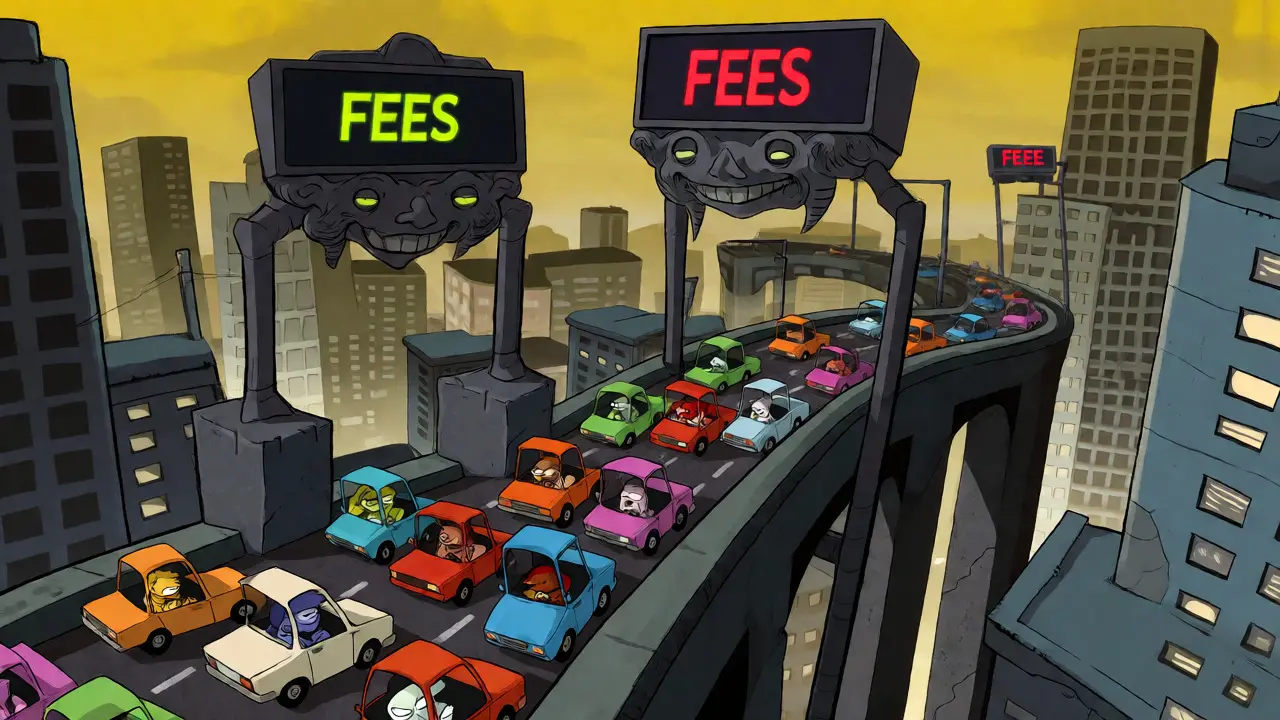
Blockchains like Ethereum and Bitcoin are secure, but they’re slow. Think of them as single-lane highways in a major city. Every car (transaction) has to wait its turn, pay a toll (gas fee), and fit within strict size limits. When too many cars show up, traffic grinds to a halt, and tolls skyrocket. Rollup technology solves this by building express lanes off the main highway. It batches hundreds or thousands of transactions together, processes them off-chain, and then submits a single compressed proof back to the main chain. This approach slashes costs and boosts speed while keeping the security of the original blockchain.
The mechanism is clever. Instead of every node verifying every transaction individually, the main chain only verifies a cryptographic proof that the batch was processed correctly. For example, a standard Bitcoin transfer costing 5,000 satoshis can drop to just 50 satoshis when routed through a rollup. That’s not just an improvement; it’s a fundamental shift in usability. Without this, mass adoption remains stuck in the "early adopter" phase.
ZK-Rollups vs. Optimistic Rollups: The Big Divide
Not all rollups are created equal. The market currently splits into two main camps: Optimistic Rollups and Zero-Knowledge (ZK) Rollups. Understanding the difference is key to predicting which one wins in specific scenarios.
Optimistic rollups operate on trust-but with a safety net. They assume transactions are valid unless someone proves otherwise. If you try to cheat, anyone can challenge it during a "fraud proof" window. This makes them fast to build and compatible with existing smart contracts (like those on Ethereum). However, there’s a catch: finality takes time. You might have to wait seven days before you can move funds back to the main chain because of this challenge period. It’s efficient for now, but it’s a band-aid solution.
ZK-rollups, on the other hand, use advanced cryptography to prove validity instantly. No waiting periods, no fraud challenges. The math itself guarantees correctness. This offers better privacy and faster withdrawals. The downside? Building these systems is incredibly hard. Generating the proofs requires heavy computation, and writing smart contracts for ZK environments often means learning new languages like Cairo or Noir. But here’s the twist: as hardware gets cheaper and algorithms improve, the cost gap is closing rapidly.
| Feature | Optimistic Rollups | ZK-Rollups |
|---|---|---|
| Finality Time | ~7 Days (due to fraud proof window) | Minutes (instant verification) |
| Security Model | Fraud Proofs (assume valid until challenged) | ZK Proofs (mathematically proven valid) |
| Compatibility | High (EVM equivalent) | Low to Medium (requires custom tooling) |
| Cost Efficiency | Good | Excellent (data compression) |
| Privacy | Low (public data) | High (optional shielding) |
The Rise of Validiums and Data Availability
Here’s where things get interesting. Pure rollups store their data on the main chain (Layer 1). This is secure but still expensive because Layer 1 space is scarce. Enter Validiums. These are hybrid solutions that keep transaction data off-chain entirely, storing it with a separate committee or a dedicated data availability layer like Celestia or EigenDA. They’re even cheaper than rollups but sacrifice some security-if the data committee goes offline, you might lose access to your funds temporarily.
In 2026, we’re seeing a trend toward modular blockchains. Instead of one giant monolithic chain doing everything, we split tasks. One layer handles consensus, another handles data availability, and rollups handle execution. This modularity allows for specialized chains optimized for gaming, DeFi, or social media. For instance, a gaming rollup might prioritize speed over absolute decentralization, using a Validium model to handle millions of micro-transactions per second.

Bitcoin’s Late Bloomer Moment
Ethereum led the charge, but Bitcoin is catching up. Historically, Bitcoin scaling meant Lightning Network, which is great for payments but terrible for complex smart contracts. Now, projects like Stacks and newer BitVM-based rollups are bringing Ethereum-like functionality to Bitcoin. Imagine issuing stablecoins or running NFT marketplaces directly on Bitcoin rails, secured by Bitcoin’s hash power but priced in cents.
This expansion matters because Bitcoin holds the most value in crypto. If rollups unlock programmability for BTC holders, trillions of dollars in dormant capital could flow into decentralized applications. We’re already seeing early experiments where users bridge assets from Ethereum to Bitcoin rollups, attracted by lower fees and higher security assurances. This cross-chain fluidity is a hallmark of the next generation of infrastructure.
User Experience: The Invisible Tech
The biggest hurdle for rollups isn’t technical-it’s user experience. Right now, bridging assets between layers is clunky. You have to leave your wallet, go to a bridge site, sign multiple transactions, and wait. Most regular users won’t do this. The future of rollup technology depends on abstraction.
We’re moving toward "intent-centric" architectures. You don’t care which chain your money is on; you just want to buy an NFT. The software behind the scenes routes your request to the cheapest, fastest rollup automatically. Wallets like MetaMask and Rabby are integrating features that hide the complexity. In five years, you might never know you used a rollup. You’ll just see fast, cheap transactions. That invisibility is the ultimate success metric.

Challenges on the Horizon
It’s not all smooth sailing. Centralization risks remain. Many rollups rely on sequencers-single entities that order transactions. If a sequencer goes down or acts maliciously, the network halts. Decentralized sequencer networks are being built, but they’re still young. Additionally, interoperability between different rollups is messy. Moving assets from Arbitrum to zkSync currently involves multiple hops and high friction.
Another concern is the "blob" competition. With Ethereum’s Dencun upgrade introducing proto-danksharding (EIP-4844), data storage costs dropped significantly. But if every rollup tries to use the same limited blob space, fees could rise again. Long-term solutions involve more aggressive compression and off-chain data availability committees, but these introduce trust assumptions that purists dislike.
What Comes Next?
The trajectory is clear: rollups are becoming the default execution environment for smart contracts. Mainnets like Ethereum are shifting roles-they become settlement and data availability layers, while rollups handle the actual application logic. This hierarchy creates a multi-chain ecosystem where hundreds of specialized rollups coexist.
For developers, this means picking a niche. Don’t build a generic L2; build a gaming-specific rollup with low-latency requirements, or a privacy-focused ZK-rollup for institutional finance. For investors, look at protocols that solve the sequencing bottleneck or provide seamless cross-rollup messaging. The winners won’t be the ones with the highest TVL today, but the ones with the best developer tools and user abstraction tomorrow.
If you’re holding assets, consider diversifying across different rollup types. An optimistic rollup for general DeFi, a ZK-rollup for privacy-sensitive trades, and perhaps a Bitcoin rollup for long-term savings. The fragmentation is real, but so is the opportunity.
Are rollups safer than sidechains?
Yes, generally. Rollups inherit the security of the underlying Layer 1 blockchain (like Ethereum) because they post data or proofs to it. Sidechains, by contrast, have their own independent validator sets. If a sidechain’s validators collude or fail, the sidechain can halt or fork independently of the main chain. Rollups force compliance with the main chain’s rules.
Why do optimistic rollups have a 7-day withdrawal delay?
This delay exists to allow time for fraud proofs. Since optimistic rollups assume transactions are valid by default, anyone can submit a challenge if they spot an invalid state change. The 7-day window ensures there’s enough time for honest actors to detect and dispute any cheating before the funds are finalized on the main chain.
Will ZK-rollups replace optimistic rollups?
Not entirely, but they will dominate in areas requiring instant finality and privacy. Optimistic rollups will likely persist for applications where EVM compatibility and ease of development are prioritized over speed. However, as ZK-proof generation becomes cheaper and developer tools mature, ZK-rollups are expected to capture the majority of high-value and high-frequency use cases.
What is a sequencer in a rollup?
A sequencer is a centralized entity responsible for ordering transactions within a rollup. It receives user transactions, orders them, executes them, and produces a state root. Currently, most sequencers are run by the project team, which introduces centralization risk. Future developments aim to decentralize this role via auction mechanisms or shared sequencer networks.
How does EIP-4844 affect rollup costs?
EIP-4844 introduced "blobs," a new type of temporary data storage on Ethereum. Rollups can now publish their transaction data to blobs instead of calldata. Blobs are much cheaper because they are discarded after a short period (not stored forever). This has reduced rollup transaction fees by 90% or more, making micropayments and high-throughput apps viable.