
Forget the wild west days of 2020 where you could find 1,000% returns overnight. That era of unsustainable hype is gone, replaced by a professional landscape where smart money focuses on risk-adjusted returns. If you're looking to put your idle crypto to work in 2025, you aren't just looking for the biggest number; you're looking for the most sustainable one. The goal has shifted from gambling on "degen" pools to building a diversified portfolio that can reliably beat inflation and traditional savings accounts.
The Modern Landscape of Yield Farming
At its core, Yield Farming is the process of leveraging decentralized finance (DeFi) protocols to generate returns on cryptocurrency holdings through liquidity provision, staking, and strategic asset allocation. In 2025, we've seen this evolve from simple token rewards to complex, multi-chain ecosystems. Most successful farmers now aim for a sustainable APY between 5% and 30%, depending on their risk appetite.
The shift toward maturity is evident in how we deploy capital. We are no longer tethered to a single chain. With the rise of Layer 2 solutions, the cost of entry has plummeted. While farming on the Ethereum mainnet often requires a minimum of $5,000 just to make the gas fees make sense, platforms on Solana or Sui allow you to start with as little as $500 with almost zero transaction costs.
Top Yield Farming Strategies for 2025
Depending on whether you are a conservative saver or an aggressive growth seeker, your approach will differ. Here are the three most effective frameworks currently being used by profitable farmers.
The "Set-and-Forget" Automation
Manual harvesting is a chore that often leads to "psychological delays"-basically, you forget to claim your rewards, and you lose out on compounding. This is where auto-compounders come in. Using Beefy Finance, rewards are reinvested every 15 minutes. This small change can boost your effective APY by 8-12% annually compared to doing it manually once a week.
Similarly, Yearn Finance acts as a yield aggregator. Their V3 architecture automatically shifts your assets between different protocols based on where the best real-time yield is. It's the DeFi equivalent of a managed mutual fund, though you'll typically pay a small performance fee for the convenience.
The Stablecoin Safety Net
If you can't stomach the volatility of altcoins, stablecoin farming is your best bet. Curve Finance remains the gold standard here. Because it specializes in assets of the same value (like USDT and USDC), the risk of impermanent loss is nearly zero. By locking CRV tokens, farmers can boost their yields significantly, often landing in the 2.5-8% range with very low risk.
The Liquid Staking Loop
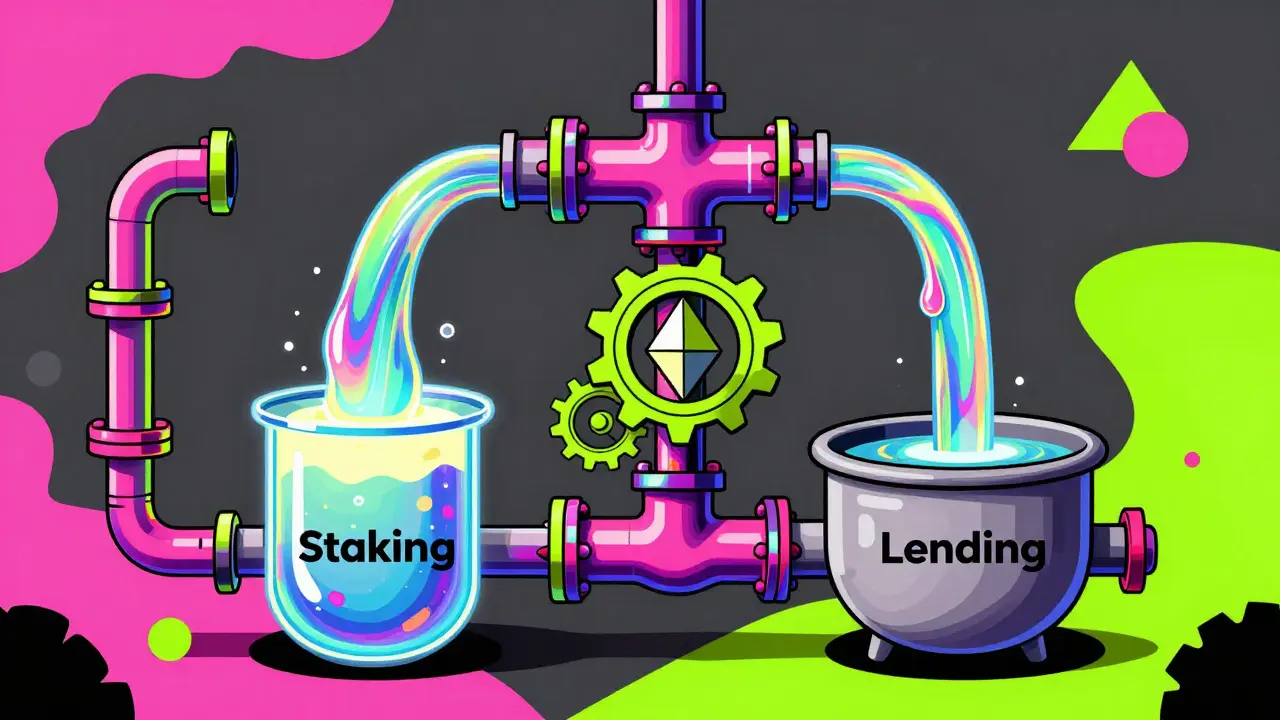
Why choose between staking and farming when you can do both? Lido allows you to stake your ETH and receive stETH in return. Instead of letting that stETH sit idle, you can deploy it into lending protocols like Aave. This "layering" strategy allows you to earn base staking rewards (roughly 3.5-5.2%) plus additional lending yields, effectively stacking your profits.
| Platform | Primary Use Case | Typical APY | Risk Level |
|---|---|---|---|
| Curve Finance | Stablecoin Pairs | 2.5% - 8% | Low |
| Aave | Lending/Borrowing | 4.2% - 9.7% | Low/Medium |
| Yearn Finance | Automated Vaults | 12% - 18% | Medium |
| PancakeSwap | DEX Liquidity | 22% - 35% | High |
Managing the Risks: How Not to Lose Your Principal
The biggest mistake beginners make is chasing the highest APY. If you see a pool offering 250%, there is almost certainly a catch. Often, these rewards are paid in a native token that is hyper-inflating. If the token price crashes faster than you can harvest it, your "massive gains" actually result in a net loss of your initial investment.
To survive in DeFi, you need to master three key concepts:
- Impermanent Loss (IL): This happens in liquidity pools when the price of your deposited assets diverges. If one token moons while the other stays flat, you might have been better off just holding the tokens in your wallet.
- Liquidation Risk: If you use your staked assets as collateral to borrow more funds (leverage), a sharp price drop can trigger an automatic sale of your assets to cover the loan.
- Smart Contract Vulnerabilities: No matter how good the audit is, bugs happen. Diversifying your capital across 4-6 different chains prevents a single exploit from wiping out your entire portfolio.
A pro tip from the most profitable farmers: convert your volatile reward tokens into stablecoins within 24 hours. Don't hold the reward tokens hoping they'll go up; treat the yield as profit and lock it in.

Essential Tools for the 2025 Farmer
You can't manage what you can't measure. Professional yield farming requires a specific toolkit to track performance and spot opportunities before the crowds arrive.
- DefiLlama: The industry standard for comparing TVL (Total Value Locked) and finding the best yields across different chains.
- Zapper.fi: Great for a visual overview of your portfolio across multiple wallets and protocols.
- Etherscan/Solscan: Essential for monitoring transactions and ensuring your funds are moving as expected.
- YieldBay Dashboards: Used by over 60% of active farmers to track real-time APY shifts and trigger alerts for reallocation.
The Future of Sustainable Yields
We are moving toward a world of "Institutional DeFi." We're already seeing regulated entities deploy capital into permissioned pools. The future is likely to involve AI-driven prediction models that adjust your strategy based on market volatility and integrated insurance that covers up to 80% of potential exploit losses.
For the average person, the best path forward is a hybrid approach: keep the bulk of your assets in low-risk stablecoin pools (5-10% yield) and allocate a small a portion to automated high-yield vaults (15-20% yield). This balance ensures you grow your wealth without risking a total wipeout.
Is yield farming still profitable in 2025?
Yes, but the strategy has changed. While the 1,000% returns of 2020 are gone, sustainable yields of 5-30% are common. Profitability now comes from compounding and diversification rather than gambling on new, high-risk tokens.
What is the safest way to start yield farming?
The safest entry point is stablecoin farming on established platforms like Curve Finance or Aave. These avoid the volatility of altcoins and the risk of significant impermanent loss.
How do I avoid impermanent loss?
To minimize impermanent loss, provide liquidity to pairs with similar price movements, such as two different stablecoins or a wrapped version of the same asset (e.g., ETH and stETH).
Which blockchain is best for yield farming right now?
For those with smaller budgets, Solana and Sui are excellent due to near-zero transaction fees. For those with larger portfolios ($5k+), Ethereum Layer 2s like Arbitrum offer a great balance of security and efficiency.
What happens if a protocol is hacked?
If a protocol is exploited, you could lose your deposited funds. This is why it is critical to use audited platforms (checked by firms like OpenZeppelin) and never put all your capital into a single protocol.






Adedamola Oyebo
DefiLlama is the gold standard here!! Always check the TVL trends before jumping into any pool... Safety first!!!