
Imagine you’re at a party. Someone whispers a rumor to three friends. Those three tell three more each. Within minutes, half the room knows. No one’s in charge. No central speaker. Just people telling people. That’s how gossip protocol works in blockchain networks - except instead of rumors, it’s transactions and blocks spreading across thousands of computers worldwide.
Why Gossip Protocol? Because Centralized Systems Don’t Scale
Blockchain is built on decentralization. No server. No boss node. No single point of failure. But if every node had to talk to every other node directly, the network would collapse under its own weight. A network with 10,000 nodes would need 50 million connections. Impossible. That’s where gossip protocol steps in. Instead of broadcasting to everyone, each node picks a few random peers - maybe three or five - and shares what it knows. Those peers do the same. And so on. It’s not fast, but it’s reliable. And it keeps growing, no matter how big the network gets. This isn’t new tech. It started in 1987, when computer scientists studied how databases stay in sync across machines. They noticed something: information spreads like a virus. Not because it’s forced, but because it’s passed along naturally. They called it an epidemic algorithm. Later, people just started calling it gossip.How It Actually Works - Step by Step
Here’s the real mechanics, plain and simple:- Every few seconds (say, every 2 seconds), a node picks a few other nodes at random.
- It sends them a summary of what it knows: new transactions, blocks, or updates to its local state.
- The receiving node checks what it already has. If it’s missing something, it adds it. If it has newer info, it sends that back.
- Both nodes now have a more complete picture.
- Repeat. Over and over.
What Gets Spread - Transactions, Blocks, and More
In Bitcoin, when you send 0.5 BTC to a friend, your node doesn’t shout it to the whole world. It tells a few random peers. Those peers tell a few more. Within seconds, dozens of nodes know. Within a minute, most of the network has it. Same with blocks. When a miner finds a new block, it doesn’t broadcast it to every node. It gossips it. Nodes that already have the block ignore it. Nodes that don’t, add it to their chain and pass it on. But it’s not just data. Gossip also handles:- Node discovery - New nodes join by connecting to a few known peers, then learn the rest through gossip.
- Membership lists - Nodes keep track of who’s online. If a node stops responding for a while, others assume it’s gone and stop sending it messages.
- Fault detection - If a node vanishes, gossip helps the network notice without needing a central watchdog.

Pros: Why It’s Perfect for Blockchain
Gossip protocol isn’t just convenient - it’s essential. Here’s why:- Robust - If 100 nodes drop offline, the network keeps going. Messages reroute through others.
- Scalable - Works just as well with 10,000 nodes as with 100,000. No rewrites needed.
- Simple - No complex routing tables. No leader election. Just random calls and data swaps.
- Efficient - Nodes piggyback multiple updates in one message. No need for separate channels.
- Decentralized - No authority. No single point to attack or censor.
Cons: The Hidden Costs
But it’s not perfect. Gossip has trade-offs:- Slow - It’s eventually consistent, not instantly. A transaction might take 5-15 seconds to reach 95% of nodes. That’s fine for Bitcoin, but not for high-frequency trading.
- Redundant - The same block might be sent 20 times across overlapping connections. Bandwidth is wasted.
- Hard to debug - If a node misses a block, where did it break? You can’t trace the path. It’s like asking who started the rumor at the party.
- Stale data - Nodes might temporarily disagree. One has block 800,000. Another still has 799,999. They’ll sync eventually, but not right away.
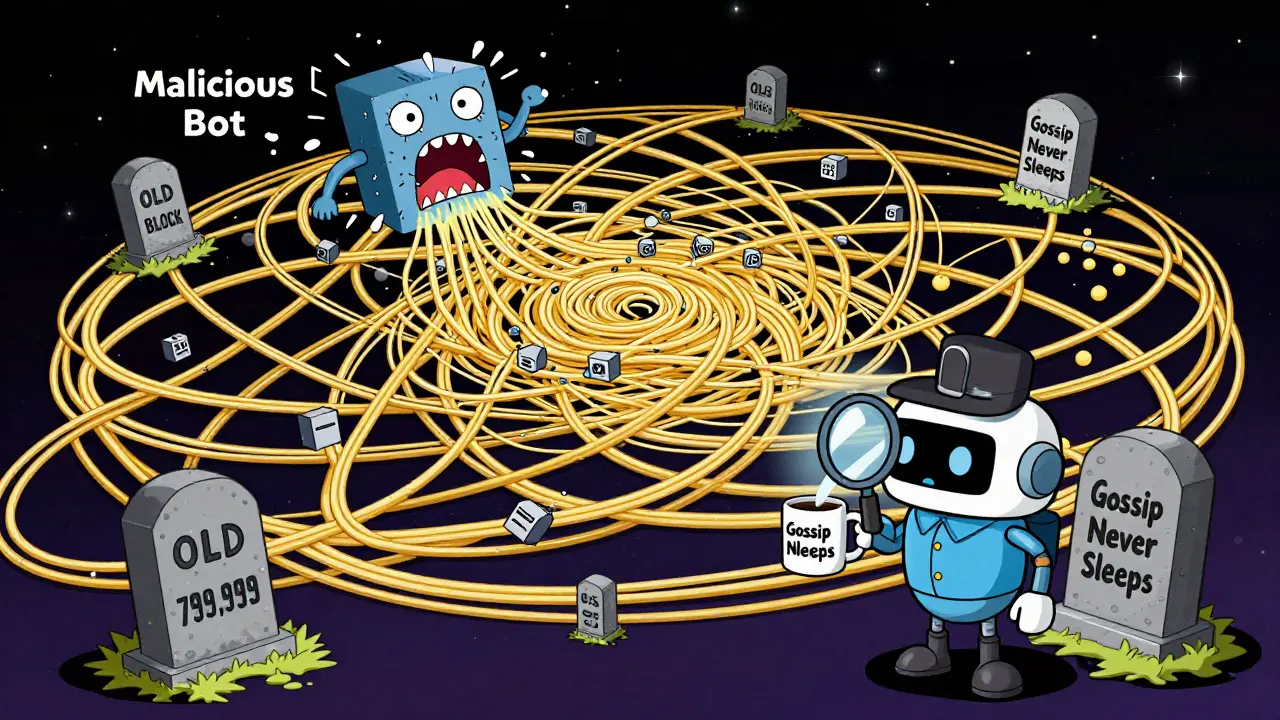
Real-World Tweaks and Variants
Not all gossip is the same. Blockchains tweak it to fit their needs:- Bitcoin - Uses a simple push model. Nodes flood new transactions to peers. No fancy logic. Just “send it to a few others.”
- Ethereum - Adds prioritization. High-fee transactions get gossiped faster. Also uses “eth/66” protocol with headers-first syncing to reduce data load.
- Polkadot - Uses a variant called “gossipsub,” which builds a mesh topology. Nodes form stable connections with reliable peers, reducing redundant messages.
- Cardano - Implements a “pull-based” gossip. Nodes ask for updates instead of waiting to be pushed. Reduces spam.
What’s Next for Gossip in Blockchain?
As blockchains grow, gossip has to evolve:- Adaptive timing - Instead of gossiping every 2 seconds, nodes adjust based on network load. Less chatter when quiet, more when busy.
- Security filters - Malicious nodes try to spread fake blocks or spam. New gossip variants now verify message signatures before forwarding.
- Sharding integration - In sharded chains like Ethereum 2.0, gossip must now work within shards and between them. That means cross-shard gossip protocols are being tested.
- Geographic optimization - Nodes in Europe gossip more with other European nodes to cut latency. Not random anymore - smart routing.
Final Thought: The Quiet Engine of Decentralization
You don’t hear about gossip protocol in crypto news. No headlines. No influencers. But without it, Bitcoin wouldn’t work. Ethereum wouldn’t sync. Blockchain wouldn’t be decentralized. It’s the unsung hero. The quiet hum in the background that lets thousands of strangers agree on a shared ledger - without ever meeting, without trusting anyone, and without a single server in sight. That’s the power of gossip. Not because it’s fast. But because it’s stubborn. It keeps spreading. Even when things break. Even when nodes vanish. Even when the world tries to silence it. And that’s why it’ll keep running - long after the hype fades.Is gossip protocol the same as broadcasting in blockchain?
No. Broadcasting means sending a message to everyone at once. Gossip sends it to a few random peers, who then pass it on. Broadcasting overwhelms networks. Gossip scales.
Why not use a centralized server to spread blockchain data?
Because it defeats the whole point of blockchain. Centralized servers are single points of failure. They can be shut down, hacked, or censored. Gossip removes that risk by spreading control across every node.
Does gossip protocol slow down transaction confirmation?
It adds a small delay - usually under 15 seconds - before a transaction reaches most nodes. But confirmation speed depends on mining or validation, not gossip. Gossip just gets the data there. The consensus layer handles the rest.
Can malicious nodes break the gossip protocol?
They can try - by sending fake blocks or spam. But most modern blockchains verify digital signatures before relaying messages. A malicious node can’t fake a valid transaction. And since gossip is redundant, one bad message gets drowned out by hundreds of good ones.
Do all blockchains use gossip protocol?
Most public, permissionless blockchains do - Bitcoin, Ethereum, Litecoin, Dogecoin, etc. Private or consortium chains sometimes use direct messaging or centralized relays because they control who’s on the network. But for true decentralization, gossip is the standard.







Michael Sullivan
Gossip protocol? More like blockchain’s version of a high school rumor mill. 🤭 At least at parties, people don’t mine blocks to verify who said what.