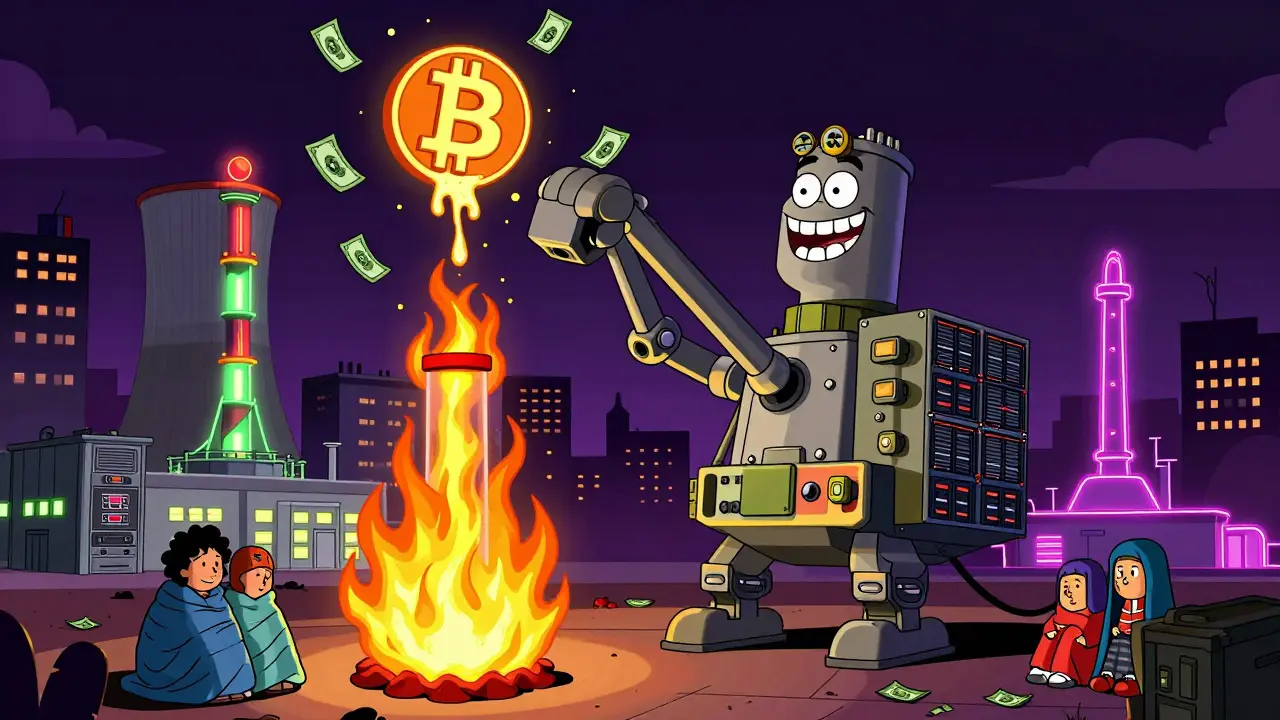
Iran’s Bitcoin mining isn’t just about making money-it’s a survival tactic.
When the U.S. pulled out of the Iran nuclear deal in 2018, sanctions slammed shut nearly every door to global finance. Banks refused to process payments. Oil buyers vanished. Foreign currency dried up. Iran’s economy shrank. But instead of surrendering, Iran turned to something no one expected: Bitcoin mining.
Today, Iran runs one of the largest Bitcoin mining operations in the world-accounting for 4.5% of all global mining power. That’s not a coincidence. It’s policy. The government doesn’t just tolerate mining; it encourages it. Licenses were handed out to over 10,000 mining farms by 2022. Nine major cryptocurrency exchanges now operate legally inside the country. And by 2024, more than $4 billion in cryptocurrency had flowed out of Iran-up 70% from the year before.
How does mining help Iran bypass sanctions?
Sanctions block Iran from using SWIFT, from accessing U.S. dollars, and from trading oil through normal channels. But Bitcoin doesn’t care about borders or bank accounts. It runs on a global network that no single country can shut down.
Iran mines Bitcoin using its biggest advantage: cheap electricity. The country has massive natural gas reserves and power plants that run at near-zero cost for state-backed operations. Miners in Rafsanjan, Kerman, and other industrial zones get electricity so cheaply it’s practically free-sometimes under $0.005 per kWh. Compare that to the U.S., where miners pay between $0.03 and $0.08 per kWh. That gap turns mining into a profit machine.
Once Bitcoin is mined, it’s converted into other digital assets or sent to international exchanges. From there, it’s traded for stablecoins like USDT or USDC, which can be used to buy everything from medicine to machinery. Iran doesn’t need a bank. It doesn’t need a middleman. It just needs an internet connection and a wallet.
The role of the IRGC and state-backed mining
This isn’t a grassroots movement. The Islamic Revolutionary Guard Corps (IRGC) controls the biggest mining operations. Facilities are built inside military bases, on land owned by powerful religious foundations like Astan Quds Razavi, and inside special economic zones with no oversight.
One 175-megawatt mining farm in Rafsanjan-a joint project between IRGC-linked companies and Chinese investors-is powered by natural gas and runs 24/7. These aren’t hobbyists with rigs in their garages. These are industrial-scale operations with dedicated power lines, armored server rooms, and political protection. They don’t pay electricity bills. They don’t answer to regulators. They answer to the Supreme Leader.
Since 2019, Iran’s top leadership has openly endorsed Bitcoin mining as a way to replace lost dollar revenues. In 2020, the Central Bank of Iran began issuing licenses for crypto transactions. By 2021, Iran completed its first official import purchase using cryptocurrency: $10 million worth of medical supplies. That was a turning point. It proved the system worked.

How it compares to other sanctioned nations
Venezuela tried something similar with its Petro coin-but it was a state-controlled token with no real value. No one outside the country trusted it. North Korea hacked exchanges and stole crypto. Iran does something different: it legally mines Bitcoin, following the rules of the network while breaking the rules of the world.
Russia also ramped up mining after its 2022 sanctions, but it’s still playing catch-up. Iran has had seven years to build infrastructure, train technicians, and embed crypto into its economy. It’s not just mining-it’s building a parallel financial system.
Iran’s strategy is also more integrated. Alongside crypto, it runs a “dark fleet” of over 320 tankers to smuggle oil. It uses shell companies in the UAE and Hong Kong to move money. It works with Russia on crypto-based trade deals. It’s not one tool-it’s a whole ecosystem.
Who pays the price?
While the regime profits, ordinary Iranians suffer. The electricity used for mining is equivalent to burning 10 million barrels of oil per year-roughly 4% of Iran’s total oil exports. That’s power that could be heating homes, running hospitals, or powering factories.
Blackouts are common. In winter, cities go dark for hours. Families huddle under blankets while mining rigs in government-controlled facilities hum along, consuming power they don’t pay for. Iranian citizens report internet slowdowns because bandwidth is prioritized for mining farms. Small businesses struggle to stay online.
And the wealth? It doesn’t trickle down. It flows to the IRGC, to religious foundations, and to a handful of connected elites. The average Iranian can’t even open a crypto wallet without jumping through bureaucratic hoops. Meanwhile, the state’s mining operations are growing.

Why the world can’t stop it
Bitcoin is decentralized. No central server. No headquarters. No single point of failure. You can’t sanction a network. You can’t shut down a protocol. You can only try to block access to exchanges or freeze wallets-but miners keep moving.
Iran uses proxy services, mixing tools, and cross-chain swaps to hide where Bitcoin comes from. Transactions flow through TRON-based stablecoins, Chinese exchanges, and shell companies in free zones. Chainalysis and Elliptic can trace some of it-but not all. And even if they could, forcing exchanges to block Iranian IPs would mean breaking Bitcoin’s core promise: open access for everyone.
Western financial institutions are caught in a bind. If they refuse to touch any Bitcoin that might have been mined in Iran, they risk excluding millions of users. If they don’t, they risk sanctions violations. That’s why some banks just ignore it. Others hire blockchain analysts to scan every transaction. Neither solution is perfect.
The future of Iran’s crypto strategy
Iran isn’t stopping. In 2025, new mining farms opened in Bushehr and Khuzestan, powered by surplus gas and solar. The government plans to increase mining capacity by 50% over the next two years. It’s building its own domestic exchanges to reduce reliance on foreign platforms like Binance.
Experts warn this could become a blueprint for other sanctioned nations-North Korea, Syria, even Russia. If one country can use crypto to survive sanctions, others will follow. The global financial system wasn’t built for this.
But there’s a catch: Bitcoin mining is energy-intensive. As the world moves toward renewables, Iran’s advantage-cheap fossil fuels-could fade. If new mining hardware becomes more efficient, Iran’s cost edge shrinks. And if international pressure forces more exchanges to block Iranian addresses, the flow of funds could slow.
Still, as long as sanctions stay in place, Iran will keep mining. It’s not a gamble. It’s a necessity. And right now, it’s working.
What this means for the rest of the world
This isn’t just about Iran. It’s about what happens when a country refuses to play by the old rules. Bitcoin wasn’t designed to help rogue states. But it doesn’t care who uses it. It just runs.
Sanctions were meant to cripple economies. Instead, they pushed Iran to build something new-a decentralized, state-backed financial alternative that’s harder to control than any bank.
The lesson? Financial isolation doesn’t always work. Sometimes, it just forces innovation. And in the age of crypto, the weakest link isn’t the economy-it’s the system trying to control it.





Matthew Kelly
this is wild. i live in canada and we complain about our hydro bills... these guys are mining btc with gas that costs less than a candy bar. 🤯