People often mix up NFTs and cryptocurrencies because both use blockchain technology. But they’re not the same thing - not even close. One is money. The other is a digital ownership certificate. If you think buying an NFT means you own a song or artwork like you own a CD or painting, you’re already on the wrong track. Let’s clear this up once and for all.
What Exactly Is a Cryptocurrency?
Cryptocurrency is digital money. Bitcoin, Ethereum, Dogecoin - these are all cryptocurrencies. Each unit is identical to every other unit. One Bitcoin is always worth the same as another Bitcoin. You can split them, send fractions, trade them, use them to buy coffee, or hold them like gold. That’s what fungible means: interchangeable, like dollar bills.
Cryptocurrencies run on blockchains that record every transaction. Bitcoin’s blockchain has been running since 2009. Ethereum, launched in 2015, added smart contracts, which let developers build apps on top of it. These apps use tokens - mostly ERC-20 tokens - that behave just like currency. You can send 0.003 ETH to a friend. You can buy 0.75 BTC on Coinbase. You can even use crypto to pay for groceries in some places now.
Value comes from supply, demand, and trust. Bitcoin has a max supply of 21 million coins. That scarcity, combined with global adoption, drives price. Ethereum’s value is tied to how much people use its network - for DeFi, NFTs, or dApps. Prices swing wildly. Bitcoin hit $68,000 in 2021, then dropped below $18,000 in 2022. That’s normal. That’s how money behaves.
What Exactly Is an NFT?
An NFT - Non-Fungible Token - is not money. It’s a unique digital certificate. Think of it like a numbered limited edition poster, but on a blockchain. Each NFT has a unique ID, metadata, and history that no other token shares. You can’t split an NFT. You can’t swap it for another one and call it even. That’s what non-fungible means: one-of-a-kind.
NFTs are built on standards like ERC-721 and ERC-1155, mostly on Ethereum. These standards let creators attach data: who made it, when, what it represents, even royalty percentages. A digital artwork NFT might link to a JPEG. A virtual land NFT might point to coordinates in a metaverse. A music NFT might bundle a high-res audio file and a lifetime license to play it live.
But here’s the catch: buying an NFT doesn’t mean you own the copyright. You own the token. The artist still holds the rights to the image, song, or video. That’s why you can screenshot a Bored Ape and post it online - you’re not stealing the NFT, you’re just copying the file. The real value is in the blockchain record proving you’re the official owner.
Fungibility: The Core Difference
This is the heart of it. Fungibility is the only feature that separates them.
Cryptocurrencies are fungible. You can exchange one for another without losing value. 1 BTC = 1 BTC. 100 USDT = 100 USDT. It’s like exchanging one $20 bill for another. No one cares which one you have.
NFTs are non-fungible. Each one is unique. You can’t trade your CryptoPunk #7804 for someone else’s CryptoPunk #5577 and expect it to be the same. One might have a rare hat. One might have been owned by a celebrity. Their value isn’t based on quantity - it’s based on history, rarity, and demand.
That’s why you can’t buy “an NFT” like you buy “Bitcoin.” You’re buying a specific item, not a currency. It’s like going to an auction - you’re not bidding on art in general. You’re bidding on that exact painting.
How Value Is Determined
Cryptocurrency prices are driven by macro factors: adoption, regulation, mining costs, market sentiment. Bitcoin’s value rises when institutions like BlackRock or Fidelity buy it. It falls when governments crack down.
NFT values are driven by micro factors: who made it, how many exist, who owns it, and how much hype surrounds it. A single Bored Ape NFT sold for over $3 million in 2022 - not because of technical merit, but because it became a status symbol. A digital doodle by a 17-year-old artist sold for $1.5 million because the community believed in it.
There’s no formula. No earnings report. No balance sheet. Just supply, scarcity, and social proof. That’s why NFT prices crash harder than crypto. When the hype fades, there’s often nothing left to hold value.
Ownership and Rights
When you buy Bitcoin, you own the coin. You control the private key. You can send it, sell it, or hold it. That’s it.
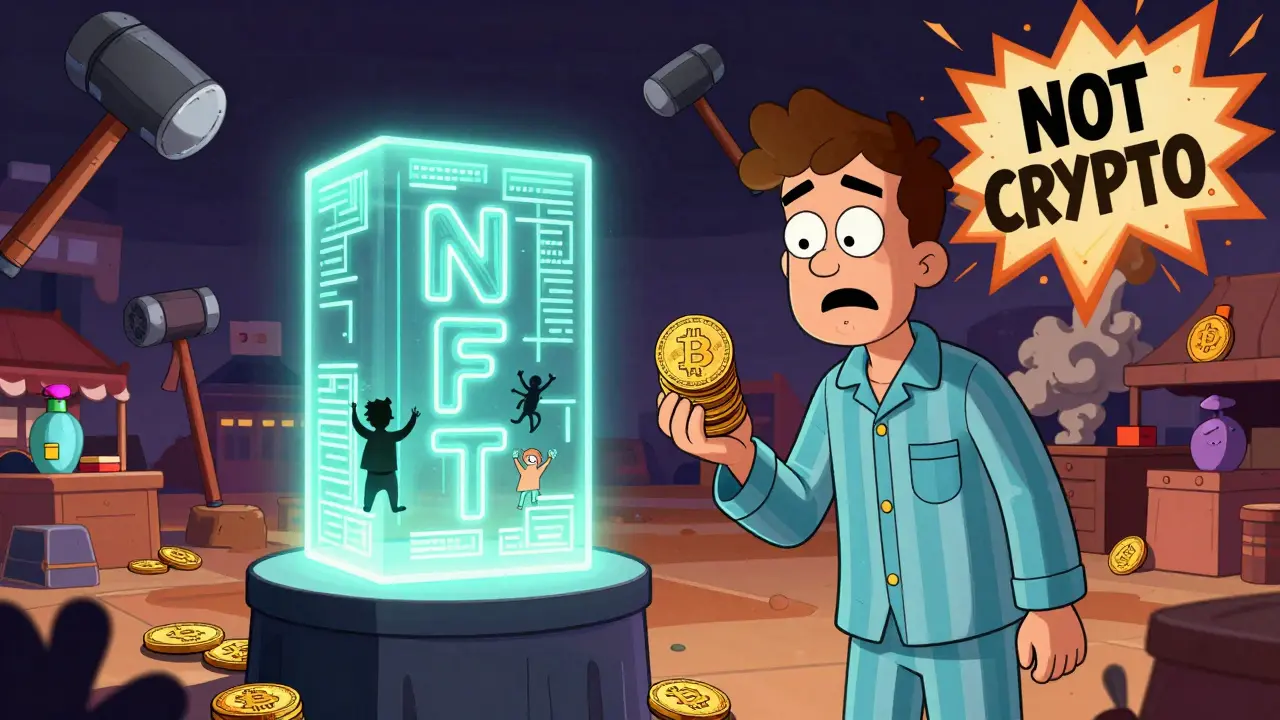
When you buy an NFT, you own the token - not the content. The creator keeps copyright. You can’t legally make prints, sell merchandise, or use the image in a movie. You can display it in your MetaMask wallet or on your profile. That’s it.
Some NFT projects, like those from Yuga Labs (Bored Ape creators), now offer commercial licenses. But those are exceptions. Most NFTs come with no rights beyond ownership of the token. Buyers often don’t realize this until they try to use the art - and get sued.
Liquidity and Marketplaces
Cryptocurrencies trade 24/7 on dozens of exchanges: Coinbase, Binance, Kraken, KuCoin. You can sell Bitcoin in seconds. The market is deep. Billions change hands daily.
NFTs trade on niche platforms: OpenSea, Blur, Magic Eden, Foundation. Liquidity is thin. You might list your NFT for 5 ETH. No one buys it. Three months later, you drop it to 0.5 ETH. Still no takers. Some NFTs never sell. Others flip 10x in a day.
Wash trading is common. Fake bids inflate prices. Chainalysis found 18% of NFT volume in 2022 was fake. That doesn’t happen with Bitcoin. You can’t fake trading volume on a global exchange.
Who Uses Them?
Cryptocurrency users are traders, investors, remittance senders, and developers. In the U.S., 128 million people own crypto, according to Pew Research (2023). People use it to send money overseas for $2 instead of $50. They use it to earn interest on DeFi platforms. They use it as a hedge against inflation.
NFT users are mostly collectors, artists, gamers, and influencers. Artists who couldn’t get gallery space now sell directly to fans. A musician dropped an album as an NFT and earned $400,000 - 80% more than they’d make from streaming. A gamer bought virtual land in Decentraland and later sold it for 3x. These are real stories.
But many NFT buyers are speculators. They buy hoping to flip. When the market cooled in 2022, 90% of NFTs lost value. The average NFT collector lost money.
Regulation and Risk
Cryptocurrencies are increasingly treated like financial assets. The EU’s MiCA law (effective 2024) requires exchanges to follow strict rules. The U.S. SEC treats Bitcoin as a commodity - not a security. That’s clear.
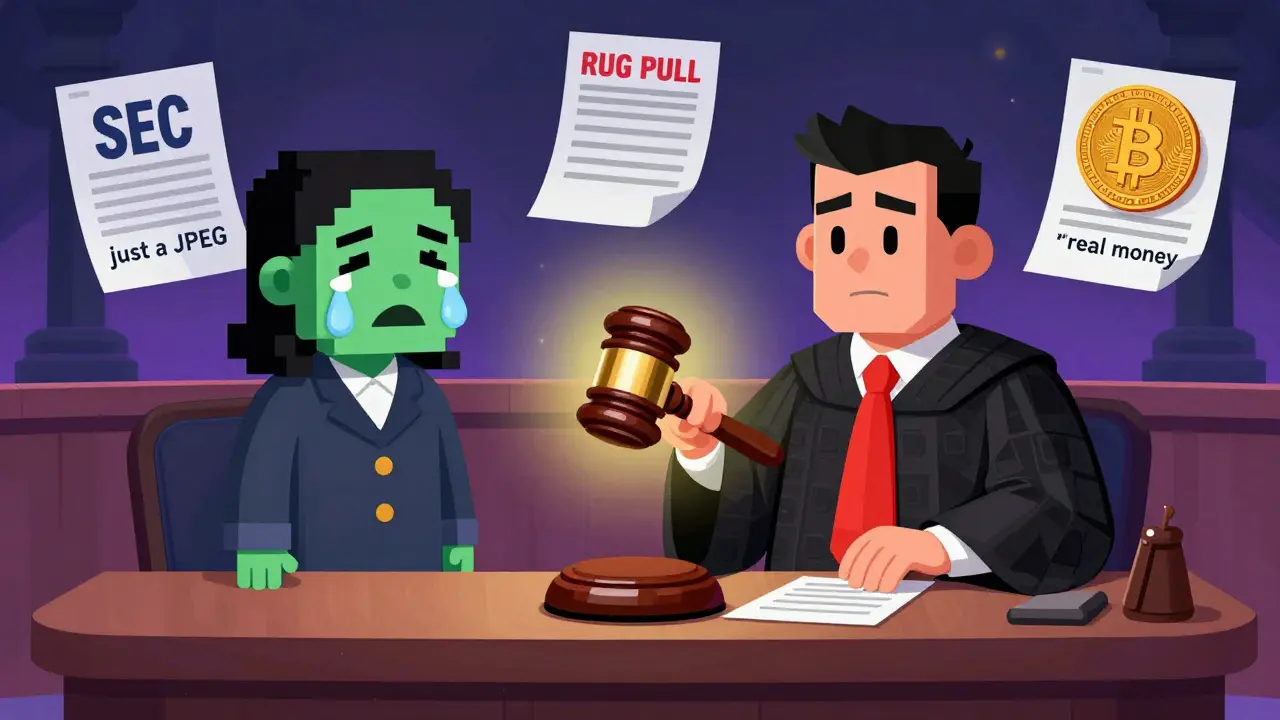
NFTs? They’re in legal gray zones. The SEC says if an NFT acts like an investment - promising profits from others’ work - it’s a security. That’s why some NFT projects got shut down. But most NFTs are sold as collectibles. No one knows how regulators will classify them long-term.
Security risks differ too. Crypto users fear exchange hacks. The Poly Network hack in 2021 stole $600 million. NFT users fear rug pulls - where creators vanish after collecting funds. Or plagiarism - someone mints your art as an NFT and sells it. There’s no customer support. No refund policy.
What’s Next?
Cryptocurrencies are becoming infrastructure. Bitcoin is being added to corporate balance sheets. Ethereum’s energy use dropped 99.95% after the Merge. More banks are offering crypto custody. It’s not going away.
NFTs are evolving beyond art. FIFA sold 3.2 million NFT tickets for the 2022 World Cup. Propy sold a Ukrainian property as an NFT for $22 million. Nike’s .SWOOSH platform made $185 million in 2022 selling digital sneakers. These aren’t gimmicks - they’re use cases.
But NFTs still need to prove they’re more than hype. Will they be used for identity, music rights, or event access? Or will they fade like the pet rock craze? Only time will tell.
Final Takeaway
NFTs and cryptocurrencies aren’t rivals. They’re different tools. Cryptocurrency is money. NFTs are proof of ownership. One lets you pay. The other lets you prove you own something unique.
If you want to send value across borders, use crypto. If you want to own a rare digital collectible, use an NFT. Don’t confuse the two. Don’t buy an NFT thinking you’re investing in a currency. Don’t sell crypto thinking you’re selling art. They’re not the same. And that’s the whole point.
Can an NFT be a cryptocurrency?
No. An NFT is not a cryptocurrency because it’s non-fungible - each one is unique and can’t be exchanged for another. Cryptocurrencies are fungible, meaning each unit is identical and interchangeable. While both use blockchain, their structure and purpose are fundamentally different. Some projects mix the two - like NFTs with embedded crypto rewards - but the NFT itself remains non-fungible.
Are NFTs a good investment?
Most NFTs are not good investments. Unlike cryptocurrencies with measurable demand and use cases, NFT values rely heavily on hype, community, and scarcity. Over 90% of NFTs lost value after the 2021 boom. Only a tiny fraction - like Bored Apes or CryptoPunks - retained value. If you’re buying for profit, you’re gambling. If you’re buying because you love the art, that’s different.
Do I own the copyright if I buy an NFT?
No. Buying an NFT gives you ownership of the token, not the copyright. The original creator usually keeps all rights to reproduce, sell, or license the underlying work. Some projects, like Yuga Labs, offer commercial licenses - but those are rare exceptions. Always check the terms before assuming you own the content.
Why do NFTs cost so much if they’re just digital files?
NFTs cost money because they prove ownership on the blockchain - not because of the file. You can download a JPEG of a Bored Ape for free. But only one person owns the original NFT linked to that image. That ownership has value because it’s verifiable, rare, and often tied to community perks. It’s like owning the original Mona Lisa vs. a poster.
Can I use cryptocurrency to buy NFTs?
Yes. Most NFT marketplaces accept Ethereum (ETH) as payment. Some also accept USDC, SOL, or other tokens. You need a crypto wallet like MetaMask to connect and pay. You’re not buying the NFT with money - you’re swapping crypto for the token. Gas fees on Ethereum can be high, so timing matters.


KingDesigners &Co
NFTs are just digital graffiti with a blockchain receipt. People pay millions for a JPEG they can screenshot. The real value is in the community clout, not the art. I've seen more substance in a meme than in 90% of these NFTs. 😒