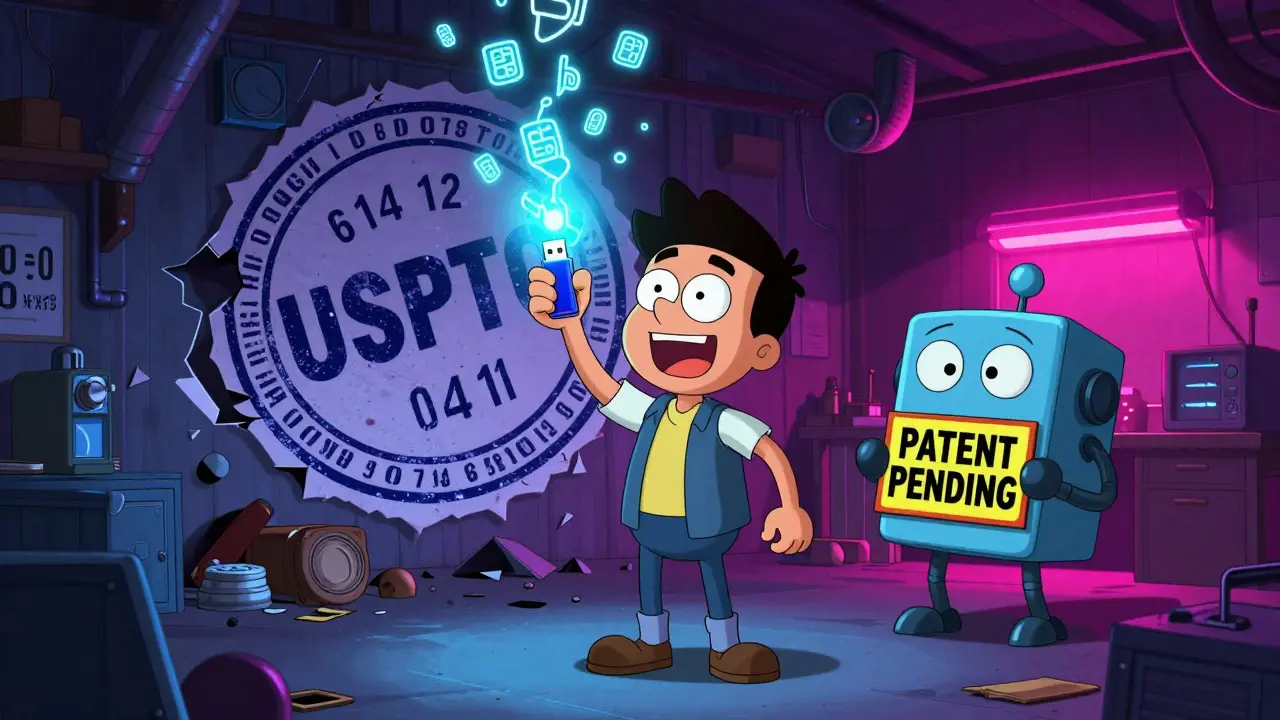
Blockchain Proof of Creation Generator
Enter a description of your invention to generate a blockchain timestamp and hash. This tool demonstrates how blockchain creates tamper-proof proof of creation for your intellectual property.
Blockchain Hash
Timestamp
This is a simulated blockchain proof. In real implementations, this hash would be recorded on a decentralized ledger with cryptographic security. You can use this timestamp as evidence of when you created your invention concept. For legal purposes, consider filing through a recognized patent office.
Imagine you just finished building a new algorithm that automates patent searches using AI. You’re excited - this could save companies thousands of hours. But before you file for a patent, you worry: What if someone else files first? What if the patent office loses your paperwork? What if, five years from now, you can’t prove you created it in January 2025? These aren’t hypotheticals. They’re real problems in today’s patent system.
That’s where blockchain patent management comes in. It’s not science fiction. It’s already being tested by patent offices and tech companies around the world. Instead of relying on paper filings and centralized databases, blockchain creates an unchangeable, time-stamped record of your invention - visible to authorized parties, secure from tampering, and globally accessible.
How Blockchain Solves the Patent System’s Biggest Problems
The current patent process is slow, expensive, and messy. You file with a national office - say, the U.S. Patent and Trademark Office (USPTO). It takes 18-36 months just to get an initial review. During that time, your invention is vulnerable. Competitors can reverse-engineer it. Investors hesitate. Startups run out of cash.
Blockchain fixes this by turning the moment you create something into a verifiable event. When you submit your invention to a blockchain-based system, it’s hashed - turned into a unique string of letters and numbers. That hash is recorded on the blockchain with a timestamp. No one can change it. No central authority controls it. And you don’t need to wait for approval to prove ownership.
For example, a digital artist uploads a design to a blockchain IP platform. The system generates a hash like a7f2b9c1...d8e4 and locks it into a block with the exact time: January 14, 2025, 14:23:07 UTC. That hash becomes proof of creation. Even if the artist never files a formal patent, they have legally defensible evidence of who created it and when.
The European Patent Office saw blockchain-related patent filings jump 220% between 2015 and 2018. That wasn’t random. It was a response to real pain points in innovation.
Smart Contracts: Automating Royalties and Licensing
Patents aren’t just about protection - they’re about money. Licensing, royalties, and usage tracking are often handled manually. Lawyers draft contracts. Accountants track payments. Disputes arise over whether a license was activated or if royalties were paid correctly.
Blockchain introduces smart contracts - self-executing agreements coded directly into the ledger. Let’s say you patent a new type of battery cell. You set up a smart contract that says: “If a manufacturer uses this design in a product sold in the EU, pay $0.50 per unit to the patent holder.”
When that manufacturer ships 10,000 units, the system automatically checks the blockchain for license approval, verifies the sale data from their ERP system, and triggers a payment to your wallet. No invoices. No delays. No disputes. The entire history - who licensed it, when, how much was paid - is permanently recorded.
This isn’t theoretical. Companies like IBM and Sony have filed patents for blockchain-based royalty systems. Startups like IPwe and KODAKOne are already offering platforms where creators can register, license, and track IP using blockchain.
Why Traditional Systems Can’t Keep Up
Patent offices still rely on paper trails, scanned documents, and siloed databases. If you file in the U.S., that record doesn’t automatically exist in Japan or Germany. You need separate filings, separate fees, separate lawyers. The World Intellectual Property Organization (WIPO) estimates that over 70% of small innovators skip international protection because it’s too costly and complex.
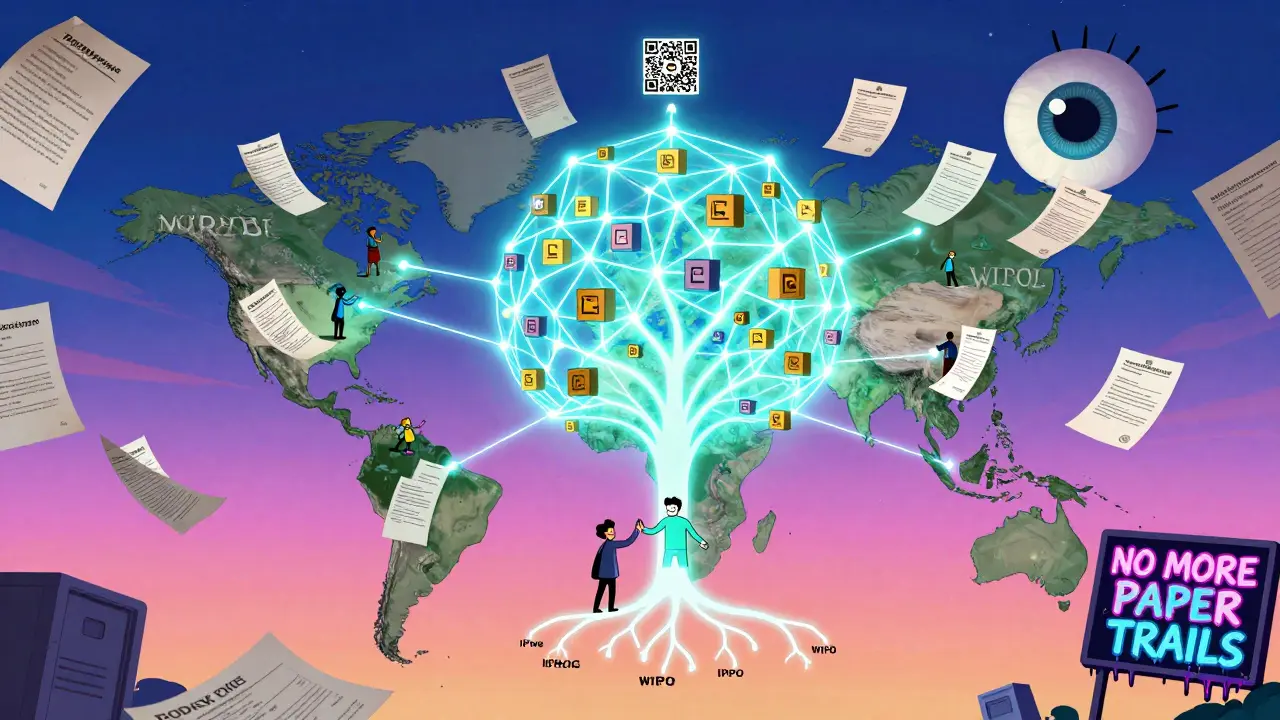
Blockchain removes that barrier. A single entry on a global blockchain network can serve as prima facie evidence across jurisdictions. That’s why WIPO is actively exploring blockchain pilots. It’s not about replacing national offices - it’s about connecting them.
And it’s not just for big tech. A freelance engineer in Nairobi, a biochemist in Brazil, a designer in Seoul - all can now prove ownership without needing a U.S.-based patent attorney. The system levels the playing field.
The Legal Hurdles: Not All Countries Are Ready
Here’s the catch: Blockchain doesn’t automatically make your invention patentable. You still need to meet legal standards - like novelty, non-obviousness, and utility - under laws like 35 U.S.C. §101 in the U.S.
And here’s the bigger problem: courts don’t universally accept blockchain timestamps as legal evidence. A 2022 study in the Berkeley Technology Law Journal found that many judges still don’t understand how blockchain works. They want paper affidavits, not cryptographic hashes.
Some countries, like Estonia and Georgia, have already integrated blockchain into their national registries. Others, including the U.S. and EU, are still debating whether blockchain records qualify as “authentic” under evidence rules. Until legal frameworks catch up, blockchain won’t replace patent offices - but it can strengthen them.
That’s why experts are pushing for legal harmonization. The idea? Create global standards so that a blockchain timestamp in Tokyo is treated the same as one in Toronto. The Standardization and Interoperability Protocol (SIP) is one such framework being discussed by international IP bodies.
Interoperability and Privacy: The Technical Challenges
Blockchain isn’t magic. It has limits.
First, interoperability. Most patent systems today run on legacy software. Connecting them to a blockchain network isn’t plug-and-play. You need APIs, data mapping, and security protocols that don’t exist yet.
Second, privacy. You don’t want your entire invention publicly visible on a blockchain. So how do you prove ownership without revealing the design? The answer: zero-knowledge proofs and encrypted hashes. Only authorized parties - like patent examiners or licensees - can decrypt the details. The public sees only the hash and timestamp.
Third, scalability. The USPTO receives over 600,000 patent applications a year. Can a blockchain handle that volume without slowing down? Private, permissioned blockchains (like Hyperledger Fabric) are being tested for this exact purpose. They’re faster, more efficient, and designed for enterprise use.
What’s Next? The Future of IP on Blockchain
By 2025, we’re seeing real momentum. The USPTO launched a blockchain pilot with MIT to test timestamping for AI-generated inventions. The European Union is funding cross-border IP blockchain projects. China’s State Intellectual Property Office is integrating blockchain into its trademark system.
The next big wave? Merging blockchain with AI and IoT. Imagine a smart factory where every component has a digital twin. Each design, each modification, each upgrade is automatically logged on a blockchain. If a patent dispute arises, you don’t dig through folders - you query the chain.
And it’s not just patents. Trademarks, copyrights, industrial designs - all can benefit. Unregistered rights, like copyright in digital art, become enforceable. Creators who never filed paperwork suddenly have proof.
The goal isn’t to eliminate patent offices. It’s to make them faster, fairer, and more accessible. Blockchain turns IP management from a bureaucratic marathon into a transparent, automated process.
Who Should Care - and Why
If you’re a startup founder, inventor, or designer - this matters. You don’t need to be a tech expert to use it. Platforms are emerging that let you upload your work, click a button, and get a blockchain timestamp in seconds. Cost? Under $50. Time? Under a minute.
If you’re in licensing, legal, or R&D - this changes your workflow. No more chasing down royalty reports. No more guessing who owns what. Everything is traceable.
And if you’re an investor? Blockchain-proven IP is a red flag remover. It reduces risk. It increases confidence. Companies with verified, blockchain-tracked IP portfolios are more attractive - because their assets are real, not just claimed.
The future of innovation isn’t just about creating new things. It’s about protecting them - simply, securely, and globally. Blockchain isn’t the only solution. But it’s the most promising one we have.
Can blockchain replace the patent office entirely?
No. Blockchain doesn’t evaluate whether an invention is novel or non-obvious - that’s still the job of patent examiners. Instead, it acts as a secure, timestamped evidence layer. Think of it like a digital notary that proves when you created something. The patent office still decides if you get the patent, but now they can trust the proof of creation.
Is blockchain patent registration legally binding?
Not yet everywhere. In countries like Estonia and Japan, blockchain timestamps are accepted as legal evidence. In the U.S. and EU, courts are still deciding. But even where it’s not binding, it strengthens your case. A blockchain timestamp is far harder to dispute than an email or dated PDF. Many lawyers now recommend it as a first step before filing.
Do I need to be tech-savvy to use blockchain for patents?
No. Platforms like IPwe, Ascribe, and Proof of Existence let you upload files and get a blockchain hash with a few clicks. You don’t need to understand cryptography, wallets, or mining. It’s like using Dropbox - but with legal proof attached.
Can I patent a blockchain method itself?
Yes - and many companies already have. Patents have been granted for blockchain-based systems that automate IP registration, verify ownership via smart contracts, or link IoT devices to patent records. But the invention must be technical, not just an abstract idea. The USPTO requires a concrete application - like a specific algorithm that reduces patent review time by 40%.
What happens if the blockchain network goes down?
Blockchain networks are designed to be decentralized. There’s no single server to crash. Even if some nodes go offline, others keep the ledger running. Most patent-focused blockchains use private, permissioned networks with multiple trusted nodes - often operated by universities, patent offices, or legal firms. These are more reliable than public blockchains like Bitcoin.
How much does it cost to register a patent on blockchain?
Blockchain timestamping typically costs between $10 and $50 per filing. That’s a fraction of the $5,000-$15,000 it costs to file a U.S. utility patent. Many services offer free trials or low-cost bundles for multiple filings. It’s an affordable first step - especially for startups or independent inventors.




Jessica Eacker
Blockchain timestamping is already saving indie inventors thousands. I filed my AI tool last month for $35 and slept better that night.