Smart contracts are supposed to be trustless, automatic, and unbreakable. But in reality, they’re just code - and like any code, they can have bugs. In 2024 alone, over $3.2 billion was lost to smart contract exploits. These aren’t theoretical risks. Real people lost life savings. Companies collapsed. Entire DeFi protocols froze. The problem isn’t that the technology is broken - it’s that developers keep making the same mistakes.
Access Control Vulnerabilities: The #1 Killer
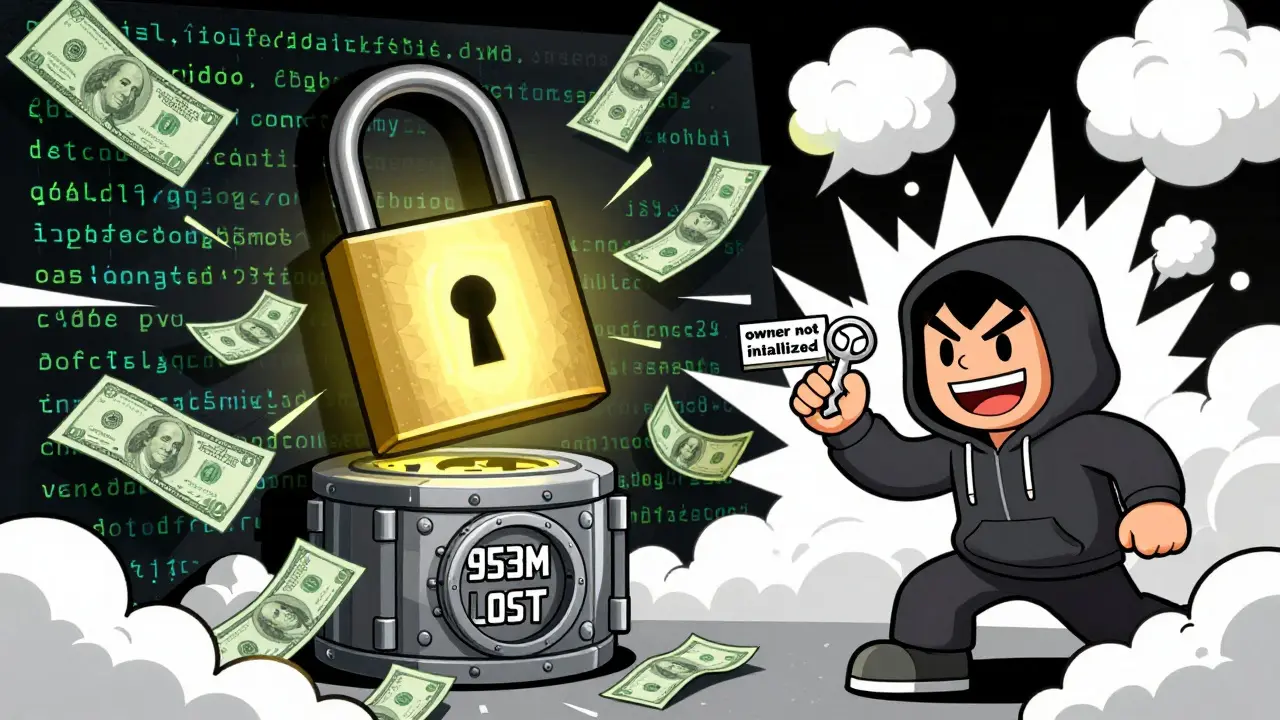
If you think hackers break into systems with fancy tools, think again. Most breaches happen because someone forgot to lock the door. Access control vulnerabilities are the leading cause of smart contract losses, responsible for $953.2 million in damages in 2024. This isn’t some obscure flaw - it’s basic hygiene.
Imagine a contract that lets only the owner change critical settings. Sounds safe? Not if the owner check is written as if(msg.sender == owner) without verifying that the function is even callable by outsiders. Or worse - if the owner variable is never initialized and defaults to address(0). Attackers have used this exact trick to take over contracts, reset ownership, and drain funds.
The 88mph exploit in September 2023 showed how dangerous this can be. Attackers called a function meant to initialize the contract - but it wasn’t protected. They reinitialized it with their own address as owner. That’s it. No complex code. No magic. Just a missing check.
Use OpenZeppelin’s Ownable or AccessControl contracts. Don’t write your own. And always test: if you can call a privileged function without being the owner, you’ve got a problem.
Price Oracle Manipulation: When Data Lies
Smart contracts don’t know the real world. They rely on oracles - third-party services that feed them data like token prices, exchange rates, or interest rates. If that data is wrong, the contract will act on lies.
In 2024, price oracle attacks caused $412.7 million in losses. One common method? Pumping a token’s price on a small DEX, then using that fake price to borrow massive amounts of another asset. The attacker repays the loan with the inflated value and walks away with real money.
The Hundred Finance exploit in August 2024 followed this pattern. A user lost 12.7 ETH because the oracle trusted a single DEX with low liquidity. The price jumped from $3,000 to $12,000 in one block. The contract allowed borrowing based on that number. The attacker drained $18 million before the price crashed.
Solutions? Use multiple data sources. Chainlink’s network pulls from 15+ exchanges. Don’t rely on one. Add time-weighted averages. Require data to be stable over several blocks. And always assume the oracle can be manipulated - because it can.
Reentrancy Attacks: The Classic That Won’t Die
The DAO hack in 2016 was the first major smart contract disaster. It exploited reentrancy: a function calls an external contract, which calls back into the original function before the first call finishes. This creates a loop - and if you’re not careful, you keep paying out money.
Even today, 28 reentrancy attacks happened in 2024. Why? Because developers still write code like this:
function withdraw() public {
    uint amount = balances[msg.sender];
    (bool success, ) = msg.sender.call{value: amount}("");
    balances[msg.sender] = 0;
}
The problem? The external call happens before the balance is updated. The attacker’s contract calls withdraw() again before the balance is zeroed. And again. And again.
Fix it with the Checks-Effects-Interactions pattern:
function withdraw() public {
    uint amount = balances[msg.sender];
    balances[msg.sender] = 0; // Effect first
    (bool success, ) = msg.sender.call{value: amount}(""); // Interaction last
}
Or use OpenZeppelin’s ReentrancyGuard. It’s a one-line fix. Don’t reinvent the wheel.

Unchecked External Calls: The Silent Killer
When you call another contract - whether it’s a token transfer or a lending protocol - you assume it works. But what if it fails? In older Solidity versions, if the call failed, your contract kept going. That’s dangerous.
In 2024, unchecked external calls caused $93.5 million in losses. One example: a staking contract that called a token’s transfer function without checking if it succeeded. The token contract had a bug and returned false. The user’s staked tokens vanished - but the contract still credited them with rewards. The attacker exploited this to mint fake rewards and cash out.
Solidity 0.8.0 fixed this by making external calls throw an error on failure. But many contracts still run on older code. And even with 0.8+, developers sometimes use call with ignore return value - which is just as bad.
Always check the return value:
(bool success, ) = token.transfer(address(this), amount);
require(success, "Transfer failed");
And avoid call for token transfers. Use transfer or transferFrom from ERC-20 interfaces. They’re safer.
Flash Loan Attacks: Not a Bug, But a Weapon
Flash loans let you borrow any amount of crypto - with no collateral - as long as you pay it back in the same transaction. It’s a feature, not a flaw. But attackers turned it into a weapon.
In 2024, flash loan attacks caused $382.1 million in losses. Here’s how it works:
- Take a $10 million flash loan.
- Use it to buy up all the liquidity of a token on a small DEX.
- The price skyrockets.
- Call a DeFi protocol that uses that price to calculate collateral.
- Borrow millions based on the fake price.
- Sell the borrowed assets.
- Pay back the flash loan.
- Keep the profit.
Aave alone had 19 flash loan exploits in 2024. The attacks weren’t against Aave’s code - they were against the protocols that trusted Aave’s price feeds.
You can’t stop flash loans. But you can defend against them:
- Use price feeds that average over time - not just the latest price.
- Require minimum liquidity thresholds before accepting a price.
- Delay critical actions - don’t let a loan be taken and repaid in one block.

Integer Overflow and Underflow: The Problem That Got Fixed
In 2018, a bug called integer overflow caused the $32 million BeautyChain exploit. A user could multiply their balance by a huge number and create infinite tokens.
Thankfully, Solidity 0.8.0 (released in July 2021) made overflow and underflow checks automatic. Now, if you try to add 1 to the maximum uint256 value, the transaction reverts.
So why did $28.4 million still get lost in 2024? Because old contracts still run. Many DeFi protocols haven’t upgraded. Legacy code is a ticking bomb.
If you’re maintaining an old contract - upgrade it. If you’re auditing one - flag it. Use Slither or Mythril to scan for unchecked arithmetic. Even if you’re on 0.8+, avoid unchecked blocks unless you’re 100% sure.
What You Can Do Right Now
Smart contract security isn’t about being a genius. It’s about being disciplined.
- Use OpenZeppelin. Don’t write your own access control, token transfers, or reentrancy guards. They’ve been battle-tested.
- Test everything. Use Foundry or Hardhat to simulate attacks. Try to break your contract before anyone else does.
- Audit before launch. 89% of new DeFi projects now do formal audits. You should too. Even a $10,000 audit beats losing $10 million.
- Update your compiler. Solidity 0.8.30 (released May 2025) adds automatic checks for unchecked external calls. Use it.
- Monitor the OWASP Top 10. It’s updated every year. Read it. Share it. Follow it.
Security isn’t a feature. It’s the foundation. Skip it, and you’re not building the future - you’re building a target.
What’s the most dangerous smart contract vulnerability in 2025?
Access Control Vulnerabilities are the most dangerous in 2025, responsible for over $950 million in losses. They’re also the easiest to fix - yet most developers ignore them. A missing owner check or unguarded function can let attackers take full control of a contract. This isn’t a complex exploit - it’s a basic oversight.
Can smart contracts be hacked even if they’re on Ethereum?
Yes. Ethereum’s network is secure, but smart contracts are code written by humans - and humans make mistakes. The blockchain doesn’t care if your contract has a logic error. It executes it exactly as written. That’s why audits, testing, and using trusted libraries like OpenZeppelin are critical.
Are flash loans illegal?
No, flash loans aren’t illegal. They’re a legitimate DeFi feature that allows borrowing without collateral, as long as the loan is repaid in the same transaction. But attackers abuse them to manipulate prices and drain funds. The issue isn’t the flash loan - it’s how protocols respond to price data. Defenses like time-weighted averages and liquidity thresholds are the real solution.
Why do so many smart contracts still use old Solidity versions?
Many were deployed before Solidity 0.8.0 (July 2021) and haven’t been upgraded. Updating requires re-auditing, re-deploying, and sometimes migrating user funds - which is costly and risky. Legacy contracts are the biggest source of exploits today. Always check the compiler version before interacting with a contract.
Do audits guarantee a smart contract is safe?
No. Audits reduce risk, but they don’t eliminate it. Even top firms like OpenZeppelin and Trail of Bits miss things. A contract can pass an audit and still be vulnerable to new attack patterns. Audits should be part of a broader strategy: automated testing, formal verification, and ongoing monitoring. Treat them as a checkpoint, not a finish line.






Gaurav Mathur
Access control is all you need to fix. No fancy tools. No magic. Just check if owner is set. If not, you're hacked. Simple. Done. Stop overcomplicating.
Use OpenZeppelin. Or don't. But don't blame the code when you forgot to lock the door.