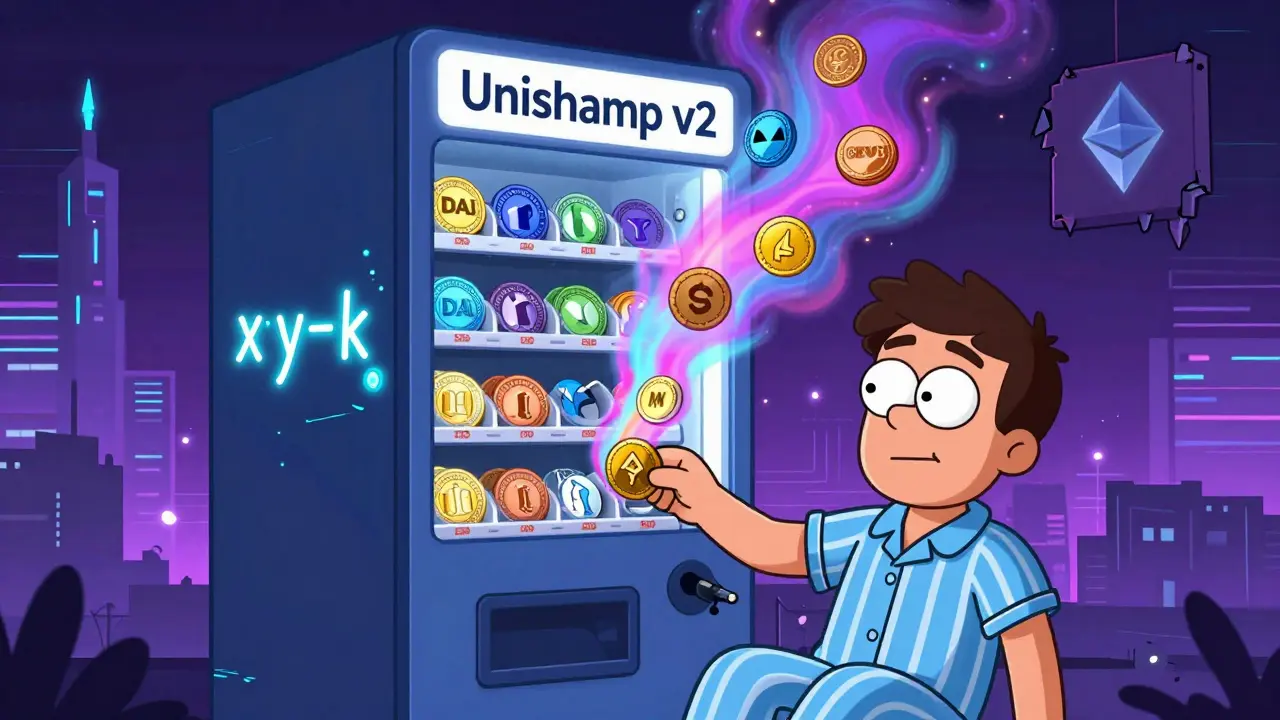
Uniswap v2 isn't the newest kid on the block anymore. Launched in May 2020, it was the version that made decentralized trading actually usable for millions. Today, in March 2026, most of the action has moved to Uniswap v3. But that doesn't mean v2 is dead. In fact, if you're trading obscure tokens, dealing with low liquidity, or just want a simple, no-frills way to swap crypto, v2 is still one of the most reliable tools you can use.
Here's the truth: Uniswap v2 works because it's stupidly simple. No sign-up. No KYC. No middleman. You connect your wallet-usually MetaMask-and swap one token for another directly on the Ethereum blockchain. The whole system runs on smart contracts that automatically match trades using a formula called x*y=k. Think of it like a vending machine for crypto: you put in Token A, and it spits out Token B based on how much of each is already in the machine. That’s it.
How Uniswap v2 Changed Everything
Before v2, you could only trade ETH for other tokens. That meant if you wanted to swap DAI for LINK, you had to do two trades: DAI to ETH, then ETH to LINK. Uniswap v2 removed that middle step. It let any ERC-20 token trade directly with any other ERC-20 token. Suddenly, hundreds of new tokens could get liquidity overnight. By the end of 2020, over 80% of all new tokens launched their first liquidity pool on v2. That’s not a coincidence-it was the only game in town.
It also introduced flash swaps. This sounds fancy, but it’s just a way to borrow tokens without putting up any money upfront-as long as you pay them back in the same transaction. It’s used mostly by arbitrage bots and advanced traders, but it’s a big reason why v2 became so powerful. And then there’s the price oracle. For the first time, DeFi protocols could reliably check what a token’s price was over the last 288 blocks (about 1 hour). That made lending, borrowing, and derivatives way safer.
What You Get: Pros of Uniswap v2
- Zero downtime: Since its launch, v2 has never gone offline. Not during the 2021 bull run, not during the 2022 crash, not even when Ethereum gas fees hit $500. That kind of reliability is rare in crypto.
- Simple interface: If you’ve used it once, you know how to use it. No confusing sliders, no concentrated liquidity zones, no liquidity range settings. Just pick a token, enter the amount, and click swap.
- Works with everything: MetaMask, Trust Wallet, Ledger, WalletConnect-v2 talks to all of them. It’s the most compatible DEX out there.
- Low-liquidity token haven: If a token has less than $500,000 in total value locked, chances are it’s trading on v2. V3’s concentrated liquidity model doesn’t work well for these tokens. v2 handles them effortlessly.
- Proven security: The core contracts haven’t changed since 2020. They’ve been audited, attacked, and stress-tested. In January 2025, ConsenSys’s DeFi lead said: “Over 95% of v2’s smart contracts remain unaudited yet uncompromised.” That’s a strong vote of confidence.
What You Lose: Cons of Uniswap v2
- Gas fees are brutal: Each swap uses about 110,000 gas. On a normal day, that’s $2-$5. During peak congestion, it can jump to $15 or more. If you’re swapping $50, and $10 goes to gas? That’s not worth it. That’s why most retail users avoid v2 for small trades.
- Capital inefficiency: If you add $10,000 to a liquidity pool on v2, you’re probably only using $1,500-$2,000 of it at any given time. The rest sits idle. v3 fixes this by letting you concentrate your liquidity within a price range. That’s why v3 has 4,000x better capital efficiency in stablecoin pairs.
- Slippage risk: If a token’s pool has less than $1 million in liquidity, even a $1,000 trade can move the price by 5% or more. During the SVB collapse in March 2023, over 20% of v2 pools saw slippage above 5%. You can set a slippage tolerance, but if you set it too high, you risk getting ripped off by a honeypot token.
- No yield farming: v2 doesn’t offer incentives like SushiSwap or Curve. Liquidity providers earn only the 0.3% trading fee. That’s why most LPs moved to v3 or other protocols in 2021.
Uniswap v2 vs. v3: The Real Difference
It’s not about which one is better. It’s about which one fits your use case.
Uniswap v3, launched in May 2021, lets you choose a price range for your liquidity. If you think ETH will trade between $3,000 and $3,500, you put all your money in that range. That means more fees per dollar invested. It’s brilliant-if you know what you’re doing. But if you’re just swapping a new token you found on Twitter? v3’s interface is overwhelming. You can accidentally lock your funds outside the price range and lose fees for weeks.
Today, v3 handles 58% of Uniswap’s volume. v2? Just 12%. But here’s the twist: v2 still has $1.84 billion locked in its pools. That’s not a glitch. That’s intentional. It’s the backbone for tokens that v3 can’t support.
Take the ApeChain token launch in July 2024. The team wanted to avoid the complexity of v3’s range settings. So 73% of the initial liquidity went into v2 pools. Why? Because the users were new, the token was obscure, and the team didn’t want to risk mistakes. v2 made that possible.
Who Should Still Use Uniswap v2 in 2026?
Not everyone. But if you fall into one of these groups, v2 is still your best friend:
- New crypto users: If you’re just learning how to swap tokens, v2’s interface is easier. No ranges. No warnings. Just swap.
- Traders of low-volume tokens: If you’re buying a token with under $1 million in TVL, v2 is where the liquidity is. v3 pools for these tokens are often empty.
- Users in emerging markets: In Southeast Asia, v2 accounts for 31% of all DeFi activity. Why? Simplicity. People don’t want to manage price ranges-they just want to send and receive crypto.
- Developers and auditors: Many DeFi protocols still use v2 as a fallback. It’s the most battle-tested AMM in existence.
How to Use Uniswap v2 (Step by Step)
You don’t need to be a coder. Here’s how to do it:
- Install MetaMask (or another Ethereum wallet) and fund it with ETH for gas.
- Go to app.uniswap.org and connect your wallet.
- Click "Swap" and select the token you want to trade from and to.
- Enter the amount. The interface will show you the estimated output and slippage.
- Set your slippage tolerance. For stablecoins, 0.5% is fine. For volatile tokens, 3-5% is common.
- Click "Swap" and approve the token transfer (this is a separate transaction).
- Confirm the swap in your wallet. Wait for the transaction to mine.
That’s it. No registration. No waiting. No approval from anyone.
Common Problems and How to Fix Them
- Transaction failed: Usually because gas was too low. Use Etherscan’s gas tracker to see current prices. Set your gas limit to 250,000 to be safe.
- Slippage too high: This means the token’s pool is shallow. Try a different pair, or wait for less volatility.
- Lost funds: If you added liquidity and can’t find your tokens, you might have set the wrong price range (this is rare on v2). Check your wallet’s token holdings. If they’re not there, you may have sent to a fake contract. Always double-check the contract address.
- High gas fees: Wait for off-peak hours (usually 2-4 AM UTC). Or use a Layer 2 like Arbitrum for cheaper swaps.
Is Uniswap v2 Safe?
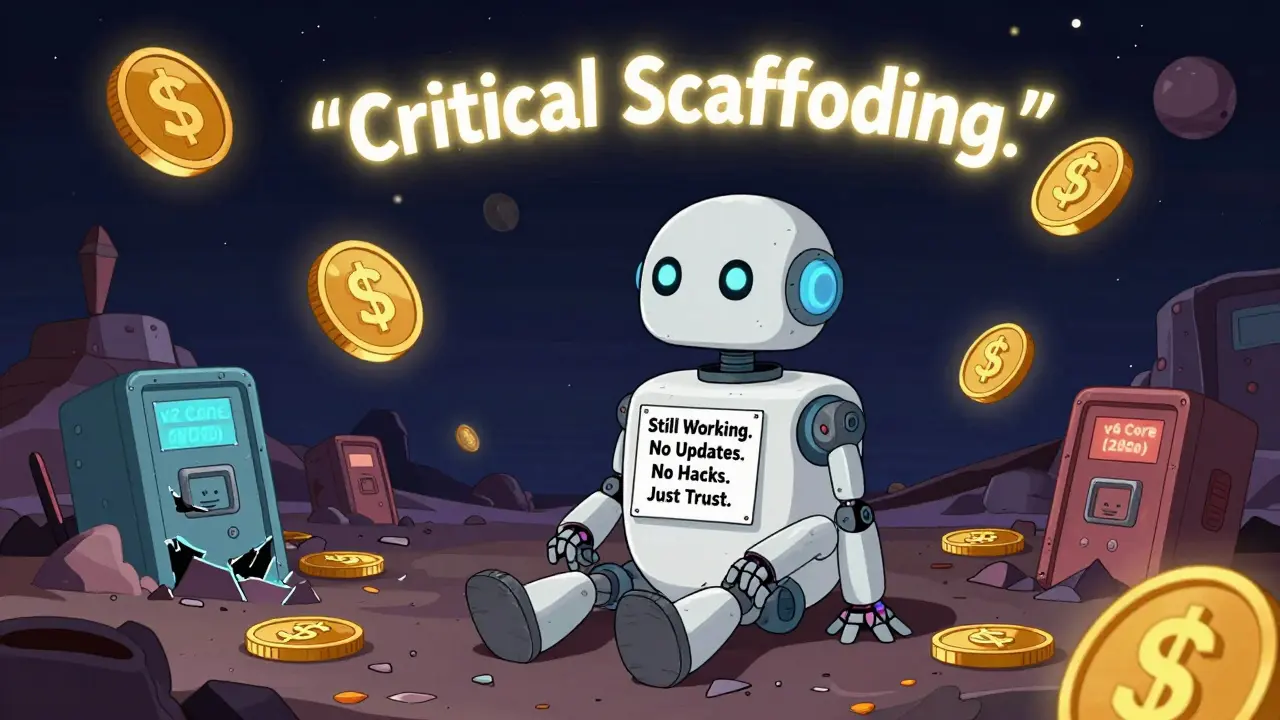
Yes, but not because it’s perfect. It’s safe because it’s been tested like nothing else. There have been no major exploits on the core v2 contracts. No hacks. No rug pulls. The code hasn’t changed since 2020. That’s rare in crypto.
But safety doesn’t mean foolproof. You can still get scammed. If you swap for a token with no liquidity, no team, and no audit? That’s on you. v2 doesn’t vet tokens. It doesn’t care. It just executes trades. Always check the token’s contract address. Look for verified contracts on Etherscan. Avoid tokens with names like "DogCoin" or "MoonLaser"-those are red flags.
The Future of Uniswap v2
Uniswap Labs isn’t building new features for v2. That ship has sailed. But they’re not shutting it down either. In January 2025, the protocol approved a $2.5 million fund to keep v2 running through 2027. Why? Because it still serves a purpose.
Ethereum’s core developer Tim Beiko said it best: “v2’s battle-tested security makes it a critical component of Ethereum’s DeFi scaffolding likely to persist for a decade.”
It won’t be the future. But it’s still part of the present. And for a lot of people-especially those trading niche tokens or just learning how DeFi works-it’s the best option available.
Is Uniswap v2 still operational in 2026?
Yes, Uniswap v2 is fully operational as of March 2026. Although most trading volume has moved to Uniswap v3, v2 continues to process trades, support liquidity pools, and handle over $1.8 billion in total value locked. The protocol’s core smart contracts remain unchanged and have not been compromised since launch.
Can I still provide liquidity on Uniswap v2?
Yes, you can still add liquidity to v2 pools. However, it’s not as capital-efficient as v3. If you’re providing liquidity for stablecoin pairs or high-volume tokens, v3 is better. But for low-liquidity tokens under $500,000 TVL, v2 remains the most practical option because v3’s range-based model doesn’t work well with shallow pools.
Why are gas fees so high on Uniswap v2?
Uniswap v2 transactions require about 110,000 gas units per swap, which is significantly higher than v3’s optimized contracts. During periods of high Ethereum network congestion, gas prices can spike, making single swaps cost $10-$15. This is one of the main reasons users migrated to v3 and Layer 2 networks like Arbitrum and Optimism.
Is Uniswap v2 safer than centralized exchanges?
Yes, in terms of custody. Unlike centralized exchanges, Uniswap v2 doesn’t hold your funds. You retain control of your private keys at all times. There’s no risk of exchange bankruptcy or hacking of a central server. However, you’re still responsible for avoiding scams, checking contract addresses, and managing your own gas fees.
What’s the difference between Uniswap v2 and v3?
Uniswap v2 uses a uniform liquidity model-your funds are spread evenly across all price ranges. v3 introduced concentrated liquidity, letting you choose a price range where your funds work. This makes v3 up to 4,000x more capital-efficient for stablecoins, but far more complex. v2 is simpler and better for beginners and low-volume tokens.
Should I use Uniswap v2 or v3 for trading new tokens?
For newly launched tokens with under $1 million in liquidity, v2 is usually the better choice. Most new tokens don’t have enough volume to justify v3’s range settings, and v2 pools are more likely to have active liquidity. v3 is better for established tokens like ETH, USDC, or DAI where you can precisely target price ranges.



manoj kumar
Honestly, v2 is still the only DEX I use for weird tokens. v3 is overengineered nonsense. If you can't figure out how to swap without a PhD in DeFi, maybe you shouldn't be trading at all.
Also, gas fees? Yeah, they suck. But I just wait until 3 AM UTC. It's not that hard.