
Most crypto investors know the pain of inflationary tokens. You farm yields, but the reward token keeps getting minted, driving its price down just as you try to sell. cVault.finance was built specifically to solve this exact problem. It introduces a governance token called a non-inflationary, deflationary asset designed for autonomous yield farming and permanent liquidity locking. Launched on the Ethereum mainnet in September 2020, the protocol aims to create a stable ecosystem where liquidity never leaves the pool, theoretically establishing a hard price floor for the token.
If you are looking at CORE Coin today, you might be confused by conflicting data across different exchanges. Some show a market cap of zero, while others list it in the tens of millions. This guide breaks down what CORE actually is, how its unique economic model works, and why it remains a niche but interesting project in the current DeFi landscape.
Key Takeaways
- CORE has a fixed total supply of exactly 10,000 tokens, making it highly scarce compared to typical DeFi assets.
- The protocol uses a 1% transfer fee that rewards liquidity providers, creating a deflationary pressure rather than inflationary emissions.
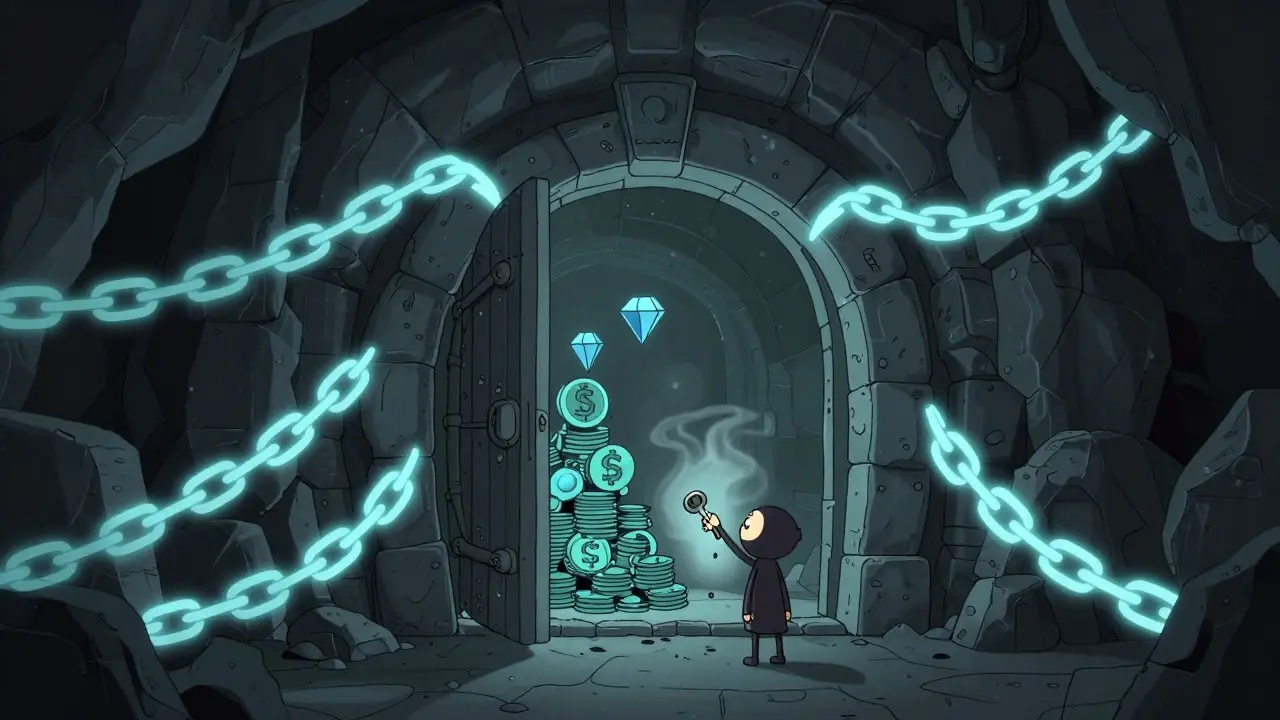
- Liquidity provided to cVault pools is permanently locked; users can stake and unstake LP tokens but cannot withdraw the underlying ETH or other assets.
- Governance is fully decentralized, with holders voting on which yield strategies go live.
- As of mid-2026, trading volume is very low, indicating it is a niche asset rather than a mainstream blue-chip DeFi token.
Understanding the Core Protocol Mechanics
To understand why CORE exists, you have to look at the flaws in traditional yield farming. Most protocols like Uniswap or Curve rely on incentive emissions. They print new tokens every block to attract liquidity. This creates a race to the bottom where farmers dump their rewards immediately, suppressing the token price. cVault.finance flips this model on its head.
The system relies on three main pillars:
- Fixed Supply: There are only 10,000 CORE tokens ever. No more will be minted. This mirrors the scarcity of Bitcoin but applied to a utility/governance context.
- Deflationary Fees: Every time you transfer CORE, a 1% fee is taken. This fee isn't burned entirely; 7% goes to the development team, and the rest goes to liquidity providers. This means holding and using the token benefits those keeping the market liquid.
- Locked Liquidity: When you provide liquidity to the core pools (ETH, BTC, DAI), you receive CORE-LP tokens. You can stake these to earn rewards. However, you cannot redeem these LP tokens back into your original assets. The liquidity stays in the pool forever.
This design attempts to eliminate "mercenary capital." In normal DeFi, liquidity providers leave when the rewards stop. In cVault, the liquidity is structurally permanent, which the team claims creates a robust price floor because there is always deep liquidity available to catch falling prices.
Tokenomics and Market Data Analysis
Looking at the numbers can be tricky because data aggregators handle thin-liquidity assets differently. As of August 2026, the fully diluted valuation (FDV) of CORE hovers around $46 million, based on a price point near $4,600 per token. However, reported market caps vary wildly.
| Platform | Reported Price | 24h Volume | Circulating Supply Status |
|---|---|---|---|
| Coingecko | $4,632.74 | $3.71 | Listed as 10,000 (FDV based) |
| Binance | $9,020.66 | $0 | 0 (Data gap) |
| Coinbase | $6,753.50 | N/A | 0 (Data gap) |
| Livecoinwatch | $5,932.52 | Low | Ranked #6227 by Market Cap |
The discrepancy in circulating supply is a known issue with small-cap ERC-20 tokens. Some databases fail to track the actual holder distribution, defaulting to zero, which results in a calculated market cap of $0. Others use the fully diluted value, giving a more realistic picture of the asset's theoretical worth. The extremely low trading volume-often single-digit dollars in 24-hour periods-highlights that CORE is not a high-frequency trading asset. It is held long-term by a dedicated group of DeFi enthusiasts who believe in the structural integrity of the lock-up mechanism.
How Yield Farming Works in cVault
Getting started with cVault.finance requires standard Ethereum tools: a wallet like MetaMask and some ETH for gas fees. The interface includes a feature called the "CORE Router," which simplifies the process significantly. Instead of manually swapping ETH for LP tokens and then staking them in two separate transactions, you can do it in one click.
Here is the typical flow for a user:
- Navigate to the "Farm" tab on the cVault interface.
- Select the amount of ETH you want to deploy.
- Click "Buy LP and Stake with One Click."
- Confirm the transaction in your wallet.
Once staked, your LP tokens generate CORE rewards. During the initial launch phase in late 2020, annual percentage yields (APYs) were reported as high as 950%. While those figures have likely normalized or changed due to lower overall activity, the structure remains the same. You earn CORE by providing liquidity. Since the underlying liquidity is locked, your exit strategy depends entirely on the secondary market for CORE or the LP tokens themselves, if they are tradable on Uniswap. This is a critical risk factor: you are betting on the long-term viability of the protocol rather than having a quick exit route.
Governance and Strategy Execution
CORE is primarily a governance token. Holders vote on which "strategy contracts" should be activated. These strategies are automated scripts that move capital around to find the best yields. For example, a strategy might automatically swap idle ETH into a higher-yielding lending pool and then revert it back later.
This approach draws comparisons to Yearn Finance (YFI), another governance-heavy DeFi protocol. However, YFI has a supply of 30,000 tokens, whereas CORE’s 10,000 supply makes it even more concentrated. The project markets itself as having "the strongest and most involved governance in DeFi." In practice, this means that significant changes to the protocol-such as adding a new asset pool or changing fee structures-require active participation from token holders. If engagement drops, the protocol may stagnate, which is a common challenge for small-governance ecosystems.

Risks and Considerations for Investors
Before investing in CORE, you need to weigh the innovative mechanics against the practical risks.
- Liquidity Lock Risk: Your capital is stuck in the pools. If the protocol fails or smart contract bugs emerge, recovering funds could be difficult or impossible without a successful governance vote to unlock liquidity.
- Thin Trading Volume: With daily volumes often under $10, selling large positions of CORE can cause significant slippage. It is an illiquid asset.
- Name Confusion: There is another cryptocurrency also called CORE, associated with the Core blockchain (focused on Bitcoin staking). Always check the contract address (
0x62359Ed7505Efc61FF1D56fEF82158CcaffA23D7) to ensure you are buying the correct token on Ethereum. - Pseudonymous Team: The founding team remains anonymous. While common in crypto, it adds a layer of trust risk regarding long-term maintenance and security audits.
The deflationary design is compelling for those who hate inflationary emissions, but it comes at the cost of flexibility. You are essentially choosing stability and scarcity over liquidity and ease of exit.
Frequently Asked Questions
Is cVault.finance (CORE) the same as the Core blockchain token?
No. cVault.finance's CORE is an ERC-20 token on the Ethereum network focused on DeFi yield farming. The Core blockchain's CORE is a native token used for Bitcoin staking yields. They are completely unrelated projects that happen to share the same ticker symbol.
Can I withdraw my liquidity from cVault pools?
Not directly. Once you provide liquidity, you receive CORE-LP tokens. You can stake or trade these LP tokens, but you cannot burn them to get back your original ETH or other assets. The liquidity is designed to be permanent.
What is the total supply of CORE tokens?
The total supply is fixed at 10,000 CORE. No additional tokens will ever be minted, making it a strictly non-inflationary asset.
Where can I buy CORE tokens?
CORE is primarily traded on decentralized exchanges like Uniswap V2. It has had secondary listings on platforms like Bilaxy and Hotbit, but liquidity is very low. Always verify the contract address before purchasing.
Does CORE have a price floor?
The project claims that the combination of locked liquidity and transfer fees creates a structural price floor. However, this is a theoretical benefit dependent on the health of the Uniswap pairs and continued community support. It is not a guaranteed financial instrument protection.





OLIVER CHRISTIAN
Great breakdown of the mechanics. The fixed supply is a bold move, but the real test is whether the governance stays active enough to keep strategies relevant without burning out the core holders.