
You see the name GPU AI Rich and think, "Finally, a crypto project that actually uses graphics cards for artificial intelligence." You expect whitepapers about neural networks, server farms, and real-world utility. But here is the twist: RICH is primarily a meme coin. It launched on Pump.fun, a platform known for rapid, community-driven token launches on Solana. While it markets itself as a solution for renting GPU resources, its current reality is driven by social hype, not server uptime. If you are wondering whether this token has legs or if it is just another fleeting trend in the Solana ecosystem, you need to look past the buzzwords.
This article breaks down exactly what RICH is, where it trades, and why its price chart looks like a rollercoaster with no brakes. We will separate the marketing fluff from the on-chain facts so you can decide if this fits your risk appetite.
The Core Identity: Meme Coin Disguised as Tech Utility
Let’s clear up the confusion immediately. GPU AI Rich (RICH) is a cryptocurrency token operating on the Solana blockchain. Technically, it is an SPL token, which is Solana’s standard for fungible tokens, similar to ERC-20 on Ethereum. The project claims to facilitate the rental and lending of GPU resources. This makes sense conceptually-AI needs GPUs, and many people have idle gaming PCs that could be used for computation.
However, most data aggregators classify RICH strictly as a meme coin. Why? Because there is little public evidence of a functioning marketplace where users are actively renting out their NVIDIA RTX 4090s using RICH tokens. Instead, the value proposition relies heavily on community engagement. The project emphasizes being "fair-launched," meaning there was no pre-sale for venture capitalists. Everyone, including the developers, bought in at the same time through the Pump.fun interface. This structure appeals to retail traders who hate seeing insiders dump on them, but it also means the project lacks the deep pockets needed for heavy technical development.
How RICH Was Launched on Pump.fun
To understand RICH, you must understand Pump.fun. Launched in early 2024, this platform allows anyone to create a Solana token instantly without writing code. The bonding curve mechanism ensures that the initial supply is distributed fairly among early buyers until a certain market cap threshold is reached, after which liquidity is migrated to decentralized exchanges like Raydium.
- No VC Funding: Traditional crypto projects raise millions before launching. RICH did not. Its capital came directly from retail wallets.
- Instant Liquidity: Once the bonding curve completed, trading moved to open markets. This created immediate volatility.
- Community Governance: Decisions are theoretically made by holders, though in practice, large whales often sway sentiment more than democratic voting.
This launch model explains the extreme price action we will discuss later. When a token starts with zero institutional backing, its price is purely a reflection of social momentum. If Twitter chatter dies, the price usually follows suit within hours.
Tokenomics: Supply and Scarcity
Numbers don’t lie, but they can be confusing when sources disagree. Here is the breakdown of RICH’s supply structure based on current on-chain data and major trackers.
| Metric | Value / Status | Implication |
|---|---|---|
| Blockchain | Solana | Fast transactions, low fees, high throughput. |
| Total Supply | ~1 Billion Tokens | Capped supply creates theoretical scarcity, but only if demand rises. |
| Circulating Supply | ~969 Million - 999 Million | Nearly all tokens are already in circulation. No massive future unlocks to crash the price. |
| Contract Address | GRQfnw...Xnpump | Verify this address on Solscan to avoid fake clones. |
| Launch Type | Fair Launch (Pump.fun) | Equitable distribution, but susceptible to pump-and-dump dynamics. |
The fact that nearly 1 billion tokens are already circulating is crucial. In many altcoins, new tokens are released monthly, diluting existing holders. With RICH, the dilution phase is largely over. The price movement now depends entirely on net buying pressure versus selling pressure. There is no "team vesting" schedule hanging over the market, which is a positive for long-term holders, provided the community stays active.

Price History and Volatility Analysis
If you looked at RICH in January 2025, you might have seen it trading near its all-time high (ATH) of $0.02628. Fast forward to March 2026, and the price hovered around $0.0000483 according to some trackers, while others reported slightly higher figures due to exchange discrepancies. That is a decline of roughly 99.8%.
Why such a massive drop? Two main reasons:
- Meme Coin Lifecycle: Most Pump.fun tokens peak within days or weeks of launch. Early buyers take profits aggressively. Without continuous marketing spend, volume dries up.
- Lack of Product Delivery: The promise of "GPU Rental" remained largely conceptual. Users didn’t see a working app connecting their GPUs to AI clients, leading to disillusionment.
As of late 2025 and into 2026, RICH ranked low in market cap lists, often sitting below rank #5,000 globally. This places it in the "micro-cap" category. Trading these coins requires caution because bid-ask spreads can be wide, and slippage during large buys or sells can eat into your returns.
Where to Buy and Trade RICH
Despite its small size, RICH maintains decent accessibility. You won’t find it on Coinbase or Binance yet, but it is listed on several mid-tier centralized exchanges (CEXs) and decentralized exchanges (DEXs).
- Bybit: Offers spot trading pairs. Requires KYC Level 1 verification.
- MEXC Global: Known for listing micro-caps quickly. Good for finding lower liquidity assets.
- HTX (formerly Huobi): Another CEX option for fiat-to-crypto entry.
- Crypto.com: Provides tracking and limited trading interfaces.
- Raydium/Jupiter: For those preferring DEX trading directly from a Solana wallet like Phantom or Solflare.
When buying on Bybit or MEXC, use limit orders rather than market orders if possible. Given the thin order books typical of micro-caps, a market buy could spike the price against you temporarily.
The Reality Check: Is the GPU Utility Real?
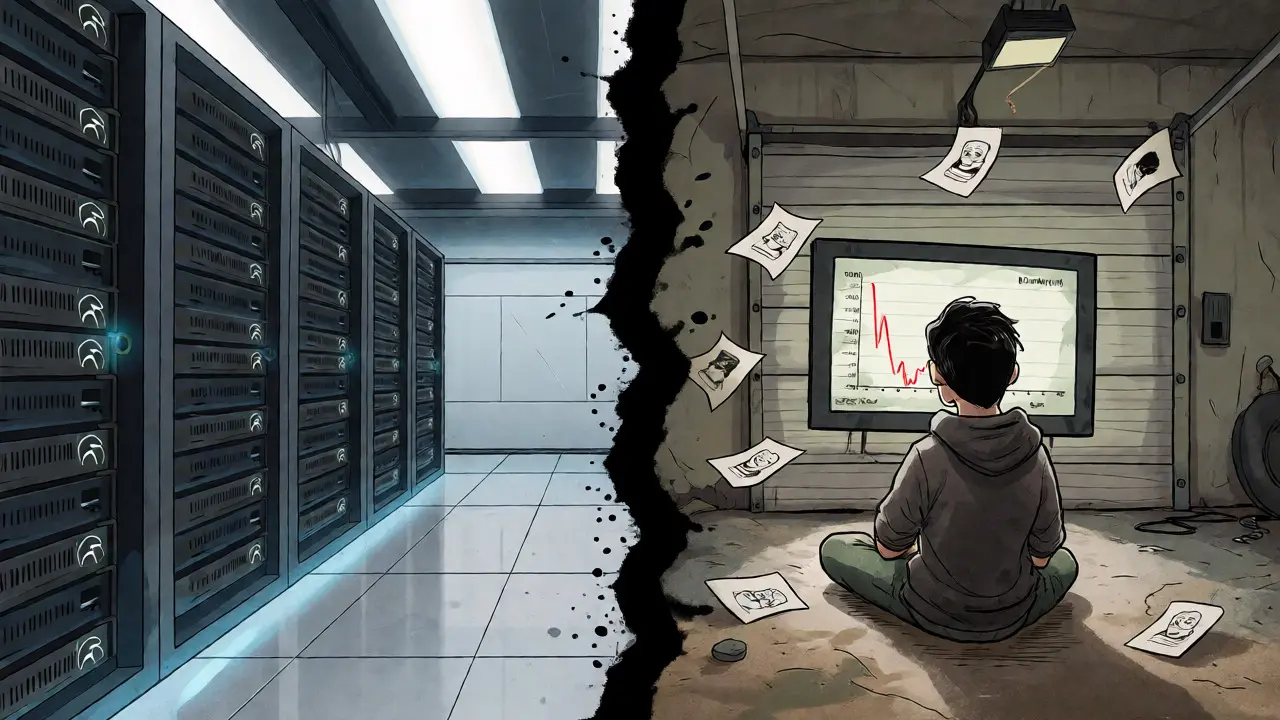
Here is the uncomfortable truth. While the name says "GPU AI," there is minimal documentation proving an active, decentralized network of rented GPUs powered specifically by RICH tokens. Projects like Render Network (RNDR) or Akash Network (AKT) have established infrastructure and enterprise clients. RICH, by contrast, appears to be leveraging the *narrative* of AI and GPUs rather than delivering the infrastructure itself.
Does this make it worthless? Not necessarily. Meme coins derive value from attention. If the community revives the narrative-perhaps by partnering with a smaller GPU provider or launching a simple dApp-the token could re-rate. However, betting on RICH today is less about investing in technology and more about speculating on community resilience.
Risks and Red Flags
Before you allocate any funds, consider these specific risks associated with RICH:
- Data Discrepancies: Different price trackers report different prices ($0.00004 vs $0.00017). This indicates fragmented liquidity and potential wash trading on smaller exchanges.
- No Clear Roadmap: Public updates on development progress are sparse. In crypto, silence often equals stagnation.
- Whale Dominance: Even in fair launches, a few wallets often hold significant percentages. Monitor the top 10 holders on Solscan to ensure concentration isn’t too high.
If you are looking for a safe investment, RICH is not it. It is a high-risk, high-volatility asset suited for speculative portfolios where you can afford to lose 100% of the allocated amount.
Final Verdict: Should You Hold RICH?
GPU AI Rich represents the chaotic energy of the Solana meme coin era. It offers a story-AI meets crypto-that resonates with current tech trends, but it lacks the hard engineering proof points of its larger competitors. If you believe in the power of communities to revive dead narratives, RICH might be worth a small position. If you prefer fundamentals, you might want to look at established GPU-focused protocols instead.
Keep your expectations realistic. This is not the next Bitcoin. It is a digital collectible with a tech-themed skin. Trade accordingly.
Is GPU AI Rich (RICH) a legitimate project?
It is a legitimate token in that it exists on the blockchain and is tradable. However, its claim to provide GPU rental services is largely unverified compared to established competitors. It functions primarily as a community-driven meme coin.
Which blockchain does RICH use?
RICH operates on the Solana blockchain. It is an SPL token, which means transactions are fast and cheap compared to Ethereum-based tokens.
Can I stake RICH to earn rewards?
Currently, there is no widely adopted staking mechanism for RICH that generates yield from GPU rentals. Any staking offered is likely experimental or community-run pools with variable APYs.
Why is the price of RICH so low?
The price dropped significantly from its all-time high due to the natural cooling off of meme coin hype cycles and a lack of tangible product delivery. Low price does not mean undervalued; it reflects current market sentiment and liquidity.
Where is the best place to buy RICH?
Major options include Bybit, MEXC, and HTX. For direct on-chain purchases, use Jupiter Aggregator or Raydium via a Solana wallet like Phantom.





Ellie Probus
OMG the audacity of calling this "AI" when it's literally just a pump.fun coin with zero code shipped is absolutely INSANE!! I am so done with these lazy devs hiding behind buzzwords while they dump their bags on us poor retail investors. The chart looks like a crime scene and everyone knows it. Why are we even pretending this has utility? It’s a casino disguised as tech!!