Ever feel like the crypto mining game is rigged? For most people, it is. If you tried to mine Bitcoin today with a home computer, you'd basically be heating your room while making zero money. That's because massive warehouses full of specialized machines called ASICs have taken over. But there is a project that decided to fight back against this trend. Vertcoin is an open-source, decentralized peer-to-peer cryptocurrency launched on January 8, 2014, specifically designed to be mined using standard consumer-grade hardware. Also known as VTC, it aims to keep the "people's coin" dream alive by ensuring that anyone with a decent gaming PC can still participate in securing the network.
The Fight Against ASIC Dominance
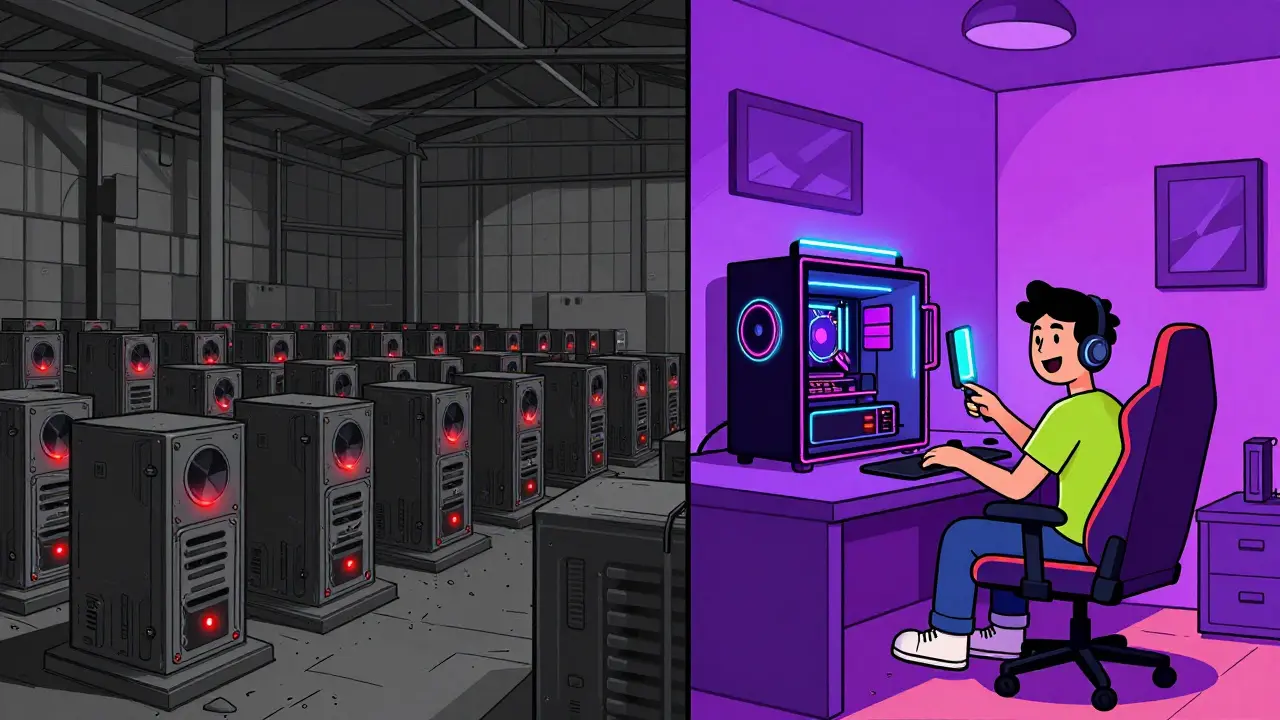
To understand why Vertcoin exists, you have to understand the problem with ASICs (Application-Specific Integrated Circuits). These are powerful machines built for one purpose: mining a specific coin. While they are efficient, they kill decentralization. When only a few companies can afford these machines, they effectively control the network.
Vertcoin takes a different path. It uses a philosophy called ASIC-resistance. Instead of letting specialized hardware take over, Vertcoin frequently updates its mining algorithm to make sure that GPUs (Graphics Processing Units) and CPUs (Central Processing Units) remain the most effective tools for the job. If a company builds an ASIC for Vertcoin, the community can simply trigger a hard fork to change the algorithm, rendering those expensive machines useless. This keeps the power in the hands of regular users rather than industrial mining farms.
Technical Specs: How VTC Differs from Bitcoin
Vertcoin is essentially a variant of Bitcoin, but it's tuned for speed and accessibility. While it follows a similar deflationary model, the numbers are scaled differently to provide a smoother user experience.
| Feature | Vertcoin (VTC) | Bitcoin (BTC) |
|---|---|---|
| Max Supply | 84 Million VTC | 21 Million BTC |
| Block Time | 2.5 Minutes | 10 Minutes |
| Mining Hardware | Consumer GPUs/CPUs | Specialized ASICs |
| Algorithm | Verthash | SHA-256 |
Because the block time is only 2.5 minutes, transactions are confirmed four times faster than on the Bitcoin network. This makes it much more practical for actual spending rather than just holding as a long-term asset. The network also uses the Kimoto Gravity Well algorithm, which adjusts the mining difficulty every single block. This prevents the "difficulty spikes" that can frustrate miners when new power suddenly joins the network.
Mining for Everyone: The 1-Click Approach
Most cryptocurrencies require you to be a bit of a tech wizard to start mining. You usually have to deal with command-line interfaces, complex configuration files, and constant troubleshooting. Vertcoin wanted to change that. They introduced a 1-click mining program that removes almost all the friction.
If you have a Windows PC with a modern graphics card, you can essentially click a button and start earning VTC. This isn't just a gimmick; it's a strategic move to increase the number of nodes and miners globally. The more people mining from their bedrooms and offices, the harder it is for a single entity to attack or control the network. It transforms a high-end gaming rig from a luxury expense into a productive tool that earns a digital store of value.
Privacy, Speed, and the Lightning Network
It's not all about mining, though. Vertcoin has integrated several features to make it a viable currency for daily use. For those who aren't fans of the public nature of blockchains, Vertcoin supports Stealth Addresses. This allows you to receive payments without revealing your main wallet address to the world, adding a layer of anonymity to your transactions.
The most exciting development currently is the work on the Lightning Network. For the uninitiated, the Lightning Network is a "Layer 2" solution that sits on top of the main blockchain. It allows for nearly instant transactions and microscopic fees. Vertcoin is pushing the envelope further by developing a multicoin Lightning Network wallet, which could potentially allow users to move between different assets with incredible speed and security.

A Community-Driven Model
One of the biggest red flags in the crypto world is the "pre-mine." This is when founders keep a huge chunk of coins for themselves before the public can even start mining. Vertcoin explicitly rejected this. There were no ICOs, no venture capital injections, and no founder allocations.
Every single VTC in existence was earned through proof-of-work mining. The project is funded entirely by donations from the community. This means there is no corporate board making decisions based on profit margins or shareholder interests. Instead, the development is handled by volunteers. When a decision needs to be made-like switching to the Verthash algorithm-it happens through community consensus.
Is Vertcoin Still Relevant?
In a market dominated by giants like Ethereum and Solana, you might wonder if a GPU-mined coin from 2014 still matters. The answer depends on what you value. If you are looking for the next 100x moonshot, you might find VTC's stability boring. But if you believe that cryptocurrency should be a decentralized tool owned by the people-not by hardware manufacturers or hedge funds-then Vertcoin is one of the few projects actually sticking to that original vision.
With a circulating supply of roughly 45 million coins (about 53.7% of the total), the asset maintains a deflationary curve similar to Bitcoin's. While its price fluctuates like any small-cap coin, its value proposition remains consistent: it is a hedge against the centralization of the mining industry.
Can I mine Vertcoin on my laptop?
Yes, as long as your laptop has a decent GPU or CPU. While gaming laptops perform much better than thin office laptops, the 1-click miner is designed to work with most consumer-grade hardware. Just keep an eye on your temperatures so you don't overheat your machine.
What is the difference between Verthash and Scrypt?
Scrypt was an earlier algorithm used by Litecoin that was eventually conquered by ASICs. Verthash is a more modern hash function designed specifically to be memory-hard, meaning it requires a lot of RAM, which is cheap in GPUs but very expensive to implement in specialized ASIC chips. This is what keeps Vertcoin ASIC-resistant.
How many Vertcoins will ever exist?
The maximum supply is capped at 84 million VTC. This is exactly four times the maximum supply of Bitcoin (21 million), providing more units for circulation while maintaining the same scarcity principles.
Does Vertcoin have a CEO?
No. Vertcoin is entirely community-driven and decentralized. There is no corporate structure, no CEO, and no centralized office. Development is handled by a global team of volunteers.
What are Stealth Addresses?
Stealth addresses allow a sender to create a one-time address for a recipient. This means that anyone looking at the public blockchain cannot easily link multiple transactions to the same user, significantly increasing financial privacy.