You have likely seen the buzz around XMS, also known as Mars Ecosystem Token. It is the governance token for the Mars Ecosystem, a decentralized finance protocol aiming to build a new paradigm for stablecoins. If you are reading this because you heard about an ongoing giveaway or want to know how to get free tokens, I need to give you the hard truth first: the major XMS airdrop campaigns are over. The big events that distributed hundreds of thousands of dollars in value have concluded. However, understanding what happened, how the system works, and where XMS fits in the crypto landscape is still valuable if you plan to buy the token or participate in future Mars Ecosystem activities.
What Happened to the XMS Airdrop?
Let’s clear up the confusion immediately. There were two primary distribution events for the Mars Ecosystem Token. Both have ended. Knowing the details helps you avoid scams claiming these events are still open.
The first event was a smaller, direct campaign called the Mars Ecosystem Airdrop. This event distributed 50 XMS tokens to 1,000 lucky participants. It was a lottery-style draw. Once the 1,000 winners were selected and paid, the campaign closed permanently. You cannot enter this one now.
The second, and much larger, event was a collaboration with CoinMarketCap. This program, known as Learn & Earn, offered a massive prize pool of $200,000 in XMS tokens. They gave away $5 worth of XMS to 40,000 winners. To qualify, users had to:
- Have both a CoinMarketCap account and a Binance account.
- Watch educational videos about the Mars Ecosystem.
- Pass a quiz with 100% accuracy (all questions correct).
- Submit a valid BEP-20 wallet address.
This event required specific actions and verification. Since the distribution window has passed and tokens were sent within three days of completion, there is no way to claim rewards from this campaign today. Any website asking you to connect your wallet to "claim" these old rewards is likely a scam trying to drain your funds.
Understanding the Mars Ecosystem and XMS Utility
If you missed the free tokens, you might be wondering why anyone cares about XMS. Is it just a meme coin? No. XMS is designed to be the backbone of a specific financial infrastructure. The project calls itself the "central bank and reserve currency for DeFi." That is a bold claim, so let’s look at what they actually built.
The core of the ecosystem is USDM, the Mars Stablecoin. Unlike traditional stablecoins that rely heavily on centralized reserves, USDM aims to solve what the team calls "positive externality." In simple terms, most stablecoin protocols pay for their own maintenance while others profit from the transactions. Mars Ecosystem tries to capture that value back into the system.
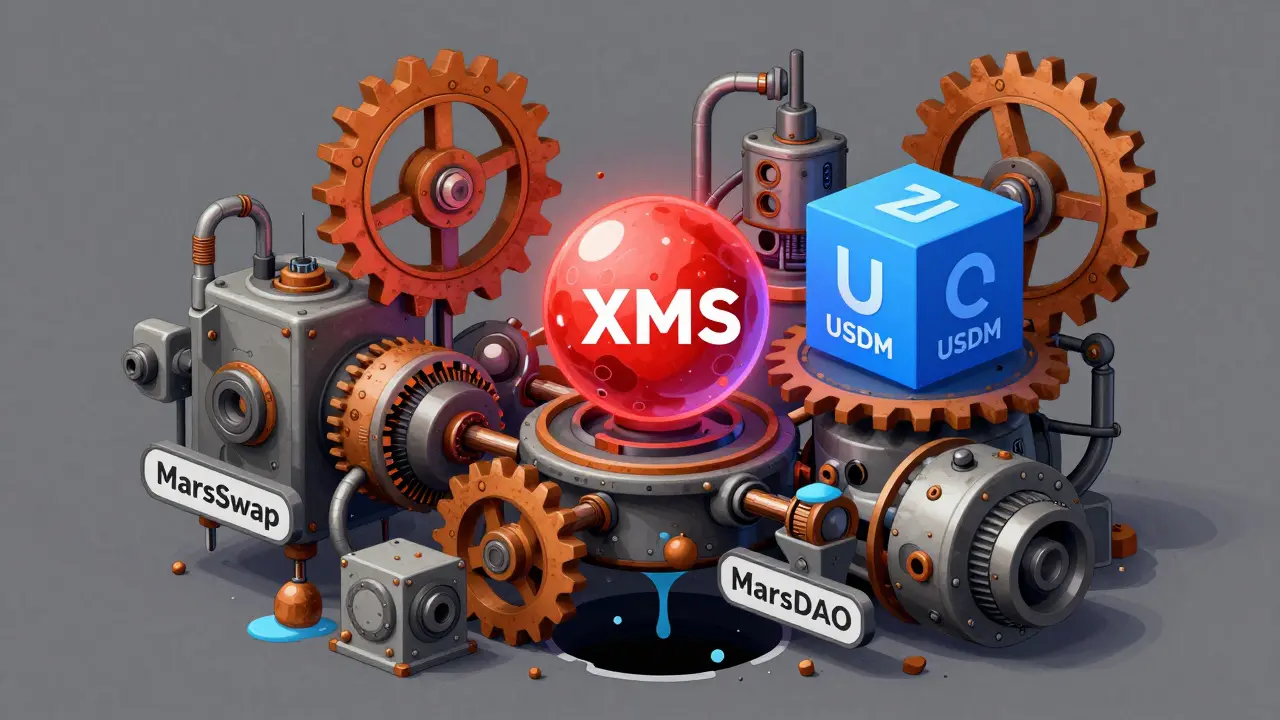
Here is how the pieces fit together:
- MarsSwap: A decentralized exchange where users trade assets, including USDM.
- MarsDAO: The governing body. Holding XMS gives you voting rights on how the ecosystem evolves.
- Technical Focus: The architecture prioritizes high stability, capital efficiency, scalability, and decentralization.
The goal is not just to create another token, but to build a self-sustaining economic loop. When you hold XMS, you are essentially betting on the success of this entire infrastructure, particularly the adoption of USDM by merchants and other DeFi protocols.
XMS Price Performance and Market Reality
Before you decide to buy XMS, you need to look at the numbers. Cryptocurrency markets can be deceptive, especially for newer projects. As of May 2026, the data for XMS shows significant volatility and some concerning signs regarding liquidity.
| Metric | Data Source | Value |
|---|---|---|
| Price (USD) | Binance | $0.000297 (+1.24% 24h) |
| Price (USD) | CoinMarketCap | $0.0004989 |
| 24h Volume | CoinMarketCap | $2,303.09 |
| Market Cap | CoinGecko | $314,755 (Rank #5891) |
| Network | Blockchain Explorer | Binance Smart Chain (BSC) |
Notice the discrepancy in price between Binance ($0.000297) and CoinMarketCap ($0.0004989). This gap is huge. It indicates low liquidity. When trading volume is only around $2,300 per day, large orders can move the price drastically. This makes buying or selling XMS risky unless you are dealing with very small amounts. The market cap of roughly $315,000 places it in the lower tiers of cryptocurrency rankings, meaning it is a high-risk, speculative asset compared to established giants like Ethereum or even major stablecoin issuers like MakerDAO.
Strategic Partnerships and Real-World Use
A token without utility is just a number on a screen. Mars Ecosystem is trying to prove its worth through partnerships. One key alliance is with MugglePay. MugglePay is described as a leading C2B (Consumer-to-Business) payment service provider.
Here is why this matters: MugglePay is integrating MarsSwap for stablecoin exchanges and plans to gradually add USDM to its payment systems. This means real merchants could eventually accept payments settled via the Mars Ecosystem. It moves the project away from pure speculation toward actual transactional utility. If USDM becomes a common tool for merchants to handle digital payments, the demand for XMS (used for governance and fees) could theoretically increase.
Security and Technical Infrastructure
In DeFi, security is non-negotiable. A single bug can wipe out millions. Mars Ecosystem takes this seriously by running a bug bounty program through Immunefi. Immunefi is a platform that rewards hackers who find vulnerabilities before bad actors do.
The bounty offers up to $10,000 for discovering critical issues. The scope covers serious attack vectors like:
- Malicious wallet interactions.
- Transaction parameter modification.
- Contract address substitution.
- Persistent content injection.
This suggests that the codebase is actively monitored and audited. However, remember that the token operates on the Binance Smart Chain (BSC). BSC is fast and cheap to use, which is great for airdrops and frequent transactions, but it is also a target for sophisticated exploits due to its popularity. Always ensure you are interacting with official contract addresses.
How to Participate in the Future
Since the airdrops are gone, what can you do? If you believe in the "New Decentralized Paradigm" Mars Ecosystem promises, here are your options:
- Buy XMS on Exchanges: Look for listings on platforms like Binance. Be aware of the slippage and low liquidity mentioned earlier. Use limit orders rather than market orders to protect yourself from bad pricing.
- Join MarsDAO: Hold XMS to vote on proposals. Governance is how the ecosystem decides on fee structures, new partnerships, and technical upgrades.
- Use MarsSwap: Provide liquidity or trade assets on their DEX. This supports the network and may earn you additional rewards depending on current incentive programs.
- Stay Alert for New Campaigns: Projects often run seasonal promotions. Follow their official social channels (Twitter/X, Discord) for announcements. Never click links from unofficial sources.
Be cautious. The lack of recent major marketing pushes and the closure of the large CoinMarketCap campaign suggest a shift in strategy. They may be focusing more on organic growth and developer activity rather than handing out free tokens. This can be a sign of maturity, or it can mean reduced community engagement. Watch the development updates closely.
Risks to Consider
I want to be direct about the risks. XMS is a small-cap token with volatile pricing. The discrepancy in price data across trackers is a red flag for liquidity depth. If you try to sell a large amount of XMS quickly, you might not find enough buyers, causing the price to crash.
Additionally, the competitive landscape for stablecoins is brutal. Established players like USDT, USDC, and DAI dominate the market. For USDM to gain traction, it needs to offer significantly better benefits or integration than these incumbents. The partnership with MugglePay is a step in the right direction, but it is early days. Do not invest money you cannot afford to lose.
Is the XMS airdrop still active?
No. The major XMS airdrop campaigns, including the 50-token lottery and the $200,000 CoinMarketCap Learn & Earn program, have concluded. Tokens were distributed shortly after these events ended. There are currently no active airdrop campaigns for XMS.
How do I buy XMS tokens?
You can purchase XMS on supported cryptocurrency exchanges such as Binance. Ensure you have a wallet that supports the Binance Smart Chain (BEP-20) standard to store your tokens securely. Due to low liquidity, use limit orders to avoid unfavorable prices.
What is the difference between XMS and USDM?
XMS is the governance token of the Mars Ecosystem, used for voting and protocol decisions. USDM is the stablecoin issued by the ecosystem, designed to maintain a stable value (pegged to USD) for transactions and payments. XMS is volatile; USDM is intended to be stable.
Why is the XMS price different on Binance and CoinMarketCap?
The price discrepancy indicates low trading volume and limited liquidity. With daily volumes around $2,300, small trades can cause significant price swings, leading to inconsistent reporting across different data aggregators and exchanges.
Is Mars Ecosystem secure?
Mars Ecosystem employs security measures including a bug bounty program via Immunefi, offering rewards for vulnerability discovery. However, all DeFi projects carry inherent smart contract risks. Users should always verify contract addresses and never share private keys.
What is the role of MugglePay in the Mars Ecosystem?
MugglePay is a payment service provider partnering with Mars Ecosystem. They utilize MarsSwap for exchanges and are integrating USDM into their payment systems, aiming to provide merchants with digital currency payment options and drive real-world utility for the stablecoin.