
When you hear about blockchain security, you might think of Bitcoin’s unbreakable ledger or a corporate system keeping supply chain data locked down. But here’s the truth: public and private blockchains aren’t just different in who can join-they’re built on entirely different security models. One relies on mass participation and cryptography. The other trusts a few chosen players. Neither is universally "better." But if you don’t understand how they differ, you could be making a dangerous assumption about which one keeps your data-or your money-safe.
How Public Blockchains Stay Secure
Public blockchains like Bitcoin and Ethereum are open to anyone. You don’t need permission. You don’t need an invite. You just download the software and start participating. This openness isn’t a bug-it’s the whole point. Their security comes from scale, not control.
Bitcoin’s network has over 480 exahashes per second of computational power working to validate transactions. That’s more than the combined computing power of the top 100 supercomputers on Earth. To hack it, you’d need to control over half of that power-a 51% attack. Experts estimate that would cost more than $13 million per hour. It’s not impossible, but it’s economically irrational. Why spend $13 million to steal a few million in Bitcoin when you can just buy it?
That’s the power of decentralization. No single company, government, or hacker can flip a switch and shut it down. Even if one node fails, thousands more keep running. Bitcoin has never gone offline since January 3, 2009. Ethereum, after switching to Proof of Stake in September 2022, now secures over $190 billion in value without burning electricity. Instead of miners competing to solve puzzles, validators lock up their own ETH as collateral. If they act dishonestly, they lose it. That’s called economic security.
Public blockchains also rely on transparency. Every transaction is visible. If something goes wrong-like the $600 million Poly Network hack in 2021-the community can see exactly what happened. They can coordinate a fix. In that case, the attacker returned the funds after public pressure. That kind of accountability is impossible in a closed system.
How Private Blockchains Stay Secure
Private blockchains are the opposite. They’re like a members-only club. Only approved organizations or employees can join. Think banks, hospitals, or logistics companies using blockchain to share data without exposing it to the public. Their security doesn’t come from thousands of strangers. It comes from control.
Platforms like Hyperledger Fabric and R3 Corda use permissioned networks. Each participant is vetted. Access is restricted. Transactions are encrypted. Roles are assigned. A warehouse manager might only see shipping logs. A finance officer sees payment records. No one sees everything unless they’re authorized. That’s called role-based access control (RBAC). It’s not just convenient-it’s legally required in industries like healthcare and finance.
These networks also move faster. Hyperledger Fabric can process 3,500 transactions per second with finality in under two seconds. Compare that to Bitcoin’s 7 tps or Ethereum’s 30-45 tps. Speed matters when you’re processing real-time supply chain updates or clearing interbank payments. Less time between transactions means less opportunity for attacks.
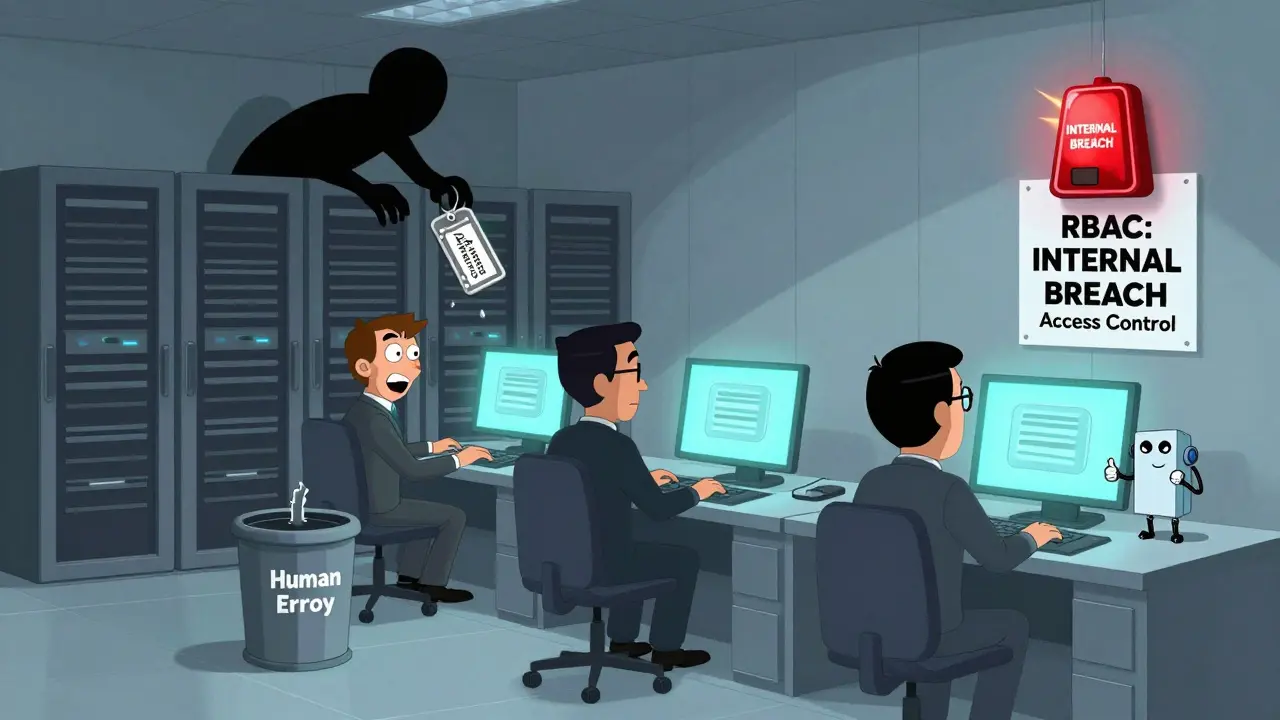
But here’s the trade-off: fewer nodes mean fewer eyes watching. If one administrator gets hacked-or makes a mistake-the whole network can be compromised. In 2022, a European bank lost control of its private blockchain when an internal admin account was hijacked. No external hacker broke in. The breach came from inside. That’s the Achilles’ heel of private blockchains: the central point of failure.
Where Public Blockchains Are Weakest
Public blockchains aren’t invincible. Their biggest weakness isn’t the network-it’s the people using it.
According to Ledger’s 2023 H1 Security Report, 95% of security incidents on public blockchains happen because users lost their private keys or fell for phishing scams. If you send crypto to the wrong address? Too bad. There’s no customer support. No undo button. The blockchain doesn’t care. It just records what you told it to.
Smart contracts are another risk. These are self-executing programs that run on blockchains. But if they’re poorly written, they can leak funds. OpenZeppelin found that 78% of audited smart contracts in 2023 had critical vulnerabilities. A single line of bad code can cost millions. The infamous DAO hack in 2016 drained $60 million because of a recursive function flaw. That’s not a network failure-it’s a coding mistake.
Privacy is another issue. Bitcoin and Ethereum transactions are public. Anyone can trace your wallet history. That’s fine for some. But if you’re a business or a high-net-worth individual, that’s a liability. That’s why solutions like Zcash (using zk-SNARKs) and Ethereum’s layer-2 networks like Optimism (with $1.1 billion locked in) exist. They add privacy on top of the base layer.
Where Private Blockchains Are Weakest
Private blockchains look safer because they’re closed. But that’s often an illusion.
Kadena’s September 2023 analysis identified four critical risks:
- Centralization: If one entity controls all the nodes, it’s not a blockchain-it’s a database with extra steps.
- Reduced scrutiny: With only a few validators, there’s less peer review. Mistakes slip through.
- Weaker consensus: Many private chains use Practical Byzantine Fault Tolerance (PBFT) instead of Proof of Work or Stake. PBFT is faster, but it’s easier to manipulate if you control the majority of validators.
- Scalability-security tradeoff: Cutting corners on decentralization to gain speed makes the system more fragile over time.
And then there’s internal threat. A 2023 Reddit thread from a blockchain security expert found that 63% of breaches in private enterprise chains came from poor internal key management-not external attacks. Employees reused passwords. Keys were stored on unencrypted laptops. Access controls weren’t enforced. These aren’t blockchain problems. They’re human problems. And private blockchains don’t fix them-they just hide them behind a firewall.
Which One Should You Use?
There’s no one-size-fits-all answer. It depends on what you’re trying to protect.
If you’re building a cryptocurrency, a decentralized app, or a public ledger that needs to be tamper-proof and censorship-resistant, public blockchains win. They’re battle-tested. Bitcoin and Ethereum have survived over a decade of attacks, hacks, and regulatory pressure. Their security is baked into the network, not the company running it.
If you’re a bank, a hospital, or a logistics company that needs to share sensitive data with trusted partners while staying compliant with regulations like HIPAA or GDPR, private blockchains make sense. They offer speed, control, and confidentiality. But they demand strong internal security practices. You can’t just deploy it and forget it. You need identity management, audit trails, and strict access policies.
And here’s what’s changing: hybrid models are emerging. R3 Corda’s 2023 update introduced "notary clusters"-a way to decentralize validation even within a permissioned network. Ethereum’s upcoming Dencun upgrade (Q1 2024) will improve scalability without sacrificing security. The future isn’t public vs. private. It’s smart combinations of both.

Real-World Examples
Maersk’s TradeLens, built on a private blockchain, tracks global shipping containers. It’s secure because only Maersk, port authorities, and customs agencies can access it. No public exposure. No risk of data leaks. But it works because they enforced strict identity verification and encrypted channels.
Meanwhile, Bitcoin’s public blockchain handles billions in value every day. It doesn’t need a CEO to approve transactions. It doesn’t need a firewall. It runs on code, math, and millions of independent computers. No single entity can shut it down. No government can censor it. That’s the power of trustless security.
And then there’s the dark side: IBM’s Food Trust, a private blockchain for food safety, has logged zero security incidents since 2018. But that’s because they invested heavily in training, monitoring, and access controls. Not because the blockchain itself was magically secure. It’s a reminder: security is a practice, not a product.
What’s Next?
The blockchain security market hit $1.85 billion in 2023. Over 60% of that went to public blockchain tools-mostly because public chains are open targets. Hackers go after Bitcoin, Ethereum, and Solana because they’re valuable and visible. Private chains? They’re quieter. But when they fall, the damage is often worse-because no one outside the company even knows about it until it’s too late.
Regulators are catching up too. The Financial Action Task Force now treats public and private blockchains differently. Public chains must monitor transactions for money laundering. Private chains must verify every participant’s identity. One can’t hide behind anonymity. The other can’t hide behind secrecy.
The bottom line? Public blockchains are secure because they’re open. Private blockchains are secure because they’re controlled. But control can be broken. Openness can be misunderstood. The most secure systems aren’t the ones with the most nodes or the tightest permissions. They’re the ones that match the right security model to the right use case.
Can a private blockchain be hacked more easily than a public one?
Yes, in some cases. Public blockchains are harder to hack because they require controlling a majority of global computing power (like Bitcoin’s 480 exahashes). But private blockchains are vulnerable to insider threats. If an administrator’s credentials are stolen or an employee abuses access, the entire network can be compromised. There’s no global community to reverse the damage. The attack surface is smaller, but the consequences are more concentrated.
Why are public blockchains considered more transparent?
Because every transaction is recorded on a public ledger that anyone can view. You can trace every Bitcoin transfer back to its origin. This transparency allows independent verification. If something looks suspicious, you can audit it yourself. Private blockchains restrict access. Only authorized participants can see the data. That’s good for privacy, but it means you have to trust the operators instead of verifying the data yourself.
Do private blockchains offer better privacy than public ones?
Yes, by design. Public blockchains like Bitcoin and Ethereum record all transactions openly. Even if you use a pseudonym, your wallet history is visible. Private blockchains encrypt data and limit access. Only approved parties see specific information. That’s why banks and healthcare providers use them-they need to comply with privacy laws like GDPR and HIPAA. However, private blockchains aren’t inherently anonymous. They just restrict who can see what.
Which blockchain type is better for enterprise use?
For most enterprises, private blockchains are the practical choice. They offer speed, control, and regulatory compliance. Over 78% of Fortune 500 companies use permissioned blockchains for internal processes like supply chain tracking or interbank settlements. But they come with a catch: you must manage your own security. That means strong identity systems, employee training, and constant monitoring. Public blockchains are too open and slow for most enterprise workflows.
Is Proof of Stake more secure than Proof of Work?
In terms of network security, yes-especially for large networks like Ethereum. Proof of Stake (PoS) replaces energy-intensive mining with economic incentives. Validators must lock up their own cryptocurrency as collateral. If they cheat, they lose it. This makes attacks economically irrational. Proof of Work (PoW) relies on computational power, which can be hijacked if someone gains 51% of the hash rate. PoS reduces that risk by making the cost of attack higher and the reward lower. Ethereum’s switch to PoS in 2022 improved its security while cutting energy use by over 99%.
Can public and private blockchains work together?
Yes, and they already are. Hybrid models are emerging. For example, a company might use a private blockchain internally to manage contracts, then anchor key transactions onto a public blockchain for verification. This gives them privacy and control while still benefiting from public trust and immutability. R3 Corda and Ethereum are already enabling this. The World Economic Forum predicts hybrid systems will dominate enterprise adoption by 2026.







Adam Ashworth
Public blockchains are like a crowded town square where everyone can see everything. Private ones? More like a members-only club where the bouncer decides who gets in. Neither’s perfect, but if you’re storing life savings, you better know which one’s got the real security.