
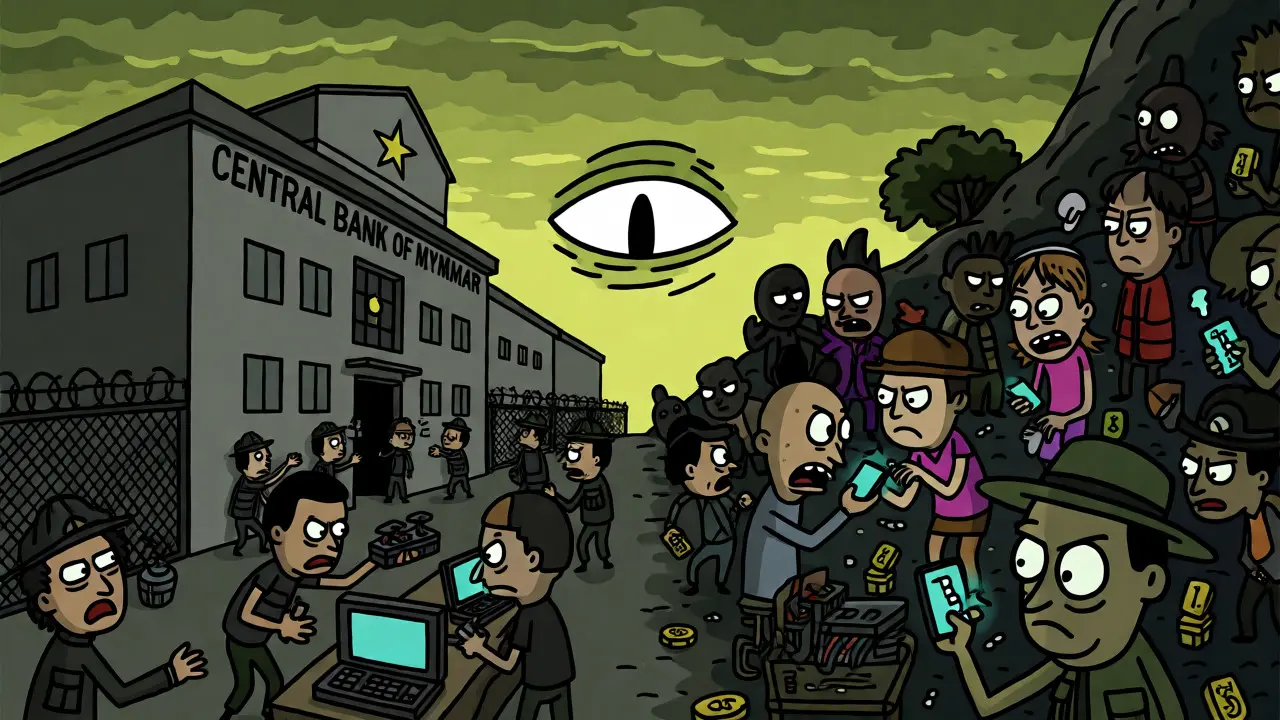
Imagine walking into your local bank to withdraw cash, only to be told your account is frozen. Not because you made a mistake, but because the Central Bank of Myanmar (CBM) suspects you traded Bitcoin or sent USDT to a friend abroad. For millions of people in Myanmar, this isn't a hypothetical nightmare-it's a daily reality. The country has some of the strictest cryptocurrency rules on the planet, and the CBM doesn't just warn; it shuts down accounts and pursues legal action.
If you are living in Myanmar, doing business there, or sending money back home, understanding these account closure penalties is critical. It’s not just about losing access to your funds; it can mean jail time. Let’s break down exactly what happens when you touch crypto in Myanmar, why the government is so aggressive, and what the future might hold with the new digital kyat plans.
The Core Problem: Why Is Crypto Illegal?
To understand the penalties, you first need to grasp the legal foundation. In Myanmar, the Central Bank of Myanmar (CBM) holds sole authority to issue currency. Any other form of "money"-including Bitcoin, Ethereum, or stablecoins-is considered unregulated and illegal to use as a medium of exchange. This stance is backed by multiple laws, including the Foreign Exchange Management Law and the Anti-Money Laundering Law.
The CBM views cryptocurrencies as a threat to financial stability. They argue that unauthorized digital currencies facilitate money laundering, evade capital controls, and undermine the national currency, the Kyat. When the military junta took control in 2021, the situation worsened. As the Kyat lost value due to political instability and economic sanctions, ordinary citizens turned to crypto to preserve their savings. The CBM responded by tightening its grip, declaring that any involvement in buying, selling, or transferring digital assets carries significant risk.
The Penalty Structure: Beyond Just Closing Accounts
Many people think the worst-case scenario is simply having their bank account closed. While that is a common immediate consequence, it is far from the end of the story. The CBM’s enforcement strategy uses a multi-layered approach to punish violations.
Account Closure is the most visible penalty. Banks are instructed to monitor transactions for signs of crypto activity. If they detect transfers linked to known exchanges or peer-to-peer platforms like Binance or Paxful, they may freeze or permanently close the account. This leaves users stranded without access to their fiat currency, often requiring lengthy bureaucratic processes to reclaim funds, if possible at all.
However, the legal repercussions go deeper. Under the Anti-Money Laundering Law, individuals engaged in unauthorized currency conversion can face criminal charges. This includes imprisonment and heavy fines. The CBM explicitly stated in a May 2024 notice that they are ready to pursue legal action against those involved in illegal currency conversion. This wasn't an empty threat; enforcement actions have already resulted in arrests and prosecutions.
| Penalty Type | Description | Severity Level |
|---|---|---|
| Account Freezing/Closure | Banks restrict access to funds suspected of being linked to crypto transactions. | High (Immediate financial disruption) |
| Fines | Monetary penalties imposed under anti-money laundering regulations. | Medium to High (Varies by amount) |
| Imprisonment | Criminal charges for unauthorized currency exchange or mining. | Very High (Long-term legal consequences) |
| Asset Seizure | Confiscation of digital assets or proceeds from illegal trades. | High (Loss of investment) |
Who Is Targeted? Mining vs. Trading
The CBM distinguishes between different types of crypto activities, though both are prohibited. Cryptocurrency Mining involves using computer hardware to validate transactions and earn rewards. Despite the electricity shortages and infrastructure challenges in Myanmar, underground mining operations persist. Authorities target these setups because they consume significant power and operate outside the regulated financial system. Miners face risks of equipment seizure and prosecution for operating without licenses.
On the other hand, Trading and Transfers are more widespread. Ordinary citizens use platforms like Telegram or offshore exchanges to send remittances or hedge against inflation. The CBM specifically targets personal Facebook accounts and web pages used for peer-to-peer (P2P) trading. Even small-scale traders are not exempt. The May 2024 warning highlighted that participation in the sale, purchase, or exchange of unregulated digital currencies puts individuals at risk of both account closure and legal pursuit.
The Rise of the Underground Economy
Strict bans rarely eliminate demand; they just drive it underground. In Myanmar, the prohibition has fueled a robust shadow economy. Between 2024 and 2025, there was a noticeable surge in P2P transactions conducted via messaging apps rather than formal banking channels. Stablecoins, particularly Tether (USDT) on the Tron network, became the de facto currency for informal international payments. Why? Because they offer stability compared to the volatile Kyat and allow for faster cross-border transfers than traditional banks.
This shift created a paradox. While the government tries to suppress crypto, the opposition National Unity Government (NUG) declared USDT legal tender in regions under its control. This means the same transaction could be considered illegal in Yangon but accepted in parts of Karen State. For merchants and freelancers, navigating this split regulatory landscape is tricky. They must weigh the convenience of stablecoins against the risk of having their primary bank accounts shut down by the central government.
A Twist: The Digital Kyat Initiative
Here is where things get interesting. While banning private cryptocurrencies, Myanmar is actively exploring its own version. In June 2025, the CBM established the Central Committee for the Issuance of Central Bank Digital Currency (CBDC). Chaired by the CBM Governor, this committee is tasked with researching and potentially launching a digital Kyat.
Does this mean the government likes blockchain? Not necessarily. A CBDC is fundamentally different from decentralized cryptocurrencies like Bitcoin. A digital Kyat would be centralized, controlled entirely by the state, and likely monitored closely for compliance purposes. The goal seems to be modernizing payments while maintaining strict control over capital flows. For now, however, the existence of a CBDC project does not relax the penalties for existing crypto activities. You cannot trade Bitcoin today expecting the digital Kyat to save you tomorrow.
Practical Steps for Residents and Investors
If you find yourself dealing with crypto in Myanmar, here is how to navigate the risks:
- Avoid Direct Bank Links: Try not to link your main bank account directly to crypto exchanges. Use intermediary wallets or separate accounts if possible, though even these can be flagged.
- Monitor Transaction Patterns: Frequent, irregular transfers to unknown parties can trigger bank reviews. Keep records of legitimate business reasons for large movements of funds.
- Understand the Local Context: Be aware that enforcement intensity can vary by region and current political climate. What flies under the radar one month might be cracked down on the next.
- Diversify Storage: Do not keep all your wealth in one place. Consider holding some assets in non-crypto forms to ensure liquidity if your digital holdings become inaccessible.
The landscape is shifting. With neighboring countries like Thailand adopting friendlier crypto regulations, many miners and traders are considering relocating operations. If you are seriously invested in the sector, keeping an eye on regional trends might be your best hedge against local policy changes.
Is it illegal to own cryptocurrency in Myanmar?
Yes, effectively. While mere ownership isn't always prosecuted, using it as a medium of exchange, trading it, or mining it is illegal. The Central Bank of Myanmar prohibits all related activities, and participants do so at their own risk.
What happens if my bank closes my account for crypto activity?
Your account will be frozen or closed, cutting off access to your fiat currency. You may need to provide extensive documentation to prove the source of funds. In severe cases, the bank may report the activity to authorities, leading to potential fines or legal action.
Can I be jailed for trading Bitcoin in Myanmar?
Yes, imprisonment is a possible penalty. Violations of the Anti-Money Laundering Law and Financial Institutions Law can lead to prison terms, especially if the amounts are large or if the activity is seen as facilitating money laundering.
Are stablecoins like USDT treated differently than Bitcoin?
No. The Central Bank of Myanmar treats all unregulated digital currencies similarly. Whether it is Bitcoin, Ethereum, or Tether, using them for transactions without authorization exposes you to the same risks of account closure and legal penalties.
Will the introduction of the Digital Kyat change crypto laws?
Not immediately. The Digital Kyat is a centralized CBDC intended to replace physical cash, not to legalize decentralized cryptocurrencies. Current bans on private crypto remain in effect until new legislation explicitly states otherwise.






Tony Byrne
It is truly heartbreaking to hear about the struggles of ordinary citizens in Myanmar, who are just trying to preserve their savings against inflation. The fear of account freezes must be constant and exhausting for them, especially when they are only trying to send money to family abroad. One hopes that a more balanced approach will emerge soon, so that people can access financial tools without living in perpetual anxiety.