For nearly a decade, if you tried to buy Bitcoin in La Paz, you were breaking the law. It wasn't just discouraged; it was strictly forbidden by the Central Bank of Bolivia (BCB). But as of late 2024, that reality has flipped. The complete prohibition is gone. If you're wondering what happened, why it changed, and what it means for your digital assets, you're looking at one of the most dramatic policy reversals in recent Latin American history.
The Decade of Silence (2014-2024)
To understand where Bolivia is now, you have to look at where it started. On May 6, 2014, the BCB issued Resolution No. 097/2014. This document didn't just say "be careful with crypto." It effectively banned all cryptocurrency activities. Banks couldn't touch them. Citizens couldn't easily use them. The rationale was straightforward: protect the national currency, the Boliviano, from the volatility and anonymity associated with digital assets. For years, this stance remained rigid. Even during the global crypto boom of 2020-2021, when neighbors like El Salvador were making headlines, Bolivia held firm. In December 2020, they reaffirmed this stance with Resolution N° 144/2020. It seemed like the door was locked and welded shut.
But economics doesn't respect closed doors forever. By 2023 and early 2024, the pressure on Bolivia's economy was mounting. Foreign reserves were dwindling. Access to US dollars became difficult for ordinary citizens and businesses alike. People were already using stablecoins informally, often through peer-to-peer networks, despite the legal risks. The government realized that prohibiting a tool people desperately needed wasn't stopping usage-it was just pushing it underground and out of the tax net.
The Turning Point: June 2024
The shift came swiftly. On June 26, 2024, the landscape changed overnight. The BCB enacted Resolution No. 82/2024. This wasn't a tentative step forward; it was a full repeal of the previous prohibitions. Suddenly, virtual assets were no longer illegal. This move signaled a pragmatic acceptance that digital assets could serve as a necessary bridge in an economy struggling with dollar shortages. It wasn't about ideology; it was about survival and utility.
Following this initial lift, the government moved quickly to build a framework. They didn't want chaos. In April 2025, Resolution no. 019/2025 laid the groundwork for recognizing Virtual Asset Service Providers (VASPs). Then, in May 2025, Supreme Decree No. 5384 established a complete legal structure. This decree introduced licensing requirements, meaning crypto exchanges had to register and comply with local rules. It was a clear signal: we welcome you, but you must play by our rules.
Explosive Growth and Market Reality
You might think that after ten years of suppression, the market would be cautious. The opposite happened. The pent-up demand was massive. According to official figures from the BCB, virtual asset transactions hit $294 million in the first half of 2025 alone. That’s not a small number for a country that barely allowed these trades a year prior. Usage skyrocketed by more than 500% within twelve months of legalization.
| Metric | Pre-Legalization (Est.) | Post-Legalization (H1 2025) | Change |
|---|---|---|---|
| Transaction Volume | Negligible/Underground | $294 Million | Significant Increase |
| User Growth (Meru Platform) | Baseline | +6,600% | Explosive |
| Regulatory Status | Prohibited | Regulated/Licensed | Full Legalization |
| Primary Use Case | Speculation (Informal) | Stablecoins/Payments | Utility Focus |
Data from Bloomberg highlighted this surge vividly. Carlos Neira, founder of the crypto wallet platform Meru, reported a staggering 6,600% increase in Bolivian users after the ban lifted. When a single platform sees that kind of growth, it tells you something fundamental: people weren't waiting for permission to use money; they were waiting for safety. Now that they have both, they are flooding in.

Why Stablecoins Rule Bolivia
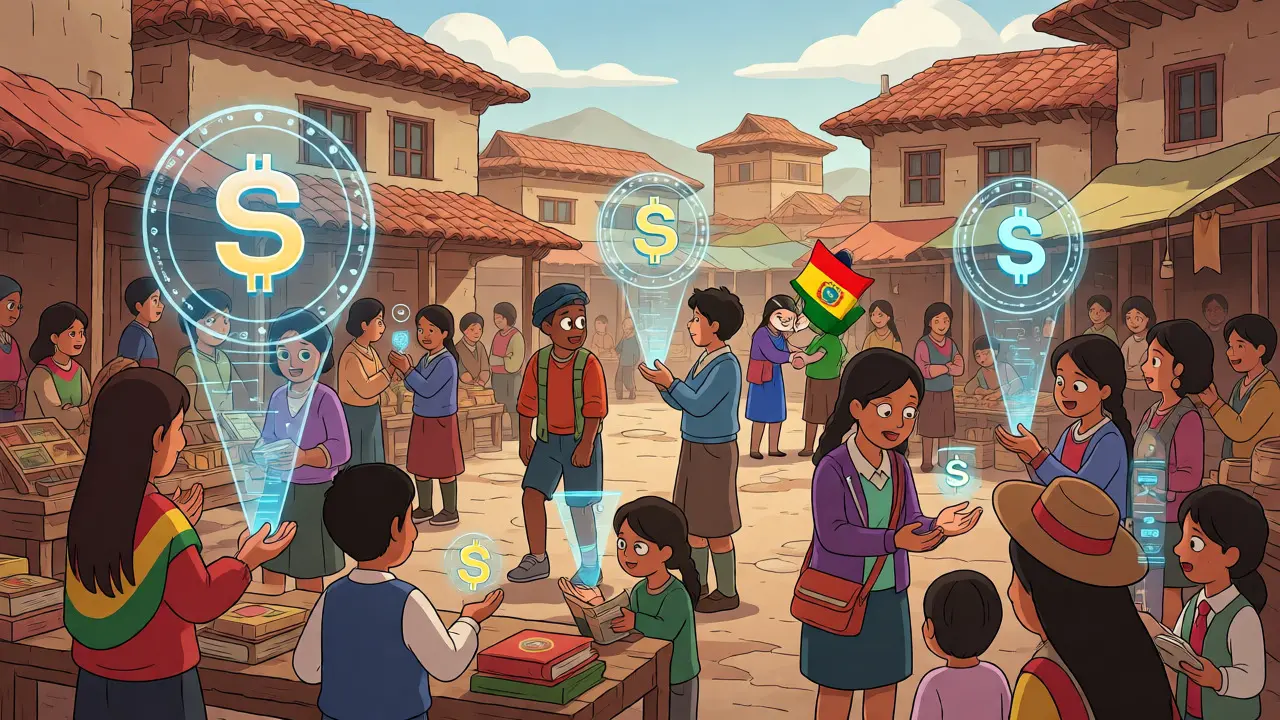
If you walk into a crypto meetup in Santa Cruz or La Paz today, don't expect to hear endless debates about Bitcoin halving cycles. The conversation is practical. In a country where inflation and currency devaluation are constant threats, stability is king. Consequently, USD-pegged stablecoins like USDT and USDC have become the workhorses of the Bolivian crypto scene.
The Central Bank itself has acknowledged this utility. In March 2025, the BCB began utilizing USD-pegged stablecoins for cross-border payments and remittances. This institutional endorsement validated what everyday users had known for years: stablecoins offer a reliable store of value when the local fiat struggles. Unlike El Salvador, which mandated Bitcoin as legal tender, Bolivia’s approach is user-driven. People choose the tool that solves their immediate problem-usually preserving purchasing power against the dollar.
A Different Path Than El Salvador
It’s tempting to compare Bolivia to its neighbor, El Salvador. Both are in Latin America. Both embraced crypto recently. But their methods are worlds apart. El Salvador took a top-down, ideological approach, adopting Bitcoin as legal tender to attract tourists and investors. Bolivia’s path is bottom-up and regulatory. They aren’t trying to replace the Boliviano with Bitcoin. They are integrating digital assets as complementary tools within the existing financial system.
This distinction matters. Bolivia’s strategy focuses on risk management and institutional integration. They signed a Memorandum of Understanding with El Salvador’s National Commission for Digital Assets (CNAD). This isn't just a photo-op; it’s a knowledge transfer agreement. Bolivia is leveraging El Salvador’s earlier experience with blockchain intelligence, data analytics, and risk oversight. They are learning how to regulate without stifling innovation, sharing staff training programs and market oversight techniques. It’s a collaborative model rather than a competitive race.
Challenges and Consumer Protection
Rapid change brings rapid risks. With thousands of new users entering the market monthly, scams are inevitable. The government launched public awareness campaigns to educate citizens on basic crypto hygiene-how to spot fake platforms, the importance of private keys, and the difference between an exchange and a broker. However, some community members worry that regulations are moving faster than consumer protection mechanisms can mature.
Licensing obligations under Supreme Decree No. 5384 help filter out bad actors, but enforcement takes time. Users need to know that while the BCB regulates the infrastructure, it does not guarantee the price of assets. Education remains the primary defense against loss. Local service providers are stepping up, offering support in Spanish and Quechua, ensuring that accessibility isn't limited to tech-savvy urban elites.
What This Means for Investors and Users
For international observers, Bolivia represents a case study in crisis-driven adoption. It shows that even strict prohibitions can’t hold back technology when economic necessity demands it. For Bolivians, it means financial inclusion. A student in Cochabamba can now legally access global markets via a smartphone app, bypassing traditional banking hurdles that previously required physical branches and extensive paperwork.
Looking ahead, the focus will likely shift to interoperability. How do these licensed VASPs connect with the broader regional payment systems? Will Bolivia integrate with other Mercosur nations' digital initiatives? The foundation is set. The laws are written. The users are active. The question now is how efficiently the ecosystem scales.
Is cryptocurrency currently legal in Bolivia?
Yes. As of June 26, 2024, the complete prohibition on cryptocurrency was lifted by Resolution No. 82/2024. Subsequent regulations in 2025 established a legal framework for virtual assets and service providers.
Which cryptocurrencies are most popular in Bolivia?
USD-pegged stablecoins (like USDT and USDC) are the most widely used due to their stability against the Boliviano. Bitcoin is also used, primarily for international transfers and long-term holding, but less frequently for daily transactions compared to stablecoins.
Do I need a license to trade crypto in Bolivia?
Individuals do not need a license to buy or sell crypto for personal use. However, companies operating as Virtual Asset Service Providers (VASPs), such as exchanges and wallets, must obtain licenses under Supreme Decree No. 5384 to operate legally.
How did Bolivia's crypto ban affect adoption rates?
The ban suppressed formal adoption for a decade. Once lifted, adoption exploded. Transaction volumes reached $294 million in H1 2025, and specific platforms saw user growth exceeding 6,000%, indicating significant pent-up demand.
Is Bolivia following El Salvador's Bitcoin model?
No. While they cooperate technically, Bolivia’s approach is more pragmatic and diverse. Instead of mandating Bitcoin as legal tender, Bolivia allows various digital assets, with a strong emphasis on stablecoins for stability and regulated service providers for security.