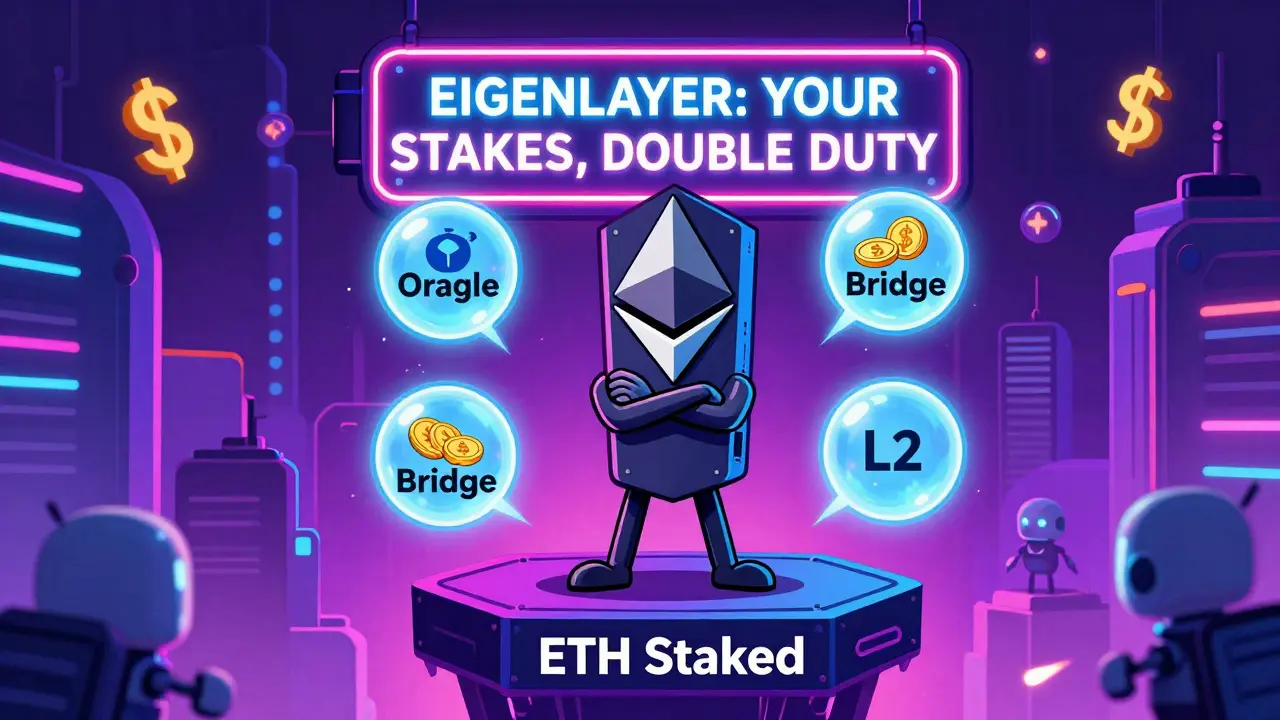
Restaking isn’t just another buzzword-it’s the next evolution in how you earn from crypto. If you’ve already staked your ETH or SOL, you’re sitting on a passive income stream. But what if you could use that same staked asset to earn even more-on another protocol? That’s restaking. And in 2025, it’s no longer experimental. It’s mainstream.
Unlike traditional staking, where you lock up your coins to support one blockchain, restaking lets you reuse your staked assets to secure other networks. Think of it like renting out your house twice: once to a tenant, then letting that tenant sublet a room. The asset stays locked on the original chain, but its security value gets borrowed elsewhere. The most famous example? Eigenlayer is a restaking protocol that allows Ethereum stakers to re-deploy their staked ETH to secure additional decentralized services like oracle networks, consensus layers, and bridges. Also known as EigenLayer, it launched in 2023 and has since secured over $20 billion in restaked ETH as of early 2026.
Why Restaking Matters More Than Ever in 2025
Restaking solves a real problem: blockchain security is expensive. New protocols need validators, but most users don’t want to run their own nodes. Restaking turns existing stakers into a ready-made validator pool. This cuts costs, speeds up adoption, and makes the whole ecosystem more resilient.
Take a new decentralized oracle network. Without restaking, it would need to attract its own stakers-expensive and slow. With restaking, it taps into the billions already locked in Ethereum. That’s why over 70% of new L2s and middleware projects in 2025 built their security on top of Eigenlayer or similar restaking frameworks.
And it’s not just Ethereum. Restaking is now expanding to Solana, Polygon, and even Cosmos-based chains. The technology is maturing fast. In 2024, restaking was a niche tool for DeFi builders. In 2025, it’s how everyday stakers maximize returns without moving a single coin.
The Top Restaking Platforms in 2025
Not all restaking platforms are created equal. Some are simple, others are complex. Some are centralized, others are fully decentralized. Here are the leaders in 2025, based on security, adoption, and ease of use.
Eigenlayer: The Restaking Standard
Eigenlayer is the backbone of modern restaking. It’s not a wallet or exchange-it’s a protocol. You interact with it through staking platforms that integrate its smart contracts. But if you’re restaking, you’re almost certainly using Eigenlayer under the hood.
Here’s how it works: When you restake ETH through Eigenlayer, you’re not giving up control. Your ETH stays staked on Ethereum’s consensus layer. But now, your validator also signs off on data for other services-like a decentralized oracle or a bridge. In return, you earn extra rewards in ETH or tokens from the services you’re securing.
As of February 2026, over $21 billion in ETH has been restaked through Eigenlayer. That’s more than 15% of all staked ETH. It’s not just popular-it’s essential.
Lido Finance: The Liquid Restaking Leader
Lido isn’t just a liquid staking provider-it’s the easiest way to start restaking. If you’ve ever used stETH, you’ve used Lido. In 2025, Lido added native restaking support for Eigenlayer. Now, when you stake ETH with Lido, you get stETH-and you can opt-in to restake it with one click.
Lido’s big advantage? Liquidity. stETH is accepted everywhere: Uniswap, Aave, Curve, Coinbase. You can use it as collateral, trade it, or lend it-while still earning restaking rewards. No waiting. No lockups. Just continuous compounding.
APY for restaked stETH on Eigenlayer averages 7.8% in 2025, up from 5.2% in 2024. That’s a 50% increase in passive income-without extra risk.
Rocket Pool: For the Decentralization Purists
If you hate centralized platforms, Rocket Pool is your go-to. It’s a non-custodial, community-run way to stake ETH-and now, restake it.
With Rocket Pool, you don’t need 32 ETH. You can stake as little as 0.01 ETH and join a pool. The protocol splits your stake across multiple validators. And now, those validators can also restake on Eigenlayer.
Unlike Lido, Rocket Pool doesn’t issue a wrapped token. Instead, you get rETH, which grows in value over time as rewards accumulate. It’s not stable like stETH, but it’s fully decentralized. No company controls it. No single point of failure.
As of 2025, Rocket Pool handles over $4.2 billion in restaked ETH. It’s the second-largest restaking protocol after Lido-and the most trusted by developers.
Stader Labs: Restaking for Solana and Beyond
While Eigenlayer dominates Ethereum, Stader Labs is building restaking for Solana, Polygon, and other chains. Its big innovation? Integrated DeFi restaking.
With Stader, you can stake SOL, get jitoSOL, and then restake that jitoSOL on a Solana-based oracle network. The rewards compound automatically. And because Stader built its own restaking module, it’s faster and cheaper than bridging over from Ethereum.
Stader’s APY for restaked SOL hits 11.3% in 2025-higher than most Ethereum restaking options. Why? Solana’s lower validator costs and higher block rewards. For Solana holders, this is the best way to earn.
Figment: Institutional Restaking Powerhouse
Figment isn’t a consumer-facing app. It’s a validator infrastructure provider. But if you’re staking through a custodial platform like Coinbase or Kraken, you might be using Figment behind the scenes.
In 2025, Figment launched its own restaking service for institutional clients. It allows hedge funds, exchanges, and DAOs to restake their ETH on Eigenlayer while maintaining full audit trails and compliance reporting.
It’s not for beginners. But if you’re managing large amounts of crypto, Figment offers the most secure, transparent, and regulated restaking option available.

How to Start Restaking in 2025
Restaking sounds complicated. But it’s never been easier. Here’s how to do it in three steps:
- Stake your ETH or SOL on a platform that supports restaking. Lido for ETH. Stader for SOL. Rocket Pool if you want full decentralization.
- Enable restaking in your wallet or platform dashboard. Most platforms now have a toggle labeled "Restake on Eigenlayer" or "Boost Your Rewards."
- Monitor your rewards. You’ll see two streams: your original staking yield, and the new restaking yield. Both compound automatically.
You don’t need to move your coins. You don’t need to learn new interfaces. Just click once. That’s the power of 2025’s restaking ecosystem.
What You Should Avoid
Not all restaking platforms are safe. Here’s what to skip:
- Platforms that require you to unstake first-If they ask you to withdraw your ETH before restaking, they’re not true restaking. You’re just re-staking manually. You lose liquidity and risk missing rewards.
- Platforms with no audits-If a protocol hasn’t been audited by firms like CertiK, OpenZeppelin, or Trail of Bits, walk away. Restaking involves double-use of your staked assets. One bug could wipe out your rewards.
- Platforms promising 30%+ APY-Restaking adds a few percentage points, not a windfall. If someone says you’ll earn 30%, they’re either lying or running a Ponzi.

Restaking vs. Regular Staking: What’s the Difference?
Let’s break it down simply:
| Feature | Regular Staking | Restaking |
|---|---|---|
| Asset Usage | Locked to one blockchain | Used to secure multiple networks |
| APY Boost | Base rate only (e.g., 3.5%-6%) | Base + extra (e.g., 7%-11% total) |
| Liquidity | Locked until unstaking | Often liquid (e.g., stETH, jitoSOL) |
| Complexity | Low | Medium-requires one extra step |
| Security Risk | Single chain | Multiple chains, more attack surfaces |
Restaking doesn’t replace staking. It enhances it. Think of it as upgrading from a basic savings account to a high-yield account with bonus interest.
The Future of Restaking in 2026 and Beyond
By 2026, restaking will be standard. Every major staking platform will offer it. New blockchains will launch with restaking baked in. Even Bitcoin staking-when it arrives-will likely use restaking to secure Layer 2s.
Regulators are watching. The SEC hasn’t ruled on restaking yet, but they’re asking questions. That means platforms with strong compliance, like Figment and Lido, will survive. Those without audits or transparency? They’ll vanish.
And as more protocols build on restaking, the rewards will grow. Imagine staking ETH, restaking it on a decentralized weather oracle, then restaking the rewards on a decentralized AI network. That’s not sci-fi. It’s 2027.
What is restaking?
Restaking is when you use crypto assets that are already staked on one blockchain (like Ethereum) to also secure another network, such as a decentralized oracle or bridge. You earn extra rewards without unstaking or moving your coins.
Is restaking safe?
Restaking is safe if you use audited, established platforms like Lido, Rocket Pool, or Eigenlayer. It adds risk because your validator secures more than one system-but these platforms have tested smart contracts and insurance mechanisms. Avoid platforms with no audits or promises of unrealistic returns.
Do I need to unstake to restake?
No. True restaking lets you keep your original stake intact while adding new security roles. If a platform asks you to unstake first, it’s not restaking-it’s just re-staking, and you’ll lose liquidity and time.
Which coins can be restaked in 2025?
ETH is the most common, thanks to Eigenlayer. SOL is growing fast through Stader Labs. Polygon, Cosmos, and Arbitrum are also supported. Bitcoin restaking is still in testing and not yet live.
Can I lose money with restaking?
Yes-but only if the protocol you’re restaking on gets hacked or fails. Your original staked asset is still protected by Ethereum’s consensus. But the extra rewards from restaking could be slashed if the secondary network is compromised. Stick to top-tier protocols with proven track records.
Restaking in 2025 isn’t about speculation. It’s about efficiency. Your crypto isn’t just sitting there earning. It’s working harder-securing the next layer of the internet. And if you’re not using it, you’re leaving money on the table.







Will Lum
Restaking is just crypto’s way of saying ‘double dip’ and calling it innovation. I’ve been staking ETH for a year and just turned on the restake toggle. My APY jumped from 4.2% to 8.1% overnight. No extra work. No new wallets. Just click and forget. Why aren’t more people doing this?