
Imagine trying to send money across the world without a bank, a server farm, or even a single company in charge. It sounds like magic, but it’s actually engineering. Bitcoin is a decentralized digital currency that operates on a peer-to-peer (P2P) network, allowing users to transact directly without intermediaries. But how does this mesh of computers actually talk to each other? If you’ve ever wondered why your transaction takes ten minutes to confirm or why your node needs half a terabyte of storage, you’re asking the right questions.
The core of Bitcoin isn’t just the code; it’s the network topology. Unlike traditional banking systems where every request hits a central database, Bitcoin relies on thousands of independent nodes sharing information. This article breaks down exactly how these peers find each other, verify data, and keep the system alive when parts of the internet go dark. We’ll look at the mechanics of peer discovery, the process by which new nodes identify and connect to existing nodes in the Bitcoin network, the role of DNS seeds, and what happens when you run your own full node.
The Anatomy of a Peer-to-Peer Node
To understand the network, you first need to understand the unit of operation: the node. In Bitcoin’s architecture, a node is both a client and a server. When you run Bitcoin Core, the reference implementation of the Bitcoin protocol, your computer doesn’t just ask for data; it serves data to others. This dual role creates a flat hierarchy. There are no "super-nodes" with special privileges. Every participant has equal status.
Each node is identified by a unique triple: an IP address, a port number, and a node ID. The node ID is particularly interesting because it ensures uniqueness. It can be generated randomly during installation or derived from hardware identifiers like your MAC address. This prevents collisions, ensuring that two different computers don’t accidentally think they are the same entity on the network.
Not all nodes do the same heavy lifting. We generally categorize them into three types:
- Full Nodes: These download the entire blockchain, a distributed public ledger that records all Bitcoin transactions, validate every block against consensus rules, and relay valid transactions to other peers. They are the backbone of security.
- Pruned Nodes: These validate blocks but delete older data to save space. They maintain security but can’t serve historical blocks to new nodes.
- SPV Clients: Simplified Payment Verification clients (like many mobile wallets) don’t store the whole chain. They rely on full nodes for verification, trusting them to some degree but verifying only the headers relevant to their funds.
Why does this matter? Because decentralization depends on redundancy. If you rely on an SPV client, you’re trusting someone else’s full node. If you run a full node, you verify the truth yourself. This distinction is crucial for anyone serious about financial sovereignty.
Solving the Bootstrap Problem: How Peers Find Each Other
When you start a new Bitcoin node, it faces a classic chicken-and-egg problem: it needs to know who is already online to join the conversation, but it doesn’t know anyone yet. This is known as the bootstrap problem. Bitcoin solves this through a multi-layered discovery strategy designed to be resilient against failure.
The primary method uses DNS seeds, special Domain Name System servers that return lists of IP addresses of active Bitcoin nodes. There are nine independent DNS seed servers operated by different individuals and organizations worldwide. When your node starts, it queries these seeds. If one goes offline, your node tries the next. This distribution makes it extremely difficult for any single entity to censor or disrupt the initial connection process.
But what if DNS itself fails? Or what if the DNS seeds are poisoned? Bitcoin has a fallback mechanism. Hard-coded within the Bitcoin Core software is a list of seed nodes, a static list of well-maintained, publicly reachable IP addresses compiled into the source code. These are stored in the `chainparamseeds.h` file. Even if the dynamic DNS system collapses, your node can still find its way onto the network using these hardcoded IPs.
Once connected to a few peers, the real magic begins: gossip protocol, a communication method where nodes share information about other peers they know. Your node asks its initial connections, "Who else do you know?" They reply with a list of other peers. Your node then connects to those new peers and repeats the process. Within minutes, your isolated computer becomes part of a global mesh, typically maintaining between 8 and 125 active connections depending on configuration.

Data Relay and Validation Mechanics
Finding peers is just step one. The actual work involves moving data-transactions and blocks-across the network. This process is governed by strict validation rules. A node never blindly trusts its neighbors. Before relaying a transaction, a full node verifies it against the current state of the UTXO set (Unspent Transaction Outputs). If a transaction tries to spend coins that don’t exist or have already been spent, the node rejects it immediately.
This validation-first approach protects the network from spam and attacks. Imagine if nodes simply passed along whatever they received. An attacker could flood the network with invalid transactions, clogging bandwidth and CPU resources. By validating before relaying, honest nodes act as filters, ensuring only legitimate data propagates.
The propagation speed is also optimized. When a miner finds a new block, they broadcast it to their immediate peers. Those peers validate it and then forward it to their peers. This exponential spread means that within seconds, most of the network knows about the new block. However, network latency plays a role here. Geographically distant peers might receive the block later than nearby ones. This can lead to temporary forks, where two miners solve the puzzle almost simultaneously, creating competing chains. The network resolves this by following the "longest chain" rule, eventually converging on a single history.
Privacy and Connectivity Enhancements
Running a node over standard IPv4 or IPv6 addresses exposes your IP address to everyone you connect with. For privacy-conscious users, this is a leak. To combat this, Bitcoin supports alternative transport layers. Tor, an overlay network that enables anonymous communication, allows nodes to communicate via onion services, masking their physical location. Similarly, I2P support provides another layer of anonymity.
Recent developments have focused on improving transaction relay privacy. Projects like Dandelion++ aim to obscure the origin of a transaction. Instead of broadcasting a transaction to all peers instantly, it travels along a random path (the stem) before being broadcast widely (the fluff). This makes it harder for observers to link a transaction to the IP address that originally created it.
| Feature | Full Node | Pruned Node | SPV Client |
|---|---|---|---|
| Storage Requirement | ~500 GB+ | Configurable (e.g., 5-10 GB) | Minimal (< 1 GB) |
| Validation Level | Complete | Complete | Partial (Headers only) |
| Trust Model | Trustless | Trustless | Trusts Full Nodes |
| Network Role | Client & Server | Client & Limited Server | Client Only |
| Privacy Risk | Low (if behind Tor) | Low (if behind Tor) | High (IP leakage common) |
Resilience Against Failure
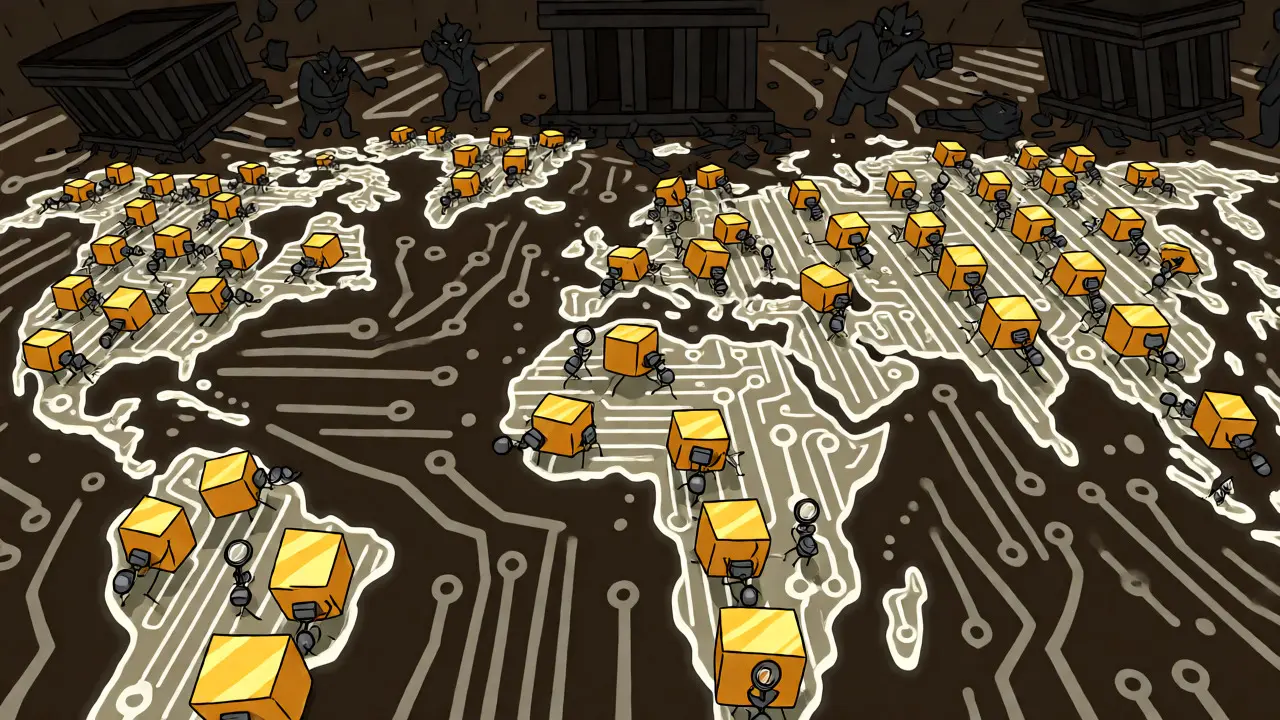
One of the most impressive aspects of Bitcoin’s P2P design is its fault tolerance. Traditional financial systems often suffer from single points of failure. If a major bank’s data center goes down, millions of transactions halt. In Bitcoin, there is no central server. If 30% of the nodes go offline due to a regional power outage or a fiber cut, the remaining 70% continue operating seamlessly.
This resilience extends to governance and upgrades. Since there is no central authority, changes to the protocol require broad consensus among developers, miners, and node operators. This slow-moving consensus mechanism prevents hasty decisions that could destabilize the network. It also means that Bitcoin is highly resistant to censorship. Governments can ban exchanges or shut down websites, but they cannot easily turn off the P2P network running on thousands of personal computers in basements and data centers around the world.
However, this decentralization comes with costs. Scalability is a persistent challenge. Because every full node must validate every transaction, the network throughput is limited compared to centralized systems like Visa. Solutions like the Lightning Network operate on top of the base layer, handling micro-transactions off-chain while settling final balances on the main P2P network. This hybrid approach preserves the security of the decentralized base layer while improving performance for everyday payments.
Do I need to run a full node to use Bitcoin?
No, you do not. Most users interact with Bitcoin through wallets that function as SPV (Simplified Payment Verification) clients. These lightweight applications connect to remote full nodes to verify transactions. However, running a full node provides maximum security and privacy, as you verify the rules yourself rather than trusting a third party.
What happens if all DNS seeds go down?
If DNS seeds fail, Bitcoin nodes fall back to hard-coded seed nodes embedded in the software. These are specific IP addresses of reliable, long-running nodes. Additionally, nodes remember peers they previously connected to. So, even if discovery mechanisms fail temporarily, existing nodes can reconnect to known peers, and new nodes can eventually find the network through manual configuration or community-shared IP lists.
How much bandwidth does a Bitcoin full node use?
Bandwidth usage varies based on network activity and the number of connections. On average, a typical full node uploads and downloads several gigabytes per day. During periods of high transaction volume or large block sizes, this can spike significantly. Users on metered connections should monitor usage, though modern broadband plans usually handle this load without issue.
Can my ISP block Bitcoin nodes?
ISPs can throttle traffic or block specific ports, but they cannot easily stop the network entirely. Bitcoin uses TCP/IP, so it looks like regular web traffic. Furthermore, features like Tor allow nodes to route traffic through encrypted tunnels, making it difficult for ISPs to distinguish Bitcoin traffic from other secure communications. As long as basic internet connectivity exists, the P2P network remains functional.
What is the difference between a seed node and a DNS seed?
A DNS seed is a domain name that returns a list of IP addresses when queried, acting as a dynamic directory. Seed nodes are specific, hard-coded IP addresses included in the Bitcoin Core source code. DNS seeds provide flexibility and scalability, while seed nodes offer a static fallback option if DNS resolution fails or is manipulated.