
Imagine you are trying to win a lottery where the odds of winning are one in ten billion. You buy one ticket every second. It might take you thousands of years to win. Now, imagine you join a group that buys billions of tickets together. Every time the group wins, they split the prize based on how many tickets each person contributed. That is exactly how mining pools are collaborative groups of cryptocurrency miners who combine their computational resources to increase their chances of earning block rewards. Instead of waiting for a solo breakthrough that may never come, pool members receive steady, smaller payouts.
The core question isn't just "how do we mine?" but "how is the money divided?" If you have ever looked at your mining dashboard and wondered why your payout looks different from your neighbor's, or why some pools charge higher fees than others, the answer lies in the reward distribution method. Understanding these mechanisms is crucial because it directly impacts your profitability, risk exposure, and even your hardware strategy.
The Foundation: What Is a "Share"?
To understand how rewards are shared, you first need to understand what you are being paid for. In blockchain mining, specifically Proof-of-Work systems like Bitcoin is a decentralized digital currency that uses proof-of-work consensus mechanism for transaction validation., miners compete to solve complex mathematical puzzles. The network sets a very high difficulty target. If your computer finds a solution that meets this exact target, you find a block and get the full reward (currently 3.125 BTC plus transaction fees).
However, finding a valid block is incredibly rare for an individual miner. So, mining pools set a much lower difficulty target called a share. A share is a valid proof-of-work result that proves you did the work, even though it wasn't good enough to win the main jackpot. Think of shares as entries in a raffle. The more shares you submit, the more tickets you hold in the pool's raffle. When the pool finally hits the big jackpot (finds a block), the total reward is distributed among all participants based on the number of shares they submitted during that period.
Pay-Per-Share (PPS): Stability Over Potential
Pay-Per-Share (PPS) is a mining pool payment scheme that pays miners a fixed amount for every valid share submitted, regardless of whether the pool finds a block. This is the most straightforward model for beginners. Here is how it works: the pool calculates an average payout per share based on recent luck and block rewards. For every valid share your rig sends to the pool, you get paid immediately. It doesn't matter if the pool finds a block today, tomorrow, or next week. You get paid for your work instantly.
This method offers incredible predictability. If you run a small operation with high electricity bills, knowing exactly how much you will earn helps with budgeting. However, there is a catch. Because the pool operator takes on all the variance risk (they pay you even when they don't find blocks), they charge higher fees. Typically, PPS pools charge between 1% and 5% more than other methods. Additionally, under strict PPS models, you often only receive the base block reward, not the transaction fees, which can be significant during high network congestion periods.
PPLNS: Rewarding Loyalty and Long-Term Play
Pay-Per-Last-N-Shares (PPLNS) is a mining pool payment system that distributes rewards based on the number of shares submitted within a specific window of time preceding a block discovery. Unlike PPS, PPLNS does not pay you per share. Instead, it looks back at the last N shares submitted by the entire pool before a block was found. If your shares fall within that window, you get a portion of the reward. The size of the window (N) varies by pool, but it usually spans several blocks worth of work.
Why would anyone choose this over PPS? Because PPLNS pools typically charge lower fees. Since the pool operator shares the risk with the miners (if no blocks are found, no one gets paid), they can afford to keep their cut smaller. More importantly, PPLNS captures transaction fees. When a block is found, the entire reward, including tips and fees, is split. This means during times of high network activity, PPLNS can be significantly more profitable than PPS.
There is a downside, though. PPLNS discourages "pool hopping." Pool hopping is when miners switch to a pool that has recently been lucky (found many blocks) to cash in, then leave when the luck runs out. Because PPLNS looks at a history of shares, new miners start with zero balance in the window. It takes time for your contribution to build up. If you switch pools frequently, you reset your progress and likely earn less. PPLNS rewards loyalty and steady participation.
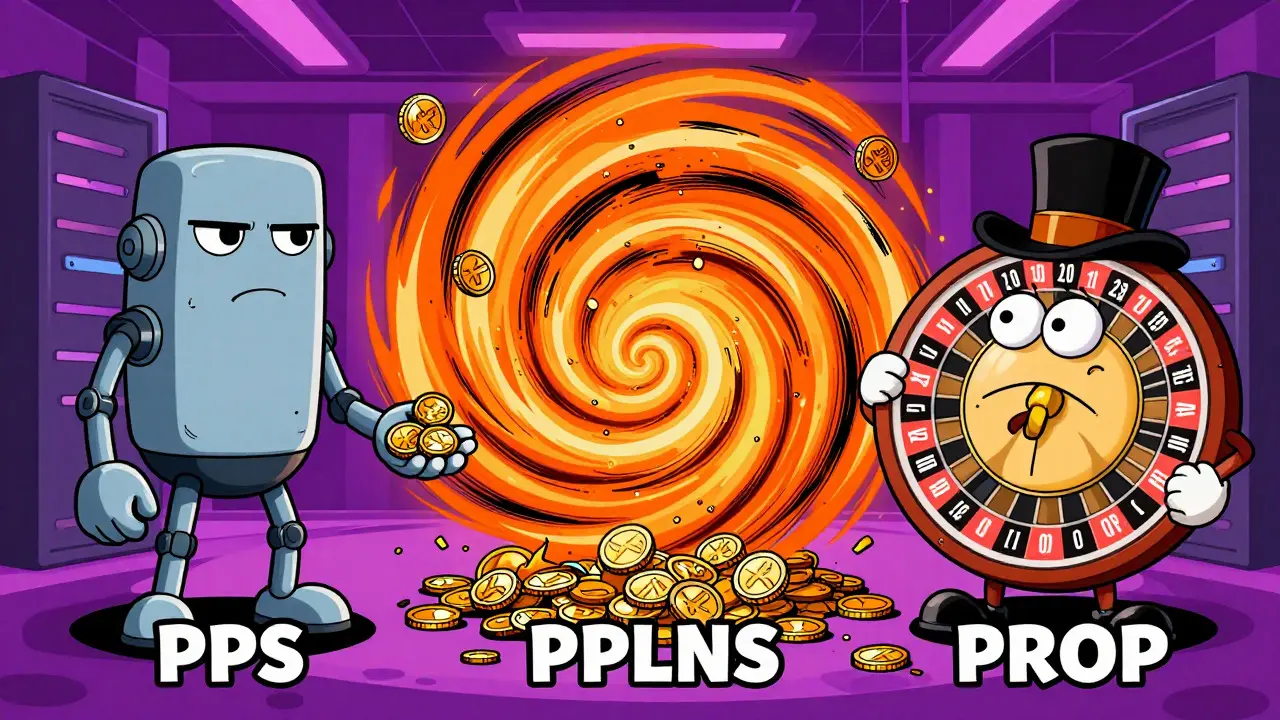
Proportional (PROP): Direct Contribution Split
Proportional (PROP) is a mining pool payout method where rewards are distributed strictly according to the percentage of shares each miner contributed to the specific block that was found. This model is simple but risky. You only get paid when the pool finds a block. If you contributed 10% of the total shares during the search for Block X, you get 10% of the reward from Block X. If the pool goes three days without finding a block, you earn nothing for those three days.
PROP puts the risk squarely on the miners. The pool operator keeps a flat fee (often lower than PPS) but guarantees themselves a profit only when the pool succeeds. This method is rarely used in major Bitcoin pools today because it encourages miners to leave unlucky pools quickly, destabilizing the network. However, it remains common in smaller altcoin pools where block times are shorter and variance is less punishing.
SOLO Mining: High Risk, Maximum Reward
SOLO mining is a mining approach where an individual miner or pool attempts to find blocks independently, keeping the entire block reward and transaction fees if successful. Technically, you can join a SOLO pool, but you are essentially playing alone against the rest of the network. If you find a block, you keep everything-no fees, no splits. With a current block reward of 3.125 BTC, that is a life-changing sum. But the odds are astronomical unless you control a massive percentage of the global hash rate. For most individuals, SOLO mining is a lottery ticket, not an income stream.
Comparison of Reward Distribution Methods
| Method | Payment Trigger | Income Stability | Pool Fees | Best For |
|---|---|---|---|---|
| PPS | Every valid share | High (Predictable) | Higher (1-5%) | Miners needing steady cash flow |
| PPLNS | Block found (based on recent shares) | Variable (Depends on luck) | Lower (0-2%) | Loyal miners seeking max long-term ROI |
| PROP | Block found (proportional to contribution) | Low (Zero if no block) | Low-Medium | Small altcoin pools |
| SOLO | Personal block discovery | None (All or nothing) | None (Usually) | Gamblers with huge hash power |

Hidden Factors: Luck, Fees, and Transaction Costs
When comparing pools, don't just look at the payout method. Look at "luck." Mining luck refers to how closely the actual block finding rate matches the expected statistical probability. A pool with "bad luck" might go longer than average between blocks. In PPS, the pool eats this loss. In PPLNS, the miners share the pain through reduced payouts during dry spells. Smart miners monitor pool luck metrics; a consistently unlucky pool might indicate underlying technical issues or simply bad RNG, causing them to switch.
Also, consider the withdrawal threshold and frequency. Some PPS pools pay out daily, while others require a minimum balance. If you are running a large farm, cash flow matters. If you are a hobbyist with a single GPU, you might prefer a pool with low minimum withdrawals so you can see your earnings accumulate visibly.
Choosing the Right Model for Your Setup
If you are a beginner with limited capital, PPS is often the safest bet. The psychological comfort of seeing consistent, albeit smaller, payments can keep you motivated. You avoid the stress of watching your balance sit at zero for weeks. However, ensure you calculate the net profit after the higher pool fees.
If you are an experienced miner with stable hardware and a long-term horizon, PPLNS is mathematically superior. By staying loyal to a reputable pool, you benefit from lower fees and the inclusion of transaction fees. Over six months or a year, the variance smooths out, and your earnings typically exceed what you would have made on PPS. Just remember: patience is part of the strategy.
For those experimenting with newer cryptocurrencies or altcoins, check if the pool uses PROP or PPLNS. Many smaller coins have shorter block times, making PROP less volatile than it is in Bitcoin. Always read the pool's documentation to understand exactly how they handle stale shares (shares that arrive too late to count) and orphaned blocks.
The Future of Reward Sharing
As mining becomes more industrialized, innovation continues. Recent academic research, such as a 2024 study on decentralized mining pools, explores reciprocity protocols that could allow miners to form temporary alliances without a central operator taking a cut. While still theoretical, these developments suggest a future where reward sharing is more transparent and efficient. For now, however, the battle between PPS stability and PPLNS potential remains the defining choice for millions of miners worldwide.
What is the difference between PPS and PPLNS?
PPS pays you a fixed amount for every valid share you submit, providing stable income but charging higher fees. PPLNS pays you based on your share contribution relative to the total shares submitted in a recent window when a block is found, offering potentially higher profits (including transaction fees) but with variable income and lower fees.
Is PPS better for beginners?
Yes, PPS is generally better for beginners because it offers predictable, immediate payouts. This helps new miners manage cash flow and understand their earnings without worrying about pool luck or long waiting periods for block discoveries.
Do mining pools charge fees?
Yes, all mining pools charge fees to cover operational costs and profit. PPS pools typically charge higher fees (1-5%) because they assume more risk. PPLNS and PROP pools usually charge lower fees (0-2%) because the risk is shared with the miners.
What is pool hopping?
Pool hopping is the practice of switching between mining pools to take advantage of short-term luck or favorable conditions. PPLNS pools are designed to discourage this by rewarding long-term loyalty, whereas PPS pools are less affected by hopping since payments are immediate.
Can I earn transaction fees with PPS?
Typically, no. Standard PPS models pay out only the base block reward. Transaction fees are usually retained by the pool operator or distributed separately. PPLNS models include transaction fees in the total reward pool, allowing miners to benefit from high network activity.
What happens if a mining pool goes bankrupt?
In PPS pools, if the operator mismanages funds and goes bankrupt, miners may lose unpaid balances. Reputable pools use escrow services or transparent accounting. In PPLNS, since payouts happen directly upon block discovery, the risk of losing accumulated "credits" is lower, but trust in the operator remains essential.
How does Bitcoin halving affect mining pools?
Halving reduces the base block reward (e.g., from 6.25 to 3.125 BTC). This decreases the total pot available for distribution. Pools must adjust their PPS rates downward. Miners may see reduced income unless offset by rising Bitcoin prices or increased transaction fees, making efficiency and low-cost electricity more critical.







Heather Austin
honestly pplns is the only way to go if you actually want to make money long term. sure pps feels nice because you see cash every day but those fees eat you alive over time. i switched my whole farm to a low fee pplns pool two years ago and never looked back. the variance is scary at first when you have dry spells but trust me it smooths out. plus you get the transaction fees which can be huge during bull runs.