
Imagine selling Bitcoin is the world's most popular cryptocurrency and a primary target of India's new taxation framework for a profit, only to realize that nearly a third of your gains vanish instantly. This isn't a hypothetical scenario for traders in India; it is the daily reality under the government's stringent digital asset regulations. If you are navigating the Indian crypto market, understanding these rules is not just helpful-it is essential to avoid costly penalties.
The landscape changed dramatically on April 1, 2022, when Finance Minister Nirmala Sitharaman introduced a flat 30% tax on all gains from Virtual Digital Assets (VDAs). This move placed India among the nations with the highest crypto tax rates globally. But the story doesn't end at the headline rate. With surcharges, cess, and additional deductions, the real cost of trading can be significantly higher. Let’s break down exactly how this works, what it means for your wallet, and how to stay compliant without losing your mind.
Understanding the Core Tax Structure
To grasp the impact, we first need to define what is being taxed. The Income Tax Department uses the term Virtual Digital Assets (VDAs) is a legal classification covering cryptocurrencies, NFTs, tokens, and other digital assets under Section 2(47A) of the Income Tax Act. This definition is broad. It includes Bitcoin, Ethereum, non-fungible tokens (NFTs), and even utility tokens. However, it explicitly excludes gift cards and vouchers.
The central pillar of this regime is Section 115BBH is the specific clause in the Indian Income Tax Act that mandates a flat 30% tax rate on gains from VDAs. Here is why this matters for you:
- Flat Rate: Unlike traditional stocks or property, there is no distinction between short-term and long-term capital gains. Whether you held your Bitcoin for one day or ten years, the base tax rate is 30%.
- No Deductions: You cannot deduct transaction fees, storage costs, or administrative expenses. The only deductible expense is the original cost of acquisition.
- Effective Rate: For most individual investors, adding the 4% health and education cess brings the effective tax rate to 31.2%. If your income exceeds certain thresholds, surcharges can push this even higher.
This structure treats crypto gains differently from almost any other investment class in India. There is no benefit for holding assets longer, which fundamentally changes how traders approach their portfolios.
The Hidden Trap: No Loss Offsetting
If the 30% rate feels steep, wait until you hear about the loss offsetting rule. This is perhaps the most controversial aspect of the current framework. In traditional equity markets, if you lose money on one stock but gain on another, you can net those figures out. Your taxable income is based on the net profit.
In the world of Indian crypto taxation, this luxury does not exist. Losses from one cryptocurrency cannot be set against gains from another. Nor can you carry forward losses to future financial years. Let’s look at a concrete example:
Suppose you buy Bitcoin and lose ₹30,000. Simultaneously, you trade Ethereum and make a ₹30,000 profit. On paper, your net position is zero. You haven't really gained anything. However, under Section 115BBH, you must pay 30% tax on the ₹30,000 Ethereum gain. That means you owe ₹9,000 in taxes, despite having broken even overall. This rule creates artificial tax liabilities and has been widely criticized by tax professionals as punitive.

TDS and GST: The Additional Layers
The income tax is not the only deduction you will face. The government introduced two other mechanisms to ensure compliance and track transactions.
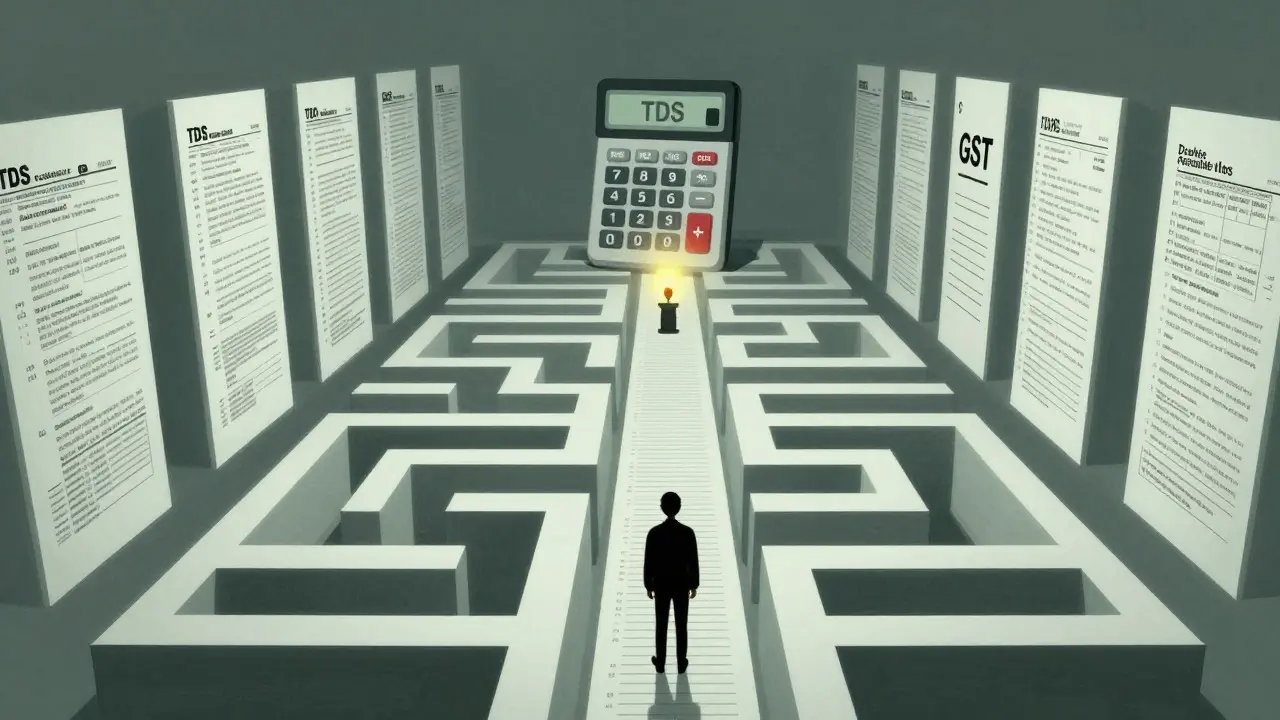
First, there is Tax Deducted at Source (TDS) is a mechanism under Section 194S requiring exchanges to deduct 1% tax on crypto transfers exceeding specified thresholds. Effective July 1, 2022, exchanges must deduct 1% TDS on every crypto transfer if the annual value exceeds ₹50,000 (or ₹10,000 in certain cases). This money is not lost; it is credited to your tax account. However, it reduces your immediate liquidity. You must file your returns to claim this credit back.
Second, starting in July 2025, an 18% Goods and Services Tax (GST) was applied to crypto platform services. This means the fees you pay to exchanges for trading are now subject to GST. While this doesn't directly tax your profits, it increases the cost of doing business. Combined with the 30% income tax and 1% TDS, you are looking at a comprehensive three-tier taxation structure that impacts every stage of your trading journey.
| Country | Tax Rate on Gains | Loss Offsetting Allowed? | Long-Term Benefits |
|---|---|---|---|
| India | 30% (+ cess/surcharge) | No | None |
| United States | 0%, 15%, or 20% | Yes | Lower rates after 1 year |
| Germany | 0% (after 1 year) | Yes | Tax-free after 1 year hold |
| Singapore | 0% | N/A | No capital gains tax |
| United Kingdom | 10% or 20% | Yes | Standard CGT allowances |
Compliance and Record Keeping
With high stakes comes high responsibility. The Indian system demands meticulous record-keeping. You cannot rely on vague estimates. For every transaction, you need to document:
- Purchase date and amount
- Sale date and amount
- Exchange rates at the time of transaction
- Cost basis (original purchase price)
When filing your income tax return, you must use the new Schedule VDA. This schedule requires specific reporting of all crypto gains and losses. For simple buy-and-hold investors, this might take 10-15 hours annually. For active traders managing multiple assets across different platforms, expect to spend 40-50 hours ensuring accuracy.
Mistakes here are costly. Underreporting can lead to penalties, while overpaying means leaving money on the table. Many traders now use specialized software like ClearTax or Koinly, which have updated their modules to handle India-specific crypto tax calculations. These tools help automate the complex math, especially regarding the non-offsetting loss rules.
Market Impact and Future Outlook
Has this strict regime worked? The data suggests mixed results. Industry reports indicate a 40-60% decline in trading volumes on Indian exchanges following the April 2022 implementation. Retail participation has contracted, and many users have migrated to international platforms or peer-to-peer (P2P) markets to avoid immediate scrutiny. However, this migration creates its own compliance headaches, as the government continues to tighten tracking mechanisms.
Institutional adoption remains minimal due to the unfavorable tax treatment compared to traditional investments. The user demographic has shifted toward long-term holders rather than active traders, as the tax structure particularly penalizes frequent buying and selling.
Looking ahead, regulatory experts predict potential modifications. The Reserve Bank of India (RBI) and Securities and Exchange Board of India (SEBI) are expected to integrate crypto reporting into broader digital asset frameworks. While no official timeline exists for changing the 30% rate, the pressure from industry bodies and the need to foster digital innovation may lead to revisions in loss offsetting rules or TDS thresholds in the coming years.
Practical Tips for Traders
So, what should you do right now? Here are some actionable steps to manage your tax liability effectively:
- Track Everything: Use automated tools to log every transaction immediately. Do not wait until tax season.
- Understand TDS Credits: Ensure your exchange provides accurate TDS certificates. Claim these credits when filing to avoid double payment.
- Consult Professionals: Given the complexity of Section 115BBH and the lack of loss offsetting, a chartered accountant specializing in crypto can save you significant money.
- Plan Holdings: Since holding period doesn't lower the tax rate, focus on minimizing transaction frequency to reduce GST and fee exposure.
The Indian crypto tax landscape is complex, but it is navigable. By staying informed and organized, you can protect your gains and comply with the law without unnecessary stress.
What is the exact tax rate on crypto gains in India?
The base tax rate is 30% under Section 115BBH. When you add the 4% health and education cess, the effective rate becomes 31.2% for most individuals. Higher-income earners may face additional surcharges, pushing the total rate even higher.
Can I offset my crypto losses against gains?
No. One of the most restrictive rules is that losses from one cryptocurrency cannot be set off against gains from another. Additionally, losses cannot be carried forward to future financial years. Each gain is taxed independently.
Does the 1% TDS apply to all transactions?
The 1% TDS under Section 194S applies to crypto transfers where the annual value exceeds ₹50,000 (or ₹10,000 in specific cases). It is deducted by the exchange at the source and credited to your tax account upon filing returns.
Is there a difference between short-term and long-term capital gains for crypto?
No. Unlike stocks or property, the Indian crypto tax regime applies a flat 30% rate regardless of how long you hold the asset. Holding Bitcoin for ten years offers no tax advantage over holding it for ten days.
How does the 18% GST affect crypto traders?
Implemented in July 2025, the 18% GST applies to services provided by crypto platforms. This means the trading fees and charges you pay to exchanges are now subject to GST, increasing the overall cost of trading activities.