Imagine paying pennies for electricity while your neighbors endure hours of daily blackouts. That is the reality in Iran, where cryptocurrency mining has become a lucrative business fueled by heavily subsidized power. The government allows licensed miners to access electricity at rates as low as $0.01 per kilowatt-hour, creating profit margins that dwarf those in any other country. But this economic advantage comes at a steep price: a strained national grid, widespread public frustration, and complex political maneuvering.
If you are trying to understand why Iran remains a major player in the global Bitcoin market despite international sanctions, you need to look at its energy policy. It is not just about technology; it is about how the state uses cheap power to generate foreign currency while struggling to keep the lights on for ordinary citizens. This guide breaks down the economics, the regulations, and the human cost of Iran’s mining boom.
The Economics of Subsidized Power
The core driver of Iran’s mining industry is the massive disparity between local electricity costs and global averages. In most developed nations, industrial electricity rates can exceed $0.10 or even $0.20 per kWh. In Iran, however, the government provides power to certain sectors at rates ranging from $0.01 to $0.05 per kilowatt-hour. For licensed cryptocurrency miners, these rates are often set at industrial tariffs, which still remain incredibly low compared to competitors like Italy or the United States.
This subsidy structure makes Bitcoin mining exceptionally profitable. According to data from late 2024 and early 2025, the estimated cost to mine a single Bitcoin in Iran was around $1,300. With global market prices fluctuating between $30,000 and $40,000 during that period, miners enjoyed profit margins of 20 to 30 times their production cost. To put this in perspective, mining one Bitcoin requires over 300 megawatt-hours of electricity. At Iranian rates, this energy cost is negligible. In contrast, similar operations in Europe might face costs exceeding $300,000 per coin due to higher energy prices and regulatory fees.
| Country/Region | Est. Electricity Rate (USD/kWh) | Est. Cost to Mine 1 BTC | Regulatory Status |
|---|---|---|---|
| Iran | $0.01 - $0.08 | $1,300 | Licensed only; strict quotas |
| Kazakhstan | $0.05 - $0.10 | $5,000 | Permitted with registration |
| United States | $0.06 - $0.15 | $15,000+ | Legal; varies by state |
| Italy | $0.15 - $0.30 | $306,000 | Banned/Restricted |
These numbers explain why Iran has attracted an estimated 3.5 to 4.2 million ASIC devices. The sector is projected to generate $1.5 billion annually by 2025, growing at a rate of 23.7% per year. For the Iranian government, this revenue stream is vital for circumventing international sanctions and securing hard currency for cross-border trade.
Grid Strain and Public Backlash
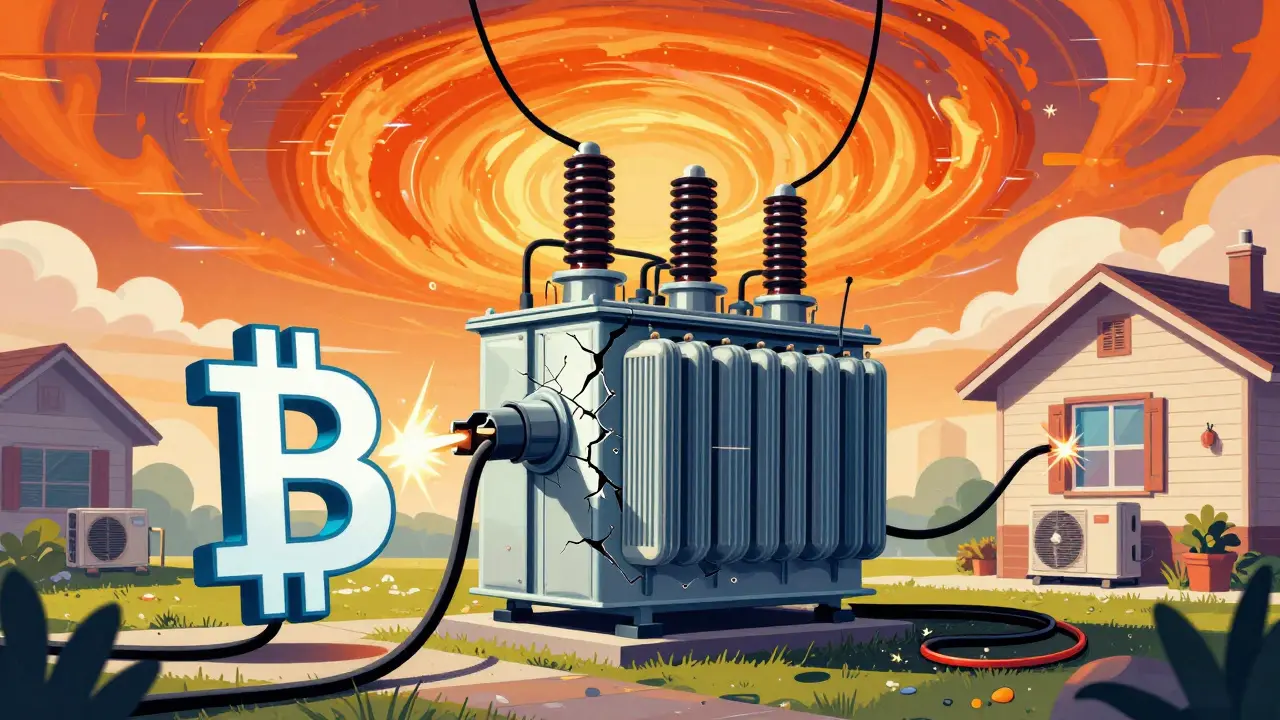
The profitability of mining does not come without severe consequences for the national infrastructure. Iran’s power grid has suffered from decades of underinvestment, operating at only 60-70% of required capacity. Cryptocurrency mining consumes nearly 2,000 megawatts (MW) of electricity, representing about 5% of the country’s total consumption but accounting for 15-20% of the electricity imbalance. During peak summer months, when air conditioning demand surges by 30-40%, this strain becomes critical.
The result is frequent and prolonged blackouts. In mid-2025, a nationwide internet outage linked to regional conflicts caused power consumption to drop by 2,400 MW when over 900,000 illegal mining devices were temporarily shut down. This event highlighted the scale of the issue: illegal miners alone consume up to two gigawatts of power daily-equivalent to the electricity usage of Tehran, a city of 9 million residents.
Public frustration is palpable. Social media platforms are filled with complaints from citizens enduring 8-12 hours of daily blackouts during summer. One resident noted, "They only mine cryptocurrency, but we are deprived of electricity." Telegram channels share real-time blackout maps, correlating outages with known mining locations. When Bitcoin prices surge, blackouts often increase by 30-40% within 48 hours, suggesting that miners ramp up operations during profitable periods regardless of grid stability.

Legal vs. Illegal Operations
The Iranian government maintains a dual approach to cryptocurrency mining. On one hand, it licenses and regulates large-scale operations to capture revenue. On the other hand, it cracks down on illegal miners who steal subsidized household electricity. This distinction is crucial for understanding the landscape.
Licensed miners must navigate a complex regulatory pathway. They need approval from the Ministry of Industry for equipment imports, registration with the Iran Power Generation Company for electricity quotas, and authorization from the Central Bank of Iran (CBI) for cryptocurrency exports. The process takes 3-6 months, with approval rates below 40%. Successful applicants pay industrial tariffs of $0.04-$0.07/kWh and must use state-approved mining pools that take 15-20% commission fees.
Illegal miners, however, operate outside this system. They tap into residential grids, paying household rates of $0.01-$0.02/kWh. This creates a strong incentive for illicit activity. The government has responded with aggressive enforcement, including a financial incentive program that offers 10% of recovered electricity costs to citizens who report illegal operations. In the first six months of 2025, this led to 8,432 reports and 2,157 shutdowns.
The Islamic Revolutionary Guard Corps (IRGC) plays a significant role in both legal and illegal sectors. Reports suggest the IRGC controls approximately 60% of illegal mining operations, effectively turning them into state-sanctioned enterprises. Critics argue this represents "state-sanctioned theft of public resources," bypassing central bank oversight and creating a parallel economy.
Regulatory Landscape and Future Outlook
Iran’s regulatory framework is evolving rapidly. While domestic cryptocurrency payments are prohibited by the CBI, the government authorizes mined coins for cross-border trade settlement. This policy allows Iran to import sanctioned goods using cryptocurrency, channeling approximately $700 million toward such transactions in 2024.
Recent changes in early 2025 require all mining operations to register with industrial-scale facilities and implement smart meters for real-time monitoring. The goal is to reduce the shadow economy and better manage grid load. However, experts warn that without significant grid upgrades, power shortages could increase by 25-30% by 2027. The International Energy Agency notes that Iran faces a dilemma: short-term economic gains versus long-term infrastructure sustainability.
The future likely involves continued periodic bans during peak demand periods, particularly in summer. Winter months offer more stable conditions for mining, but the seasonal volatility remains a risk for investors. As Kazakhstan emerges as a competitor with lower regulatory friction, Iran must balance its reliance on mining revenue with the need to maintain social stability and grid reliability.
Key Takeaways for Investors and Observers
- Cost Advantage: Iran offers some of the lowest mining costs globally ($1,300/BTC), driven by heavy energy subsidies.
- High Risk: Regulatory uncertainty, grid instability, and potential for sudden shutdowns pose significant operational risks.
- Political Control: The IRGC’s dominance in the sector means profits may not flow freely to private entities.
- Sanctions Evasion: Mining serves as a tool for bypassing international financial restrictions, making it a strategic priority for the state.
- Public Sentiment: Widespread resentment among citizens due to blackouts could lead to stricter crackdowns or policy shifts.
Is cryptocurrency mining legal in Iran?
Yes, but only under strict licensing. The government legalized mining in 2018 and requires operators to obtain permits from multiple agencies. However, domestic use of cryptocurrency for payments is banned. Miners must sell their output to authorized exchanges for trade settlement.
How much electricity do Iranian miners use?
Cryptocurrency mining consumes nearly 2,000 MW of electricity, representing about 5% of Iran's total consumption. Illegal miners alone may use up to two gigawatts daily, equivalent to the power needs of Tehran.
Why does Iran subsidize crypto mining?
The primary motive is economic survival under sanctions. By generating Bitcoin through cheap energy, Iran earns foreign currency to facilitate cross-border trade and import essential goods without using the traditional banking system.
What happens during summer blackouts?
The government often imposes temporary bans on mining operations during peak summer demand to prevent grid collapse. These bans can last for weeks, disrupting mining activities and reducing income for operators.
Who controls the majority of mining operations?
Reports indicate that the Islamic Revolutionary Guard Corps (IRGC) controls approximately 60% of illegal mining operations and holds significant influence over licensed facilities, allowing the state to capture most of the revenue.