
Buying Bitcoin or Ethereum in Canada is legal. But if you think the rules are simple, you’re wrong. The real headache isn’t federal law-it’s the patchwork of provincial restrictions that change depending on where you live. One province might welcome your mining rig; another will cut off your power supply before you even plug it in.
As of 2026, Canada treats cryptocurrency as a commodity, not legal tender. This means it falls under tax laws and securities regulations rather than currency laws. The federal government handles anti-money laundering (AML) through FINTRAC (Financial Transactions and Reports Analysis Centre of Canada), but the day-to-day oversight of who can trade what-and whether you can mine at all-is decided by provincial regulators.
This guide breaks down exactly how these rules work across key provinces, so you don’t accidentally break the law while trying to invest or mine.
The Federal Baseline: What Applies Everywhere
Before diving into provincial differences, you need to understand the floor. Every crypto business operating in Canada must register with FINTRAC as a Money Service Business (MSB). This applies to exchanges, wallet providers, and anyone facilitating crypto transactions. If a platform isn’t registered, you shouldn’t trust it with your funds.
Taxation is also federally managed. The Canada Revenue Agency (CRA) views crypto as property. When you sell, trade, or spend crypto, you trigger a capital gains event. You only pay tax on 50% of your gain, calculated at your marginal income tax rate. Buying crypto with CAD, holding it, or gifting it between personal wallets is tax-free. But remember: using Bitcoin to buy coffee counts as a disposal event for tax purposes.
| Action | Regulatory Body | Requirement |
|---|---|---|
| Operating an Exchange | FINTRAC | Mandatory MSB Registration |
| Selling/Trading Crypto | CRA | Report 50% of gains as capital income |
| Listed Investment Funds | CSA | Must comply with NI 81-102 (updated 2025) |
Quebec: The Strictest Mining Jurisdiction
If you are interested in Bitcoin mining, Quebec is effectively off-limits for new projects. In January 2023, the Régie de l'énergie (Quebec's energy regulatory body) suspended capacity allocations for cryptographic blockchain use. They didn’t just raise prices; they stopped approving new connections entirely for miners.
For existing large-scale operations, Quebec introduced a punitive electricity rate of 16.603 cents per kWh for facilities using over 50 kilowatts. Compare this to residential rates which are often below 7 cents. This policy was designed to protect grid stability during winter peaks. For individual hobbyists with small setups, the ban is less enforced, but scaling up is impossible without facing prohibitive costs or rejection.
On the trading side, Quebec follows the national standard set by the Autorité des marchés financiers (AMF). You must use authorized platforms. As of 2025, major players like Kraken and Crypto.com have secured decisions allowing them to operate here, provided they meet strict investor protection standards.
British Columbia: Power Cuts and Utility Control
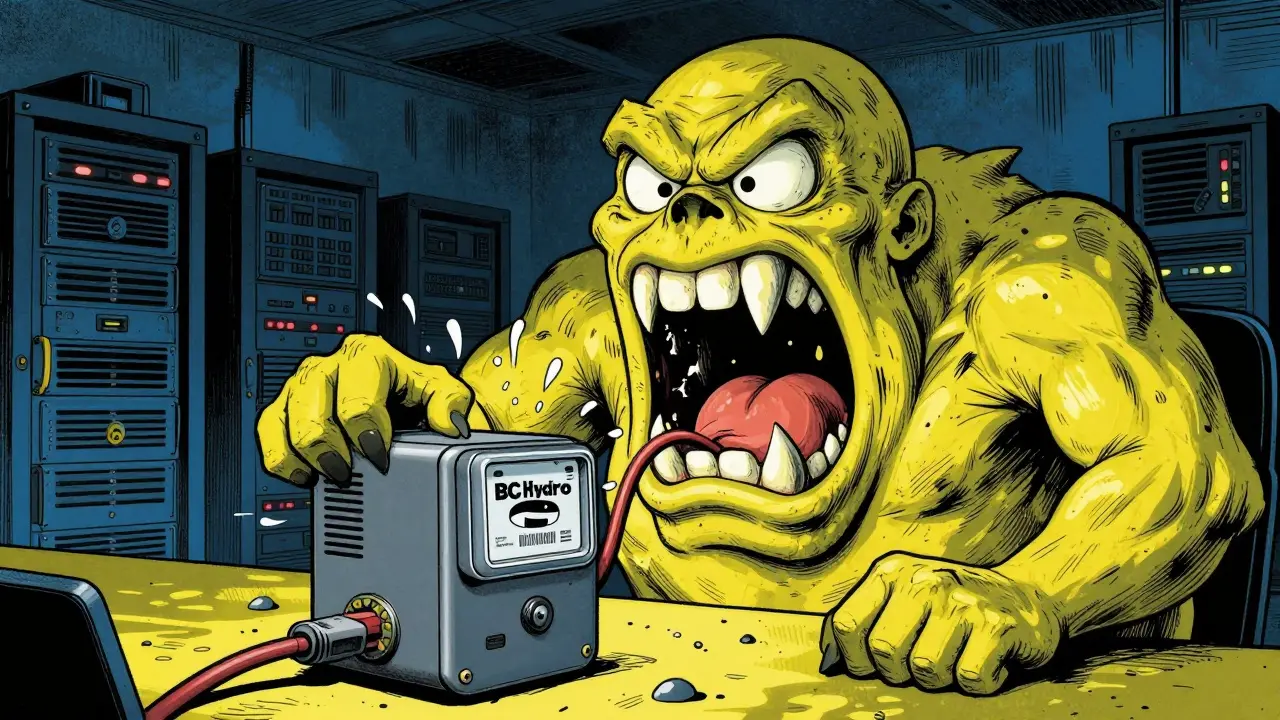
British Columbia took a different approach to mining. Instead of a flat ban, they gave utilities the power to restrict service. Effective May 17, 2024, amendments to the BC Utilities Commission Act allowed BC Hydro to prohibit, restrict, or regulate electricity service for mining projects permanently.
This followed a temporary moratorium issued in December 2022, which paused new mining connections for 18 months. The permanent legislation means that even if you have money to build a farm, BC Hydro can deny you access based on grid load concerns. This has cooled the mining boom that previously made BC a top global hub due to its hydroelectric abundance.
For traders, the British Columbia Securities Commission (BCSC) works closely with the CSA. Authorized platforms like Ndax and Newton Crypto operate legally here. The focus remains on preventing fraud and ensuring platforms segregate client assets from company funds.
Ontario: The Hub for Institutional Crypto
Ontario is home to the largest financial sector in Canada, and its crypto regulation reflects that maturity. The Ontario Securities Commission (OSC) enforces the same national instrument rules as other provinces but processes more applications due to the volume of businesses based there.
In 2025, Ontario saw significant movement in institutional adoption. The approval of Public Crypto Asset Funds under National Instrument 81-102 allowed traditional investment firms to offer regulated crypto products. This brought clarity on custody requirements and permitted asset types. If you are an investor looking for exposure through a registered fund rather than a direct exchange, Ontario offers the most options.
Trading platforms must be explicitly authorized by the OSC to solicit clients in the province. Platforms like Fidelity Digital Assets Services operate as exempt marketplaces, catering mostly to institutional clients. Retail investors should stick to fully authorized exchanges to ensure their deposits are protected under provincial insurance schemes.
Alberta and Saskatchewan: Energy-Friendly Approaches
While Quebec and BC tightened screws on mining, Alberta and Saskatchewan maintained a more open stance, leveraging their abundant natural gas and renewable resources. The Alberta Securities Commission (ASC) regulates trading platforms similarly to Ontario, authorizing entities like Kraken and Crypto.com to operate freely.
There is no blanket ban on mining in Alberta. However, miners must navigate complex environmental assessments and grid connection fees. The province encourages innovation but demands rigorous reporting on emissions and efficiency. For startups, this means higher upfront compliance costs but greater long-term certainty compared to the volatile policies in BC.
Saskatchewan follows a similar model. Its smaller population means fewer retail platforms operate exclusively there, but major national exchanges cover the jurisdiction. The regulatory burden is lighter, making it an attractive base for smaller crypto service providers who want to avoid the intense scrutiny of Toronto or Vancouver.

Navigating Provincial Authorization Lists
The biggest risk for Canadian crypto users is using an unauthorized platform. Each provincial regulator maintains a list of approved trading platforms. As of mid-2025, the landscape looks like this:
- Kraken (Payward Canada Inc.): Authorized in Alberta, BC, Manitoba, and Saskatchewan.
- Crypto.com (Foris DAX CAN ULC): Received decision on May 8, 2025, expanding its operational scope.
- Newton Crypto Ltd.: Amended decision granted March 12, 2025.
- Ndax Canada Inc.: Authorized April 1, 2025.
- Fidelity Digital Assets: Operates as an Exempt Marketplace since January 2023.
If a platform is not on your province’s specific list, you may still be able to use it, but you lose regulatory recourse if something goes wrong. Always check the latest status on the CSA website or your provincial regulator’s portal before depositing funds.
Why Fragmentation Matters for Your Wallet
The lack of a unified federal crypto law creates friction. A startup launching in Toronto must apply separately in BC, Alberta, and Quebec to go national. This delays time-to-market and increases legal costs, which often get passed on to users via higher fees.
For individuals, the main impact is on mining viability and product availability. You won’t find Bitcoin ATMs in every corner of Quebec due to stricter local interpretations of AML rules. Conversely, Ontario residents have access to a wider range of regulated ETFs and staking services because of the province’s sophisticated financial infrastructure.
Looking ahead, expect further tightening on AML compliance rather than new bans. The government’s priority is integrating crypto into the traditional financial system safely, not stifling it entirely. Stay compliant, use authorized platforms, and keep detailed records for the CRA.
Is Bitcoin mining illegal in Canada?
No, Bitcoin mining is not illegal in Canada. However, provinces like Quebec and British Columbia have implemented strict restrictions on new mining projects due to energy consumption concerns. Quebec suspended new capacity allocations, and BC allows utilities to deny service. Other provinces like Alberta remain more open but require environmental compliance.
Which crypto exchanges are legal in Canada?
Legal exchanges must be authorized by provincial securities regulators. As of 2025, authorized platforms include Kraken, Crypto.com, Newton Crypto, Ndax, and Fidelity Digital Assets. Availability varies by province, so you must check if your chosen exchange is approved in your specific jurisdiction.
How much tax do I pay on crypto gains in Canada?
The Canada Revenue Agency taxes 50% of your capital gains from crypto. This amount is added to your annual income and taxed at your marginal rate. For example, if you made $10,000 in profit, $5,000 is taxable. Buying, holding, or gifting crypto is not a taxable event.
Do I need to register my crypto business with FINTRAC?
Yes. Any Virtual Asset Service Provider (VASP) operating in Canada must register with FINTRAC as a Money Service Business. This includes exchanges, wallet providers, and payment processors. Failure to register is a criminal offense under the Proceeds of Crime and Terrorist Financing Act.
Can I use crypto to buy goods and services in Canada?
Yes, but it triggers a tax event. Using crypto to purchase goods is considered a disposal by the CRA. You must calculate the fair market value of the crypto at the time of transaction and report any capital gain or loss. Merchants accepting crypto must also comply with AML regulations.






Miss Masquer
living in quebec and reading this just confirmed why my neighbor stopped mining last year the electricity rates are absolutely insane for anyone trying to run anything serious it is not just a suggestion it is a hard stop from the regulatory body so if you are thinking about setting up a farm here think again because the grid stability arguments are real and they are enforced with teeth