Have you ever felt the sting of slippage when trying to execute a large trade on a decentralized exchange? You put in your order, hit swap, and watch as the price moves against you because there just isn't enough liquidity in the pool. It’s frustrating, expensive, and frankly, it shouldn’t happen if you’re using the right tools. This is exactly the problem Orion, a DeFi platform operating on the Binance Smart Chain (BSC), claims to solve.
Orion markets itself with a bold promise: "A DEX with the liquidity of a CEX." In plain English, this means you get the security and control of keeping your funds in your own wallet while accessing the massive trading volumes usually reserved for centralized giants like Binance. But does it actually work, or is it just another flashy DeFi project promising the moon? Let’s break down what Orion (BSC) really offers, where it falls short, and whether it deserves a spot in your trading toolkit.
What Is Orion (BSC)?
To understand Orion, you first need to grasp the concept of a liquidity aggregator. Most decentralized exchanges (DEXs) like Uniswap rely on Automated Market Makers (AMMs). These are pools of tokens provided by users. If you want to buy Bitcoin on Uniswap, you’re swapping against whatever liquidity is currently in that specific pool. If the pool is small, your big buy order pushes the price up significantly before you even finish the trade. That’s slippage.
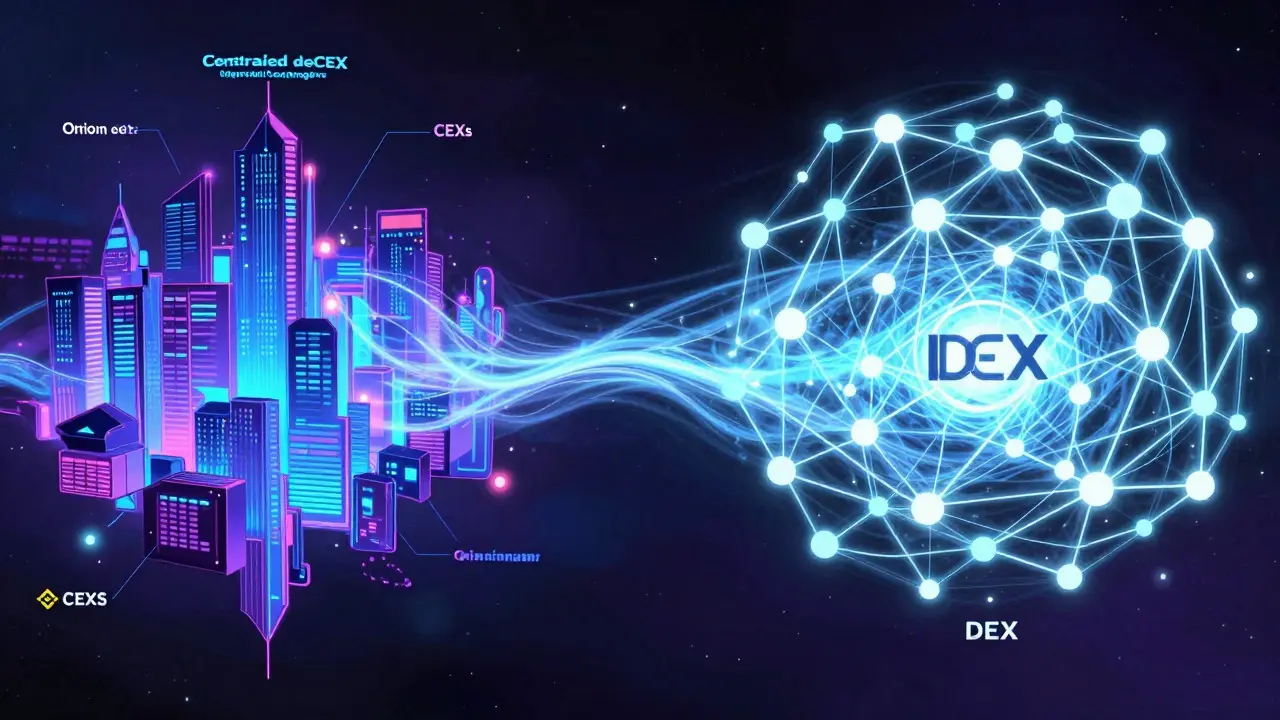
Orion takes a different approach. Founded by Alexey Koloskov, Orion was built to aggregate liquidity from over 50 different sources-both centralized exchanges (CEXs) and other DEXs. Its proprietary technology, called deCEX (decentralized Centralized Exchange), allows you to route your trades through these various venues without ever leaving your non-custodial wallet.
The BSC version of Orion launched in Q2 2021 specifically to tackle the high gas fees that plagued Ethereum during peak DeFi seasons. By moving to Binance Smart Chain, Orion aims to offer faster transaction times and lower costs while still leveraging its unique cross-platform liquidity engine.
How deCEX Technology Works
The magic behind Orion is its ability to bridge two worlds that rarely talk to each other: the permissionless world of DeFi and the order-book world of CeFi. Here is how it functions in practice:
- Liquidity Aggregation: When you initiate a trade, Orion’s algorithm scans dozens of liquidity sources simultaneously. It doesn’t just look at one pool; it looks at Binance, Kraken, Uniswap, and others.
- Price Improvement: According to data from DeFi Llama, Orion typically provides price improvements of 1.2% to 2.8% compared to standard DEX swaps. For a $10,000 trade, that’s a saving of $120 to $280 instantly.
- Non-Custodial Security: Unlike sending money to Binance, your private keys never leave your possession. You connect via MetaMask or Trust Wallet, approve the transaction, and the smart contract handles the rest.
- Cross-Chain Capability: While we are focusing on the BSC implementation here, the underlying tech supports multiple networks, allowing for flexible routing strategies.
This setup is particularly powerful for larger trades. A Reddit user noted saving $255 on a $15,000 BTC purchase by using Orion instead of trading directly on Binance, simply because Orion found a better composite price across multiple venues.
User Experience and Interface
Powerful technology means nothing if the interface is confusing. Orion’s web interface at orion.xyz is clean but can feel dense for beginners. The learning curve is real; internal surveys suggest it takes about 8 to 12 hours to fully master all features.
Once connected, the dashboard shows you available pairs and estimated price improvements. You’ll see options for different slippage tolerances and network fees. The mobile app, launched in October 2024, brings this functionality to iOS devices, though some users report occasional connection issues with certain browser extensions on desktop.
Support response times are generally quick, averaging 2 hours for priority tickets. However, documentation for beginners is somewhat sparse. If you are new to DeFi, you might find yourself digging through Discord channels (where they have nearly 48,000 members) to answer basic questions about gas fees or wallet connections.
Fees, Gas, and Tokenomics
Cost is always a factor. On BSC, gas fees are generally low, often costing just a few cents per transaction. However, Orion charges a protocol fee on top of the network gas. This fee varies based on the asset pair and volume.
The native token, ORN, plays a role in governance and fee discounts. Launched in early 2020, ORN has seen significant volatility. As of late 2025, it trades around $0.26. Critics, including researcher Nic Carter, have pointed out that the token’s utility remains primarily governance-focused, which can make its value disconnected from actual platform usage metrics.
If you hold ORN, you may be eligible for reduced fees or participation in referral programs. One user reported earning 15% cashback on trading fees through the referral program, which is significantly higher than industry averages.
Security and Audits
In crypto, trust is earned, not given. Orion operates on a non-custodial model, meaning if you lose your seed phrase, no one can help you recover your funds. That’s the risk of self-custody. But what about the smart contracts themselves?
Orion has undergone regular third-party audits. The most recent comprehensive audit was conducted by CertiK in July 2024. The report highlighted the robustness of their aggregation logic but also noted standard risks associated with oracle dependencies. Orion uses Chainlink for price feeds, adding another layer of reliability.
Despite these measures, regulatory scrutiny remains a shadow over the platform. The SEC issued an inquiry letter in April 2024 regarding their deCEX technology, specifically questioning how accessing centralized order books fits into current securities laws. While not a ban, this creates uncertainty for institutional adoption.

Orion vs. Competitors
How does Orion stack up against the heavyweights? Let’s compare it to 1inch and Uniswap.
| Feature | Orion (BSC) | 1inch | Uniswap |
|---|---|---|---|
| Liquidity Source | CEX + DEX Aggregator | DEX Aggregator Only | Single AMM Pool |
| Price Improvement | High (1.2-2.8%) | Moderate | Low (depends on pool depth) |
| Total Value Locked (TVL) | $1.8 Million | $247 Million | $5.2 Billion |
| Best For | Large trades, arbitrage | General DEX swaps | Ethereum ecosystem liquidity |
| Regulatory Risk | Higher (SEC inquiry) | Lower | Low |
Uniswap is the king of TVL but suffers from slippage on large orders due to isolated pools. 1inch is a great aggregator but lacks access to centralized exchange order books due to regulatory constraints. Orion sits in the middle, offering the best prices for those willing to navigate a slightly more complex interface and accept higher regulatory ambiguity.
The Future: Transition to Lumia
Orion is not standing still. The company is transitioning toward a new blockchain solution called Lumia, described as the "First Hyper-Liquid Layer 2." Scheduled for full mainnet launch in November 2025, Lumia aims to handle 2,000 transactions per second, a massive jump from Ethereum’s typical 15-30 TPS.
This pivot suggests Orion sees its future not just as an aggregator, but as a foundational infrastructure layer. Partnerships with Linea and plans to integrate with Coinbase’s Base network indicate a strategy to embed their liquidity engine deeper into the broader Web3 ecosystem. Analysts project a 45-60% price appreciation for ORN by end of 2026 if this transition succeeds, though ARK Invest places the platform’s survival probability at 78% over the next three years, citing regulatory headwinds.
Verdict: Who Should Use Orion?
Orion (BSC) is a niche tool for a specific job. If you are a casual trader swapping small amounts of stablecoins, Uniswap or PancakeSwap might be simpler. But if you are executing larger trades, engaging in arbitrage, or simply hate paying unnecessary slippage, Orion’s deCEX technology offers tangible savings.
Just be aware of the learning curve and keep an eye on regulatory developments. Start with small amounts, familiarize yourself with the interface, and always double-check your gas settings during periods of BSC congestion. With careful use, Orion can be a powerful ally in your DeFi arsenal.
Is Orion (BSC) safe to use?
Orion uses non-custodial architecture, meaning you retain control of your private keys. The smart contracts have been audited by CertiK as recently as July 2024. However, as with any DeFi platform, there are inherent risks including smart contract bugs and regulatory uncertainty. Always do your own research and start with small amounts.
What is the minimum deposit for Orion?
There is no minimum deposit required to connect your wallet. However, you will need enough BNB in your wallet to cover gas fees for transactions. Orion recommends having a small buffer of BNB to ensure smooth execution, especially during network congestion.
How does Orion compare to 1inch?
While both are aggregators, Orion accesses liquidity from both centralized and decentralized exchanges, whereas 1inch focuses solely on DEXs. This gives Orion an edge in price improvement for larger trades, but 1inch has a much higher Total Value Locked (TVL) and potentially lower regulatory risk.
What is the ORN token used for?
The ORN token is primarily used for governance within the Orion ecosystem. Holders can vote on proposals regarding protocol upgrades and parameter changes. Additionally, holding ORN may provide benefits such as reduced trading fees or eligibility for referral rewards.
Will Orion continue to support BSC?
Yes, Orion continues to support Binance Smart Chain alongside Ethereum and other networks. While the company is developing the Lumia Layer 2 solution, the existing BSC implementation remains active and functional for traders seeking low-cost transactions.