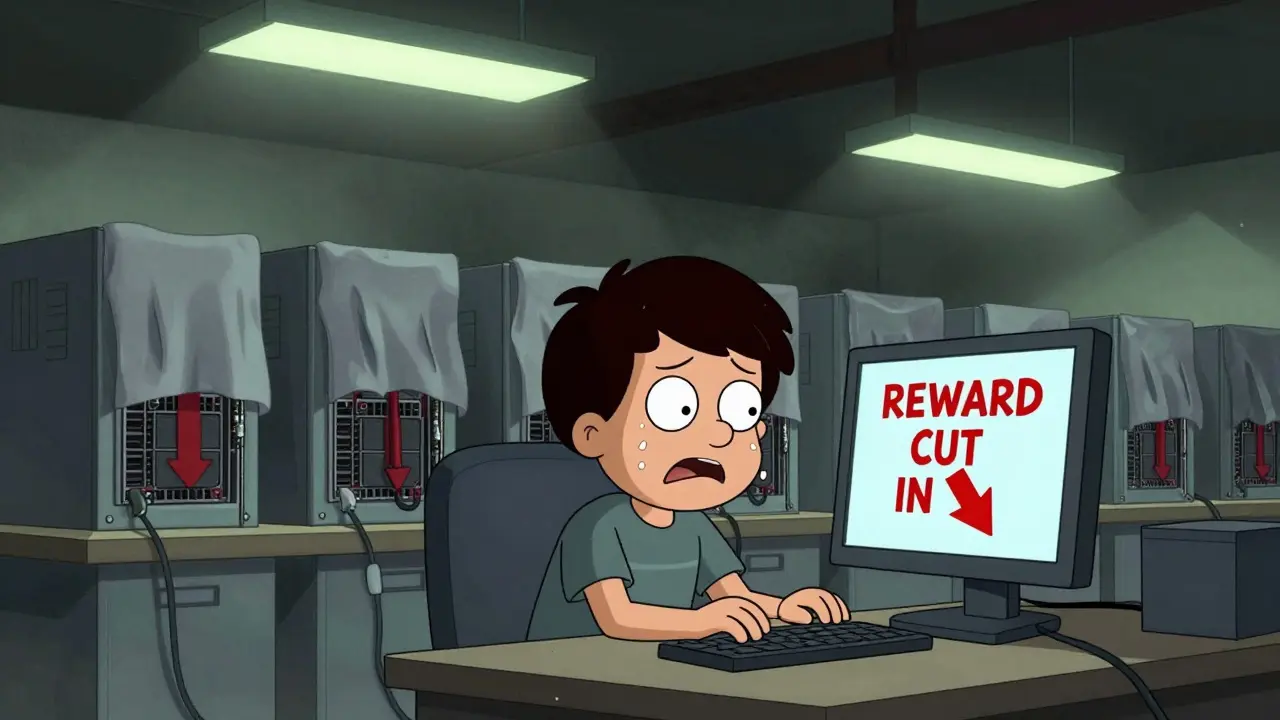
Imagine running a business where your paycheck gets cut in half overnight. Your rent stays the same. Your electricity bill doesn't drop. In fact, your competitors are working harder than ever. This is exactly what happens to Bitcoin miners during a period of economic pressure following the reduction of block rewards known as miner capitulation after halving. It sounds like a nightmare scenario, and for many operators, it is. But this chaos isn't a bug in the system-it’s a feature designed by Satoshi Nakamoto in 2009 to keep Bitcoin scarce.
The last time this happened was in April 2024. The block reward dropped from 6.25 BTC to 3.125 BTC per block. Almost immediately, the industry shook. Less efficient machines were turned off. Small operations shut down doors. And the big players? They started buying up assets at discount prices. If you are holding Bitcoin or thinking about entering the mining space, understanding this cycle is crucial. It explains why price volatility spikes right after a halving and why the network becomes more centralized in the short term.
The Economics of Sudden Revenue Loss
To understand why miners capitulate, you have to look at their balance sheets. Mining is not passive income; it is an industrial operation with high fixed costs. The primary cost driver is electricity. Before the April 2024 halving, a typical miner might earn roughly $0.055 per day for every terahash (TH) of computing power they deployed. That number is arbitrary until you realize that when the halving hits, that revenue stream is sliced in half instantly.
Let's break down the math. If you are paying $0.08 per kilowatt-hour (kWh) for electricity-common for retail users or those without special contracts-you are likely losing money immediately after the reward cuts. Efficient operations need electricity costs below $0.05 per kWh, ideally closer to $0.04 or even $0.03, to stay profitable when the reward drops. Without a corresponding jump in Bitcoin's price, the margin disappears. This creates a "race to the bottom" where only the most capital-efficient survivors remain.
| Electricity Cost (per kWh) | Hardware Efficiency Required | Viability Status |
|---|---|---|
| $0.08+ | Latest Gen ASIC (e.g., Antminer S21) | Unprofitable (Immediate shutdown likely) |
| $0.05 - $0.07 | High-Efficiency ASIC | Risky (Requires cash reserves) |
| $0.03 - $0.04 | Standard Modern ASIC | Profitable (Competitive advantage) |
| Below $0.03 | Any Modern Hardware | Highly Profitable (Industry leader) |
Who Survives and Who Folds?
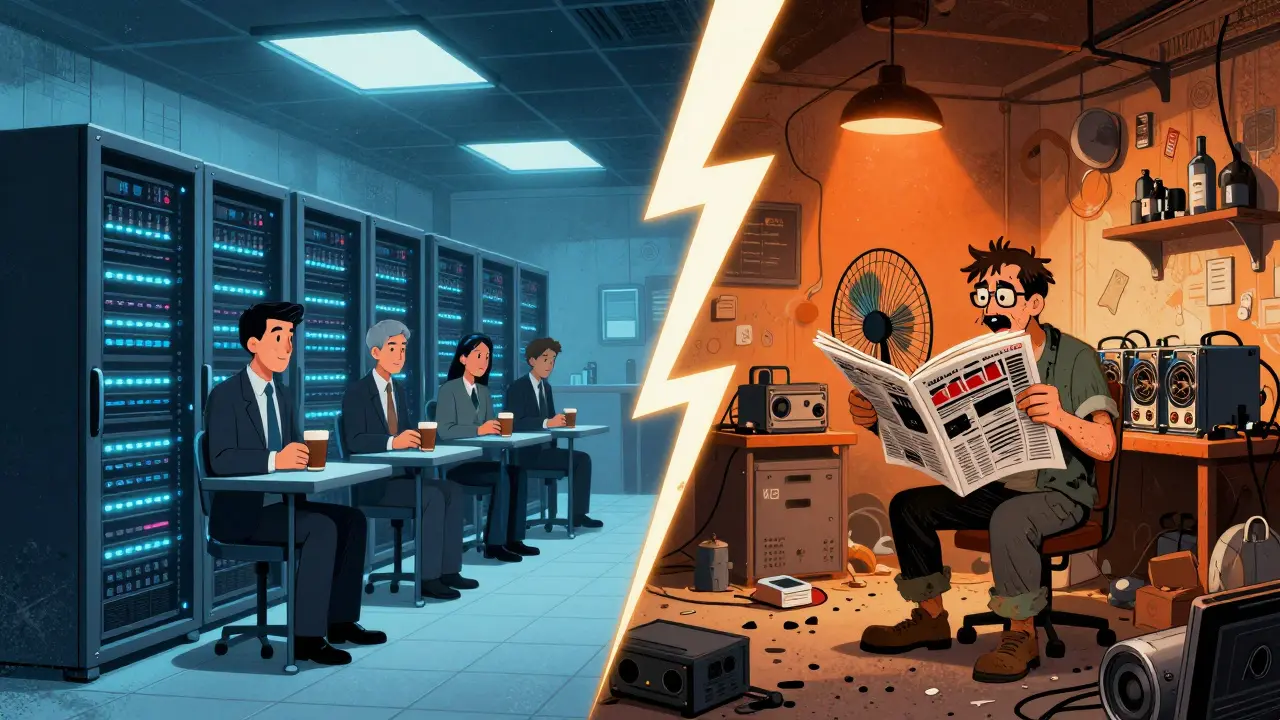
Not all miners are created equal. The post-halving landscape reveals a stark divide between industrial-scale operations and smaller, independent miners. Publicly traded companies like Bitdeer, Marathon Digital, and Riot Platforms have massive advantages. They negotiate long-term power purchase agreements (PPAs) directly with energy providers, often locking in rates well below market average. They also have access to cheap financing and can absorb months of losses while waiting for Bitcoin's price to recover.
In contrast, the "garage miner" or small-scale operator faces immediate extinction if they haven't planned ahead. Data from May 2024 showed Bitdeer's production dropping by 31% month-over-month as they strategically idled less efficient hardware. Smaller players didn't just idle hardware; they sold it. On forums like Reddit's r/BitcoinMining, discussions from mid-2024 were filled with reports of forced shutdowns. These individuals often operate older generation ASICs, such as the S19 series, which consume more power per terahash compared to newer models. When the reward halves, their machines become paperweights unless Bitcoin's price doubles quickly to compensate.
This disparity leads to consolidation. The weak are weeded out, and the strong buy their equipment at fire-sale prices. This is why analyst firms like EY Switzerland note that halvings serve a "cleansing" function. While painful for individuals, it forces the network to upgrade its infrastructure, making the entire blockchain more secure and energy-efficient in the long run.
The Role of Hash Rate and Difficulty Adjustments
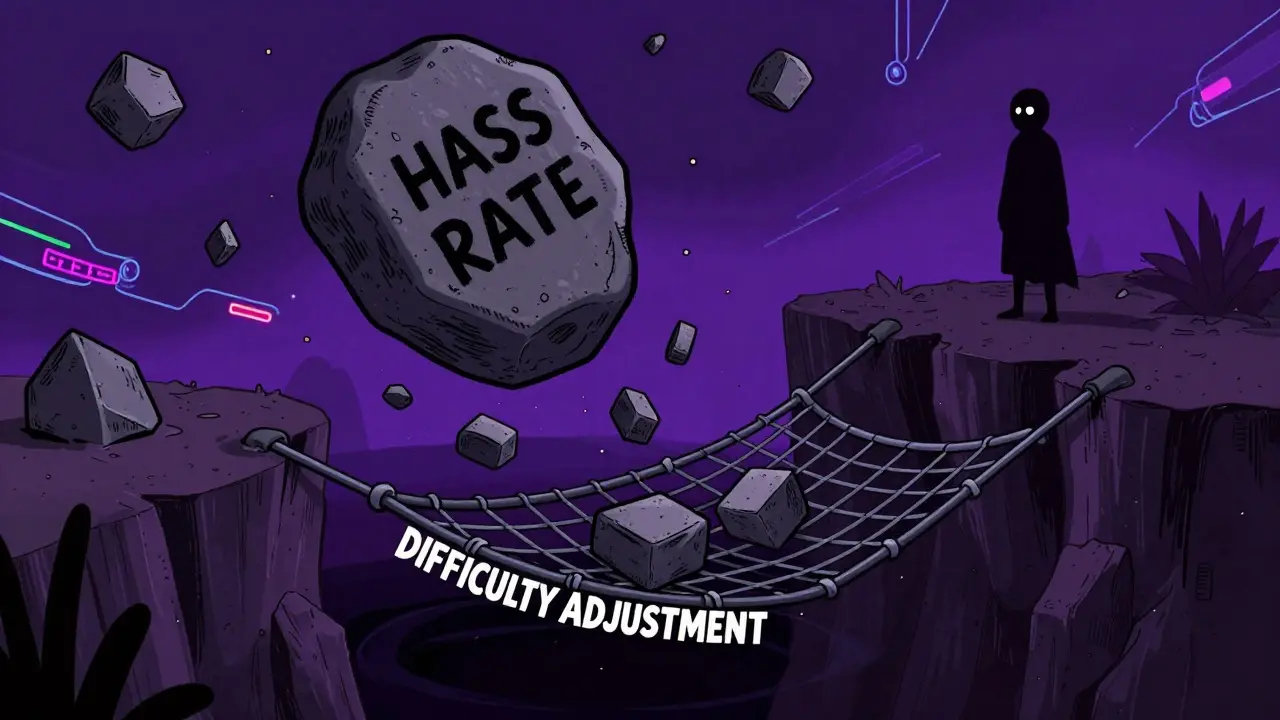
You might wonder: if so many miners quit, doesn't that make it easier for the remaining ones to mine blocks? Yes, but not immediately. Bitcoin has a self-correcting mechanism called difficulty adjustment. Every 2,016 blocks (approximately every two weeks), the protocol adjusts the mining difficulty to ensure blocks are found every 10 minutes on average.
When miner capitulation occurs, the total network hash rate-the combined computing power of all miners-drops. As unprofitable miners turn off their rigs, the hash rate falls. Over the next few weeks, the difficulty adjusts downward. This makes it slightly easier for the remaining miners to find blocks, stabilizing their revenue. However, this rebalancing process takes time. Industry estimates suggest it can take 3 to 6 months for the network to fully stabilize after a halving event. During this window, security margins tighten, and transaction fees may rise as block space becomes relatively scarcer due to lower issuance rewards.
For example, following the 2024 halving, global hash rate estimates suggested a 10-20% decrease within the first six months as inefficient capacity exited the market. This temporary dip is normal. It signals that the market is purging excess supply of mining power to match the new, lower reward structure.
Strategies for Survival in a Post-Halving World
If you are involved in mining or investing in mining stocks, survival depends on three pillars: efficiency, energy, and liquidity.
- Upgrade Hardware Aggressively: To maintain pre-halving profitability levels, operations need a 15-25% improvement in hash rate efficiency. This means moving from older models to the latest ASICs, such as those offering over 30 TH/s per 3,000W consumed. Holding onto outdated equipment is a fast track to bankruptcy.
- Secure Cheap Energy: Electricity is the lifeblood of mining. Successful operators relocate to jurisdictions with subsidized industrial rates or partner with renewable energy projects. Stranded energy sources-like hydroelectric dams that overflow during rainy seasons or wind farms with excess capacity-are goldmines for miners. Access to power below $0.04/kWh is the golden ticket.
- Maintain Cash Reserves: You cannot predict Bitcoin's price movement perfectly. WiseTree and other analysts emphasize that miners need 6-12 months of operational expenses in reserve. This liquidity buffer allows them to survive periods of negative cash flow without selling their Bitcoin holdings at a loss.
Additionally, some miners are diversifying revenue streams. With block rewards shrinking, transaction fees become increasingly important. Some large operators are exploring Layer-2 solutions or hosting services to generate additional income beyond raw block production.
What This Means for Bitcoin Investors
For the average Bitcoin holder, miner capitulation is actually a bullish signal in the medium term. Why? Because it reduces selling pressure. Miners historically sell a portion of their mined Bitcoin to cover costs. When they capitulate and stop mining, they stop adding new supply to the exchange. Combined with the reduced issuance from the halving itself, this supply shock can drive prices up if demand remains steady or increases.
Furthermore, the entry of institutional capital via Spot ETFs has changed the dynamic. Unlike previous cycles where miners were the primary sellers, today's market includes large financial institutions accumulating Bitcoin. This external demand can help offset the pain felt by miners, potentially accelerating the price recovery needed to bring them back into profitability. However, do not expect an instant fix. The period immediately following a halving is often characterized by choppy, volatile markets as the ecosystem finds its new equilibrium.
Looking Ahead: The Road to 2028
The trend is clear: mining is becoming an oligopoly. Only the largest, most efficient players with access to ultra-cheap renewable energy will dominate the future landscape. By the next halving in 2028, the remaining 1.35 million Bitcoin will be incredibly difficult to extract. Competition will be fiercer than ever.
For now, the lesson from the 2024 halving is simple. Efficiency wins. Capital preservation matters. And those who fail to adapt to the new economic reality will be left behind, clearing the way for a stronger, albeit more concentrated, network. Whether you are a miner, an investor, or just a curious observer, watching the hash rate and difficulty adjustments closely will give you the best insight into how healthy the Bitcoin network truly is during these turbulent times.
What is miner capitulation in simple terms?
Miner capitulation occurs when Bitcoin miners, unable to cover their operating costs after the block reward is halved, shut down their equipment and exit the market. It is essentially a market correction where inefficient businesses fail due to reduced revenue.
How long does it take for the network to recover after miner capitulation?
It typically takes 3 to 6 months for the Bitcoin network to fully rebalance. During this time, the difficulty adjusts downward as hash rate drops, allowing remaining miners to regain profitability without needing an immediate spike in Bitcoin's price.
Why is electricity cost so critical for miners after a halving?
Since the block reward is cut in half, revenue drops significantly. Electricity is the largest variable cost. If a miner pays too much for power (e.g., above $0.05-$0.08/kWh), they lose money on every block they attempt to mine, forcing them to shut down unless Bitcoin's price rises enough to compensate.
Does miner capitulation make Bitcoin safer or riskier?
In the short term, a drop in hash rate can temporarily reduce network security margins. However, in the long term, it strengthens the network by removing inefficient nodes and forcing upgrades to more powerful, energy-efficient hardware, leading to a more robust overall system.
Can small individual miners survive the post-halving environment?
Only if they have access to extremely cheap electricity (below $0.04/kWh) and use the latest generation of ASIC hardware. Most small miners paying retail electricity rates find it impossible to compete with industrial-scale operations and are forced to sell their equipment or join cloud mining pools.