Running a cryptocurrency exchange in Thailand is not for the faint of heart. It requires serious capital, strict compliance, and patience. But if you are willing to meet the Thai crypto exchange licensing requirements, you gain access to one of Southeast Asia’s most robust and legally clear markets. With over 8 million users expected by 2026, the opportunity is huge-but so are the barriers to entry.
The regulatory landscape shifted significantly in April 2025 with new rules that close loopholes for foreign operators. Whether you are a local startup or an international giant, understanding these changes is critical before you spend a single baht on legal counsel.
Who Controls the Rules?
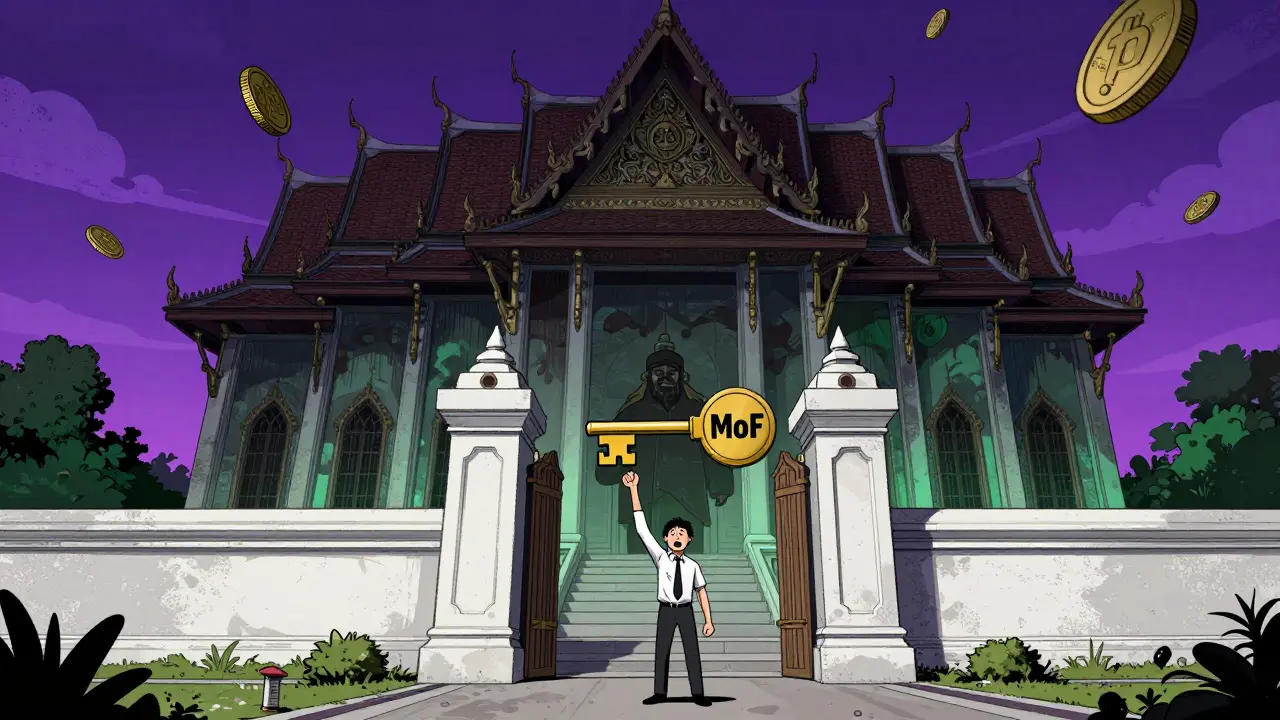
In Thailand, two main bodies govern the digital asset space. The Ministry of Finance (MoF) is the government body responsible for issuing licenses and registering digital asset businesses. They hold the keys to the kingdom. You cannot operate without their approval.
Once you have your license, the Securities and Exchange Commission (SEC) takes over as the regulator that enforces ongoing compliance, monitors market activity, and protects investors. Think of the MoF as the gatekeeper and the SEC as the referee watching every move you make.
This dual structure creates a high level of oversight. Unlike jurisdictions where regulations are vague or non-existent, Thailand offers a clear path. This clarity attracts institutional players but keeps casual operators out.
Types of Licenses Available
You don’t just apply for "a crypto license." The law defines specific roles, each with its own obligations. Most applicants fall into one of three categories:
- Digital Asset Exchange (DAE): A platform that matches buy and sell orders between users. This is the standard "exchange" model like Binance or Coinbase.
- Digital Asset Broker (DAB): An intermediary that executes trades on behalf of clients. Brokers often provide more personalized service than exchanges.
- Digital Asset Dealer (DAD): Entities that trade digital assets for their own account, often acting as liquidity providers.
There are other licenses, such as ICO portals, custodial wallet providers, and fund managers, but these are rare. As of 2025, only two operators held licenses in each of those niche categories. For most businesses, the DAE or DAB license is the goal.
The Financial Barrier: How Much Does It Cost?
Money is the first filter. The regulations set hard numbers that you must meet before you even submit paperwork.
| Requirement | Amount (THB) | Approx. USD (2025) |
|---|---|---|
| Minimum Share Capital | 50,000,000 THB | $1.4 Million |
| Application Fee | 2,500,000 THB | $70,000 |
| Total Initial Cash Commitment | 52,500,000 THB | $1.47 Million |
Note that the 50 million THB share capital must be deposited in a Thai bank account upon company incorporation. This money stays in the company. It is not a fee that disappears; it forms the foundation of your business equity. However, you also need significant operational cash flow to cover salaries, office space, and technology during the 150-day registration period.
Legal and compliance setup costs often exceed $500,000 USD beyond the required capital. When you add it all up, launching a licensed exchange in Thailand is a multi-million dollar endeavor.

The Application Process: Step-by-Step
Getting a license is not a quick online form. It is a rigorous process that typically takes 150 days from submission to final decision. Here is how it works:
- Incorporate a Thai Company: You must register a legal entity in Thailand. Foreign ownership rules apply, so you may need a local partner or a specific investment promotion certificate to hold majority shares.
- Establish Infrastructure: Set up physical office space in Thailand. Hire local staff, including a Chief Compliance Officer and IT security personnel.
- Build Compliance Systems: Develop Anti-Money Laundering (AML) and Counter-Financing of Terrorism (CFT) policies. Implement Know Your Customer (KYC) software that meets Thai standards.
- Prepare Documentation: Submit detailed business plans, cash flow projections, technical infrastructure specs, and team qualifications to the Ministry of Finance.
- Undergo Review: The MoF reviews your application. They may request additional information or clarifications. This stage can take several months.
- Receive License: If approved, you receive your license and begin operations under SEC supervision.
Most companies spend 6 to 12 months preparing before they even submit the application. Rushing this process leads to rejection.
The 2025 Rule Change: What Foreign Operators Need to Know
If you are reading this from outside Thailand, pay close attention. The Royal Decree on the Operation of Digital Asset Businesses (No. 2) B.E. 2568, effective April 13, 2025, changed the game for foreign platforms.
Previously, some international exchanges operated in a gray area, serving Thai users without a local license. The 2025 amendments explicitly state that any foreign digital asset business operator providing services to Thai residents must obtain proper licensing. This closes regulatory arbitrage opportunities.
This means you cannot simply market to Thai users from Singapore or Hong Kong and ignore Thai laws. You must either:
- Obtain a Thai license and establish a local presence.
- Block access for Thai IP addresses and users entirely.
This move aligns Thailand with stricter global standards and strengthens consumer protection. It also levels the playing field for licensed local operators who have been following the rules.
Compliance Obligations After Licensing
Getting the license is just the start. Ongoing compliance is heavy. You must maintain:
- Robust Cybersecurity: Regular audits and penetration testing are mandatory. You must protect user funds and data against breaches.
- Continuous KYC/AML Monitoring: Every transaction must be monitored for suspicious activity. You must report anything unusual to the Anti-Money Laundering Office.
- Local Accounting: Maintain detailed financial records in Thailand and undergo annual audits by approved firms.
- Capital Maintenance: Ensure your share capital remains at the required level. Dilution or losses that drop you below 50 million THB can trigger penalties or license revocation.
The SEC actively monitors licensed operators. They have shut down unlicensed platforms and penalized compliant ones for minor infractions. Staying in good standing requires dedicated legal and compliance teams.
Why Go Through the Trouble?
With such high costs and strict rules, why choose Thailand? The answer lies in market size and stability.
Thailand has one of the highest cryptocurrency adoption rates in the world. In 2025, approximately 11.6% of the population uses crypto, translating to over 8 million users. The market revenue is projected to reach $793.6 million in 2025 and grow steadily.
Licensed operators benefit from:
- Banking Relationships: Thai banks are more likely to work with licensed entities, solving a major pain point for crypto businesses.
- User Trust: Thai users know to check the SEC website for licensed status. Being listed there builds immediate credibility.
- Regulatory Certainty: Unlike countries where rules change overnight, Thailand’s framework is stable and predictable.
For serious players, the license is a badge of legitimacy that opens doors to institutional partnerships and mainstream finance.
Common Mistakes to Avoid
Many applications fail due to simple errors. Don’t let yours be one of them.
- Underestimating Preparation Time: Do not apply until your tech stack, compliance manuals, and corporate structure are fully ready.
- Ignoring Local Nuances: Thai corporate law is complex. Hire local legal experts who understand both crypto and traditional finance.
- Neglecting Cybersecurity: The SEC will scrutinize your IT infrastructure. Weak security is an automatic red flag.
- Assuming Foreign Licenses Count: Having a license in another country does not exempt you from Thai requirements. You still need a Thai license.
Patience and precision are your best tools here.
How long does it take to get a crypto license in Thailand?
The official review process by the Ministry of Finance takes 150 days. However, most companies spend 6 to 12 months preparing their documentation, infrastructure, and corporate structure before submitting the application.
Can foreigners own a crypto exchange in Thailand?
Yes, but subject to Thai foreign business laws. Typically, foreign investors need a local partner or a special investment promotion certificate to hold majority shares in a Thai company. Legal advice is essential to navigate these ownership restrictions.
What is the minimum capital requirement for a Thai crypto license?
You must deposit 50 million THB (approximately $1.4 million USD) as share capital in a Thai bank account. Additionally, there is a 2.5 million THB application fee.
Do I need a Thai license if I am a foreign exchange serving Thai users?
Yes. As of April 2025, any foreign digital asset business operator providing services to Thai residents must obtain a Thai license. Operating without one is illegal and risks enforcement action.
Which agency issues the license and which one regulates it?
The Ministry of Finance (MoF) issues the license. The Securities and Exchange Commission (SEC) handles ongoing regulation, supervision, and enforcement.






Larry Port
it is interesting how the regulatory framework in thailand has evolved to such a strict standard over the last few years i remember when people thought you could just set up a server anywhere and serve users without much oversight but now with the ministry of finance and the sec working together it seems like they really want to ensure that only serious players are in the market which makes sense for consumer protection but it does raise the barrier to entry significantly for smaller startups who might have innovative ideas but lack the capital to meet the fifty million baht requirement