
XEN Crypto isn't like Bitcoin. It doesn't need mining rigs. It doesn't have a team holding back tokens for themselves. It doesn't even have a fixed supply. Launched on October 8, 2022, XEN is a free-to-mint ERC-20 token built on Ethereum that anyone can claim with just a crypto wallet and a little patience. Its entire design flips traditional crypto models on their head - no pre-sale, no venture capital, no founder allocation. Just pure, permissionless participation.
How XEN Works: Minting Without Mining
To get XEN, you don’t solve complex math problems or buy expensive hardware. You connect your wallet - MetaMask, Trust Wallet, or Coinbase Wallet - to xen.network. That’s it. Once connected, you’re assigned a rank based on when you joined. The longer you wait before minting, the more tokens you get. There’s no rush. The system rewards patience.
The minting process takes about 3 to 5 minutes. You pay only Ethereum gas fees, which usually range from $0.50 to $3.00 depending on network traffic. After minting, you can hold, trade, or send XEN like any other token. The entire process is open source. Every mint, every rank, every transaction is visible on-chain. No hidden rules. No backdoor admin keys. The contract is immutable.
Unlike Bitcoin, which caps out at 21 million coins, XEN has no supply limit. Instead, it uses a disinflationary model. The number of tokens you earn per mint decreases over time, but the total supply keeps growing. This is intentional. The goal isn’t scarcity - it’s accessibility. The idea is to let as many people as possible get in early, without gatekeepers.
Where XEN Lives: 10 Blockchains, One Token
XEN doesn’t stay on Ethereum. Since its launch, it’s expanded to 10 different blockchains: Ethereum, Polygon, BSC, Avalanche, Ethereum PoW, Moonbeam, Evmos, Fantom, Dogechain, and OKX Chain. This multi-chain approach means users can mint and trade XEN on the network that’s cheapest or fastest for them.
On Ethereum, you trade XEN on Uniswap. On BSC, you use PancakeSwap. On centralized exchanges, MEXC handles 78% of all XEN trading volume. This spread across chains helps keep the network alive even if one network gets congested or expensive. It also makes XEN one of the most widely supported tokens across Layer 1 and Layer 2 ecosystems.
Tokenomics: Why the Price Is So Low
As of January 15, 2026, XEN’s circulating supply is over 267 trillion tokens. The price? Around $0.000000010 per token. That’s one ten-billionth of a dollar. It sounds ridiculous - until you realize it’s designed that way.
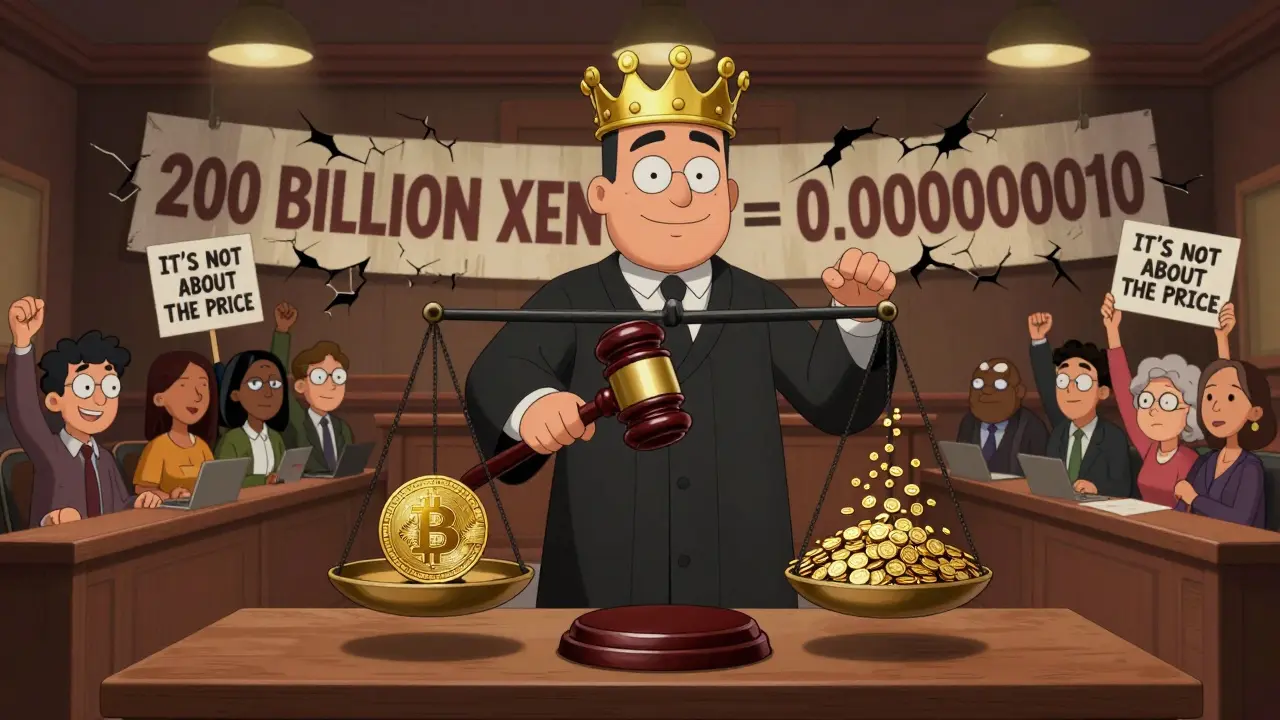
When you hold 200 billion XEN, it feels like nothing. But if you held 200 billion dollars, you’d be a billionaire. The token’s value isn’t meant to be measured in dollars per coin. It’s meant to be measured in total participation. The more people mint, the more the network grows. The value isn’t in the coin - it’s in the community.
This is where most people get confused. Critics say XEN has no value because the price is too low. Supporters say the low price is the whole point. It allows millions of small holders to participate. You don’t need to buy $1,000 worth of Bitcoin to be part of the movement. You can mint XEN for $2 in gas and own a piece of something global.

How XEN Compares to Bitcoin and HEX
Bitcoin is like digital gold - scarce, mined, capped. XEN is like digital water - abundant, freely available, flowing. Bitcoin’s supply halves every four years. XEN’s minting reward slows down gradually as more people join. Neither is better. They serve different purposes.
Compared to HEX, another long-term staking token, XEN is simpler. HEX rewards users for locking up tokens over time. XEN rewards users for joining early and waiting to mint. HEX uses T-shares. XEN uses rank and time. Both are community-driven. But XEN’s minting mechanism is more transparent and easier to understand.
And unlike most altcoins, XEN has no team wallet. No private keys. No central office. The entire system runs on code. Even its creator, Jack Levin, can’t change anything. That’s why people like Andreas Antonopoulos call it one of the purest implementations of decentralization ever built.
Who’s Using XEN? The Community Behind the Token
As of January 2026, over 42,853 unique wallets hold XEN across all 10 chains. About 63% of those wallets are active minters - people who come back to claim more tokens. The Telegram group has 34,500 members. The Discord server has 18,200. Reddit’s r/XENCrypto has thousands of daily posts.
Most users are everyday crypto enthusiasts, not Wall Street investors. They’re students, freelancers, people in developing countries with limited access to traditional banking. One Reddit user wrote: “I minted my first XEN while waiting for my coffee. Took 90 seconds. No KYC. No credit card. Just me and my phone.”
But there’s frustration too. Many users complain that the token’s value is too low to take seriously. “It’s hard to feel rich when you have 200 trillion of something worth less than a penny,” said another user. The psychological barrier is real. But for those who believe in the model, it’s not about the price today - it’s about the network tomorrow.
Use Cases: What Can You Actually Do With XEN?
Right now, XEN is mostly speculative. You can’t buy coffee with it. You can’t pay your rent with it. There are no major merchants accepting it. That’s the biggest criticism.
But the community is trying to change that. There are grassroots efforts to use XEN for microtransactions - tipping content creators, paying for small digital services, or buying low-cost digital goods. Because each token is worth so little, you can send 10 million XEN as a gift and it’s still under a dollar. That’s useful for micropayments.
The Fair Crypto Foundation’s 2026 roadmap includes three phases: improving cross-chain support, getting small businesses in developing countries to accept XEN, and eventually integrating with payment processors. These are ambitious goals. But they’re the only way XEN moves from a curiosity to a real currency.
Is XEN Safe? Risks and Realities
The smart contract has been audited. It’s open source. No one can freeze your tokens. No one can reverse your transactions. That’s a win.
But here’s the catch: XEN has no revenue, no product, no team. It’s a protocol, not a company. There’s no customer support. If you lose your wallet, there’s no help desk. If the price crashes, there’s no bailout. You’re fully on your own.
Some experts, like Peter Schiff, call it a “novelty with no fundamental value.” Others, like Digital Coin Price, predict it could hit $0.00000005 by 2027 - a 400% increase. But those are just guesses. No one knows.
What’s clear is this: XEN is not an investment. It’s an experiment. A social experiment. A test of whether a cryptocurrency can survive without funding, without marketing, without a team - just pure user participation.
How to Get Started With XEN
- Get an Ethereum-compatible wallet: MetaMask, Trust Wallet, or Coinbase Wallet.
- Go to xen.network and connect your wallet.
- Wait at least 24 hours. The longer you wait, the more tokens you’ll mint.
- Click “Mint” and confirm the transaction in your wallet. Pay the gas fee.
- Once minted, you can hold it, trade it on Uniswap or MEXC, or send it to others.
You don’t need to understand blockchain to do this. You don’t need to be tech-savvy. You just need to be willing to try something different.
Final Thoughts: Is XEN the Future or Just a Fad?
XEN Crypto doesn’t try to be Bitcoin. It doesn’t try to be Ethereum. It doesn’t even try to be a store of value. It’s trying to be something else: a truly open, permissionless, community-owned digital asset.
Will it succeed? No one knows. But it’s already succeeded in one way - it’s proven that a cryptocurrency can launch without money, without hype, without a team, and still attract tens of thousands of people. That’s rare. That’s powerful.
If you believe in decentralization, in open access, in giving power back to users - then XEN is worth a look. Not as a get-rich-quick scheme. But as a living experiment in what crypto could be if it truly belonged to everyone.



Christina Shrader
I minted my first XEN while waiting for my coffee. Took 90 seconds. No KYC. No credit card. Just me and my phone. That’s all I needed.