
You bought an ASIC Miner. You plugged it in. It hums loudly, heats up your garage, and burns through electricity like a small city. But is it actually making you money? Or are you just paying for the privilege of listening to that fan noise?
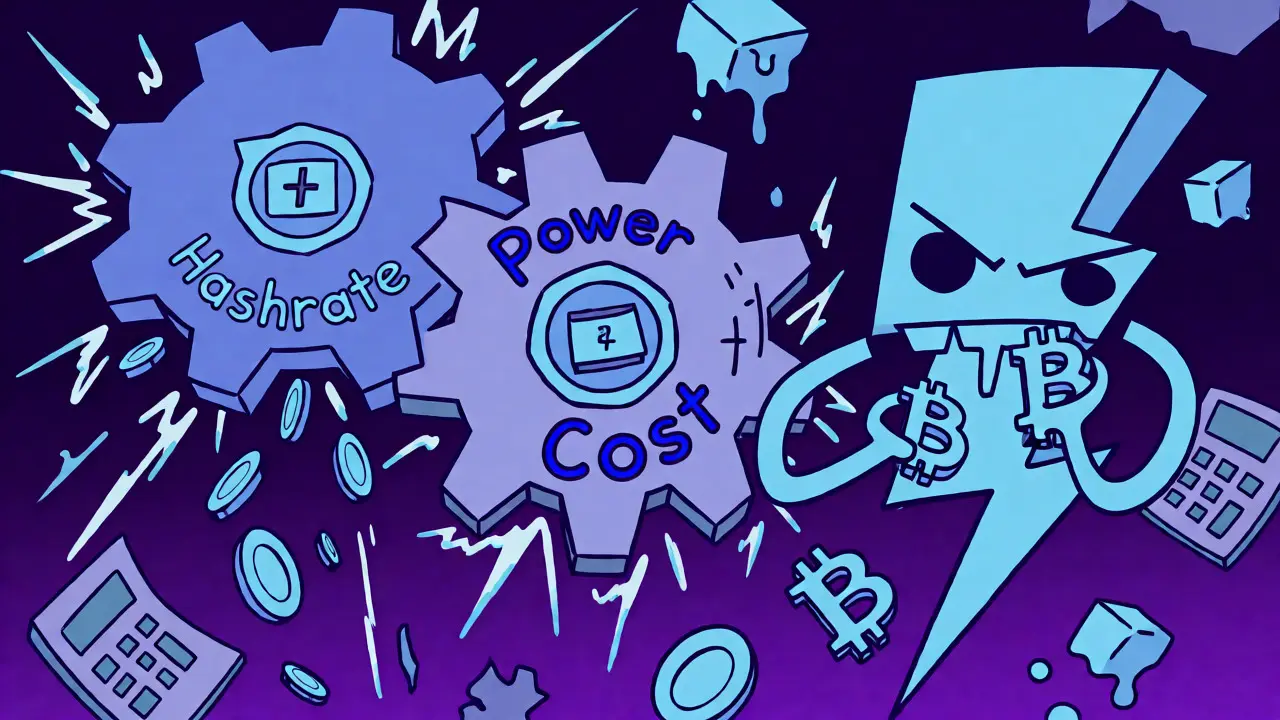
This is where an ASIC Miner Profitability Calculator comes in. It’s not just a fancy spreadsheet; it’s your reality check. In 2026, with Bitcoin halving effects still rippling through the market and energy prices fluctuating, guessing your earnings is a fast track to losing your shirt. These tools take complex variables-hashrate, difficulty, power cost, coin price-and spit out a number that tells you if you’re profitable or just burning cash.
What Exactly Is an ASIC Profitability Calculator?
At its core, this tool is a financial model for hardware-based cryptocurrency mining. Unlike GPU mining, which can switch between coins, Application-Specific Integrated Circuit (ASIC) miners are single-purpose machines designed to mine specific algorithms, usually SHA-256 for Bitcoin. Because they are specialized, their economics are rigid. A calculator helps you navigate that rigidity.
Think of it as a fuel efficiency gauge for a race car. The car (your miner) might be fast, but if gas (electricity) costs more than the prize money (block rewards), you’re losing. Early versions appeared around 2013-2014 when mining moved from CPUs to specialized hardware. Today, platforms like WhatToMine and ASICMinerValue update data every minute, reflecting real-time market shifts.
| Input Variable | Typical Value (2026) | Impact on ROI |
|---|---|---|
| Hashrate | 100-250 TH/s (e.g., Antminer S21) | Directly proportional to revenue. Higher hashrate = more shares. |
| Power Consumption | 2,000W - 3,500W | Inverse relationship. Every watt counts against your margin. |
| Electricity Rate | $0.08 - $0.15 / kWh (US Avg) | The biggest killer. A $0.02 increase can wipe out profits. |
| Network Difficulty | Dynamic (Adjusts every ~2 weeks) | Higher difficulty = fewer blocks mined per TH/s. |
| Coin Price | Volatility dependent | High leverage. A 10% price drop hurts more than a 10% difficulty rise. |
The Critical Inputs You Can’t Ignore
Most beginners mess up the inputs. They look at the box specs and assume those numbers hold true forever. They don’t. Here’s what you actually need to enter to get a result worth trusting.
- Realistic Hashrate: Don’t use the theoretical max. If your Antminer S19 Pro claims 110 TH/s, expect 105-108 TH/s after thermal throttling and firmware inefficiencies. Always under-promise here.
- Total Power Draw: This isn’t just the miner’s rating. Add the power supply unit (PSU) loss. PSUs are rarely 100% efficient. Assume 5-8% energy loss during conversion. If your miner says 3,250W, budget for 3,400W+ at the wall.
- Local Electricity Cost: Look at your actual utility bill, not the national average. Do you have tiered pricing? Does your rate jump in summer due to AC usage? Input your *marginal* cost-the cost of the next kilowatt-hour you buy.
- Pool Fees: Most solo miners fail. You’ll join a pool. Standard fees range from 1% to 3%. Some pools charge extra for withdrawals or PPLNS (Pay Per Last N Shares) models. Subtract this before calculating net profit.
Why Calculators Often Lie (And How to Fix Them)
Here’s the uncomfortable truth: most calculators overestimate your profit by 20-30%. Why? Because they ignore hardware degradation and cooling overheads.
Dr. Alex de Vries, founder of Digiconomist, pointed out in recent interviews that static calculators treat your ASIC as a new machine forever. In reality, chips degrade. Fans clog with dust. Efficiency drops. By year two, your 110 TH/s miner might only hit 100 TH/s while drawing the same power. If you don’t factor in a depreciation curve, your payback period looks shorter than it is.
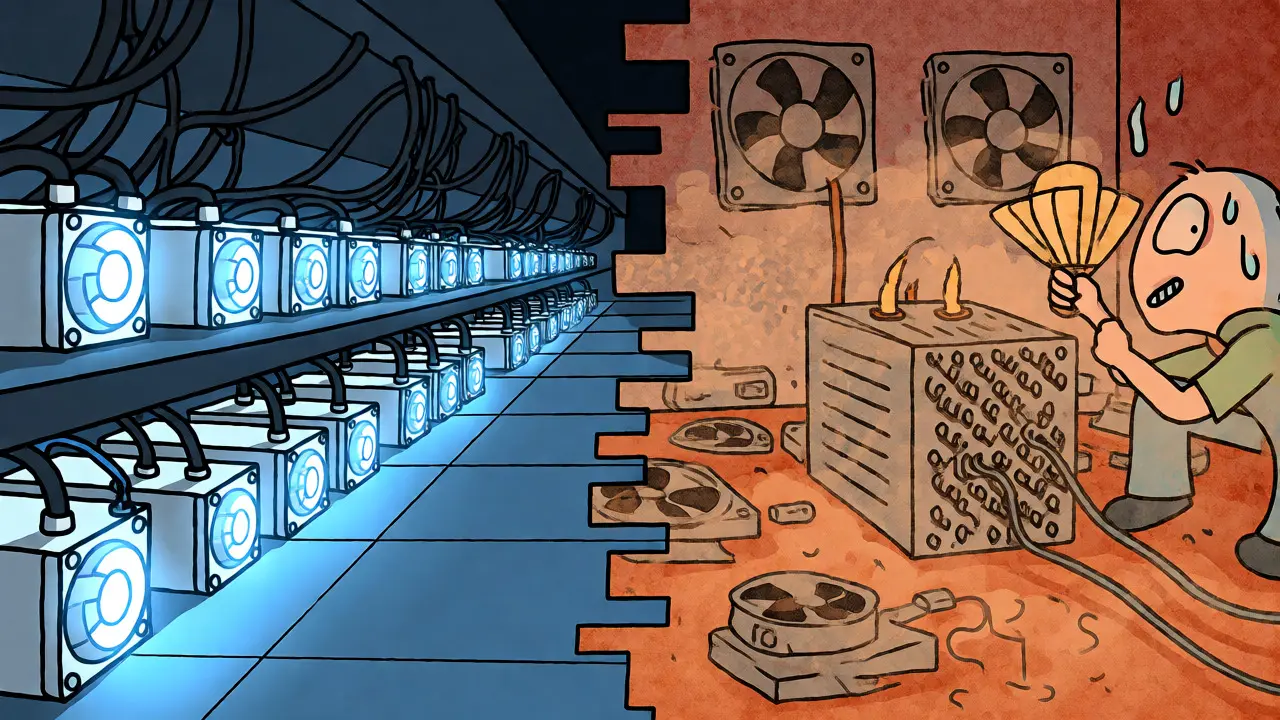
Then there’s the cooling problem. In Boulder, Colorado, we get cold air-that’s great for passive cooling. But if you’re in Texas or Arizona, you need industrial fans or immersion cooling systems. Those consume power too. A basic calculator ignores this. Advanced users add a "cooling multiplier" to their power cost. For air-cooled setups, add 10% to your energy bill estimate. For immersion, it’s less, but the initial capex is higher.
Market volatility is another blind spot. During high-volatility periods (daily moves >10%), standard projections can deviate by 15-20%. If Bitcoin crashes overnight, yesterday’s profit forecast is worthless. Use calculators that offer "stress test" scenarios, showing best-case, worst-case, and likely-case outcomes.
Choosing the Right Tool for Your Operation
Not all calculators are created equal. Your choice depends on whether you’re running one rig in a closet or a warehouse full of rigs.
| Platform | Best For | Data Refresh Rate | Unique Feature |
|---|---|---|---|
| WhatToMine | Multi-coin comparison | 5-10 minutes | Supports 150+ coins; good for altcoin ASICs. |
| Mining Now | Bitcoin-only focus | 1 minute | Real-time tracking; no altcoin clutter. |
| ASICMinerValue | Hardware resale value | Live (60 seconds) | Includes secondary market pricing trends. |
| EcoHash Cloud | Sustainable miners | 30 minutes | Calculates CO2 savings and green energy metrics. |
| BlockForge | Enterprise/Industrial | Real-time API | Thermal management cost projections; requires >1 PH/s. |
If you’re a hobbyist with one Antminer S21, stick with Mining Now or WhatToMine for simplicity. If you care about the environmental footprint of your rig, EcoHash gives you insights beyond fiat currency. For serious operations, BlockForge’s enterprise-grade modeling accounts for transformer losses and facility overheads that free tools miss.
Step-by-Step: Running an Accurate Calculation
Don’t just plug in numbers and walk away. Follow this workflow to minimize error margins.
- Gather Hardware Specs: Find the exact model number. Note the nominal hashrate (TH/s) and power consumption (Watts). Check recent user reports for real-world performance averages, not just manufacturer claims.
- Determine Your True Electricity Cost: Open your last three utility bills. Calculate the average cost per kWh. If you have time-of-use rates, calculate the weighted average based on when your miner runs 24/7.
- Select a Mining Pool: Choose a reputable pool. Note their fee structure. Enter this percentage into the calculator. Remember, lower fees often mean higher variance in payouts.
- Input Current Market Data: Use live Bitcoin price and current network difficulty. Most calculators pull this automatically, but verify it against a second source like Blockchain.com or Mempool.space.
- Run Three Scenarios:
- Optimistic: BTC price +10%, difficulty stable.
- Pessimistic: BTC price -10%, difficulty +5%.
- Realistic: Current values with a 15% buffer added to electricity costs for cooling and PSU inefficiency.
- Calculate Payback Period: Divide your total hardware cost (including shipping and taxes) by your daily realistic profit. This tells you how many days until you break even. If it’s over 18 months, think twice.
Hidden Costs That Kill Profits
Calculators show gross revenue minus electricity. They rarely show the rest. Here’s what eats into your net income:
- Internet Stability: Downtime means zero revenue. If your connection drops for 4 hours a month, you lose 0.5% of your monthly yield. Factor in a backup line if necessary.
- Hardware Maintenance: Fans fail. Capacitors blow. Budget 5-10% of your annual revenue for repairs. An out-of-warranty repair can cost $200-$500 per unit.
- Taxes: In the US, mined coins are taxed as ordinary income at fair market value upon receipt. When you sell later, you pay capital gains. This double-taxation impact is often ignored in simple ROI calcs.
- Noise Mitigation: If you live near neighbors, you might spend money on soundproofing. This is a hidden CAPEX (Capital Expenditure) that doesn’t appear in electricity costs.
When to Stop Trusting the Numbers
There’s a point where calculation precision hits diminishing returns. If your electricity rate is above $0.12/kWh, you’re already operating on thin margins. Small errors in difficulty prediction matter more than decimal-point accuracy in hashrate.
Also, beware of "stranded assets." The Digital Currency Group estimated $1.2 billion in unprofitable mining hardware stranded in 2024. If a calculator shows you breaking even in 24 months, but newer, more efficient ASICs launch in 12 months, your old rig becomes obsolete. Always ask: "Will this hardware still be competitive in two years?"
How accurate are ASIC profitability calculators?
Top-tier calculators achieve 95-98% accuracy when provided with precise input data. However, estimates can deviate by 15-20% during periods of high market volatility (daily price movements exceeding 10%). Always cross-reference results with multiple sources and apply a safety margin for electricity and hardware degradation.
Do I need to include cooling costs in my calculations?
Yes. Basic calculators often exclude the energy used by auxiliary cooling systems. For air-cooled setups, add 10-15% to your total power consumption estimate to account for exhaust fans and potential HVAC usage. Immersion cooling reduces this overhead but increases initial hardware costs.
Which calculator is best for beginners?
Mining Now and NiceHash’s calculator are highly rated for beginners due to their simple interfaces and real-time updates. WhatToMine is also popular but has a slower data refresh rate (5-10 minutes). Start with one of these to understand the basics before moving to enterprise-grade tools like BlockForge.
How does the Bitcoin halving affect profitability?
The halving cuts block rewards in half (currently 3.125 BTC per block following the April 2024 event). This instantly doubles the cost to mine one Bitcoin unless the price rises proportionally or difficulty drops. Calculators must be updated post-halving to reflect the new reward structure, as historical data pre-halving will overstate future profits.
Should I use a pool or solo mine?
For most individual miners using a single ASIC, pool mining is recommended. Solo mining offers no guaranteed income and requires luck to find a block. Pools provide steady, predictable payouts minus a 1-3% fee. Calculators should always include pool fees in the net profit projection.







Dylan Rondeau
Listen, if you are still using a static spreadsheet to calculate your ROI in 2026, you are already losing money. The article is spot on about the cooling overheads but it understates how brutal the PSU inefficiency can be when you are running multiple rigs in parallel.
You need to factor in the power factor correction losses which most basic calculators completely ignore. I have seen people burn through their entire margin because they didn't account for the reactive power penalties from their utility provider. Don't just look at the watts; look at the amperage and the voltage drop over long cable runs. That resistance turns into heat and lost revenue instantly.