Have you ever trusted a centralized exchange with your life savings, only to watch the news break that they froze withdrawals or went bankrupt? That fear is real. For years, traders had two choices: give up control of their keys for convenience on platforms like Binance or Coinbase, or deal with the headache of fragmented wallets and complex bridges. Enter AtomicDEX, a tool that promises to solve this dilemma by letting you trade directly from your wallet without handing over custody.
But does it actually work in 2026? Is it just another vaporware project from the early days of DeFi, or is it a robust solution for privacy-conscious traders? I’ve dug into the code, checked the user reviews, and tested the mechanics to see if AtomicDEX lives up to its hype as the "third generation" of decentralized trading.
What Exactly Is AtomicDEX?
Let’s clear up the confusion first. You might have heard of "Atomic Wallet." They are not the same thing. AtomicDEX is built by the Komodo Platform team, a group that has been working on decentralized tech since 2017. While the desktop app was rebranded to "Komodo Wallet" in 2023, the underlying technology remains AtomicDEX.
So, what makes it different? Most decentralized exchanges (DEXs) today use Automated Market Makers (AMMs). Think of Uniswap or PancakeSwap. You swap tokens against a liquidity pool, and you often face "impermanent loss" if you’re providing liquidity, or high slippage if the pool is thin. AtomicDEX rejects this model entirely.
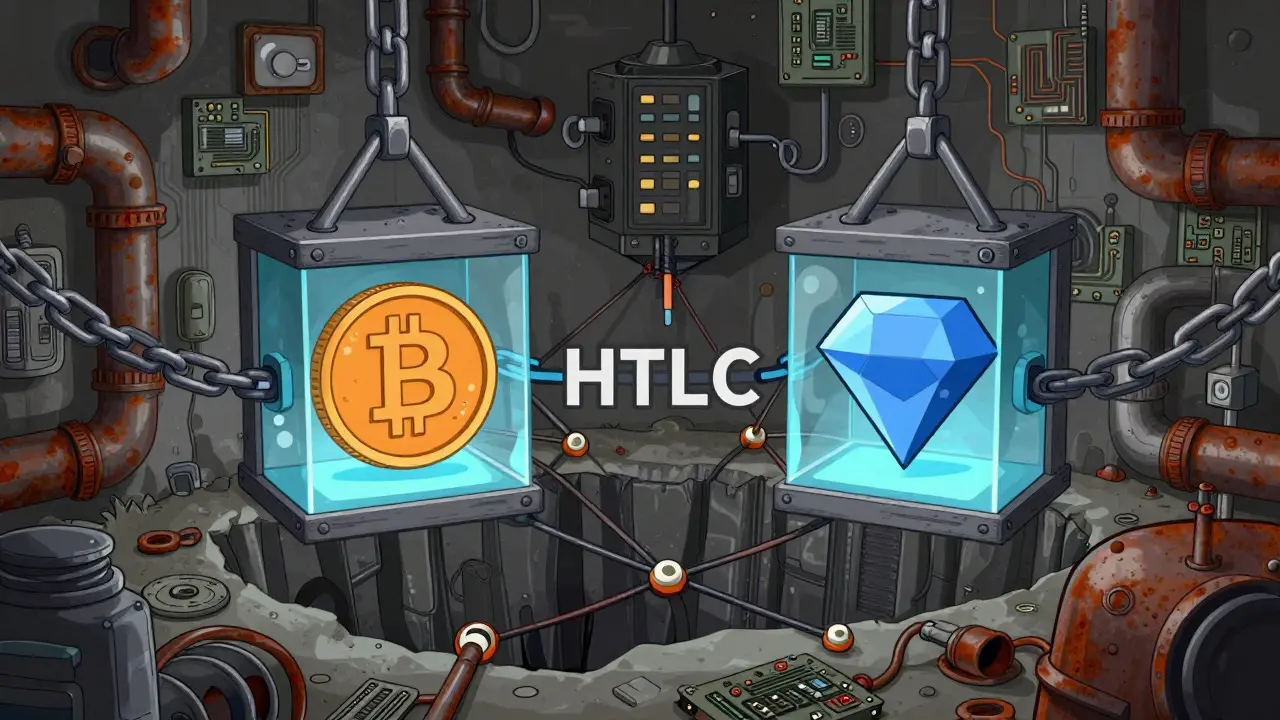
Instead, it uses an order book system-just like a traditional stock exchange-but it runs peer-to-peer. When you place an order, it broadcasts to other users running the software. The magic happens through Hashed Time-Locked Contracts (HTLCs). These are smart contracts that lock both parties' funds. If one person fails to complete the trade within a set time, the money automatically refunds to the owner. No middleman can steal it. No central server can freeze it.
The Core Technology: How It Works Under the Hood
To understand if AtomicDEX is secure, you need to look at its engine. The heart of the system is called mm2, a Rust-based daemon developed to replace older C++ versions. This engine handles all the heavy lifting: connecting to blockchains, managing your private keys, and executing swaps.
Here is how the process flows:
- Peer-to-Peer Network: Instead of sending your order to a central matching engine, mm2 connects to other nodes using the libp2p protocol. This means there is no single point of failure.
- Cross-Chain Swaps: Because it uses HTLCs, you can trade Bitcoin for Ethereum, or Litecoin for Komodo, directly. You don’t need to wrap your BTC into a fake version on Ethereum. You are moving the actual asset.
- Asset Activation: To use a coin, you must "activate" it in the wallet. For UTXO coins like Bitcoin or Litecoin, this usually requires running a local node or connecting to an Electrum server. For Ethereum and ERC-20 tokens, it relies on remote infrastructure configured in the coin definitions.
This architecture is impressive because it theoretically supports over 95% of all cryptocurrencies. However, as we’ll see, theoretical support doesn’t always mean easy access.
Fees: Who Pays What?
If you are tired of hidden fees eating into your profits, AtomicDEX offers a transparent structure that favors market makers. Here is the breakdown:
| Fee Type | AtomicDEX Cost | Typical CEX Cost |
|---|---|---|
| Taker Fee (Market Order) | 0.15% | 0.10% - 0.20% |
| Maker Fee (Limit Order) | 0% | 0.00% - 0.10% |
| Network Gas Fees | Variable (paid to blockchain) | Variable (often subsidized or passed on) |
| Custody Fee | $0 (You hold keys) | Hidden in spreads/withdrawal fees |
The 0.15% taker fee is competitive. But remember, you also pay network gas fees. For example, swapping Dogecoin might cost you 0.01 DOGE in network fees, while Komodo pairs are significantly cheaper. If you are trading small amounts on Bitcoin or Ethereum mainnet during peak times, those gas fees could outweigh the savings from the low platform fee.
User Experience: Desktop vs. Mobile
How does it feel to actually use AtomicDEX? The experience varies wildly depending on which device you pick up.
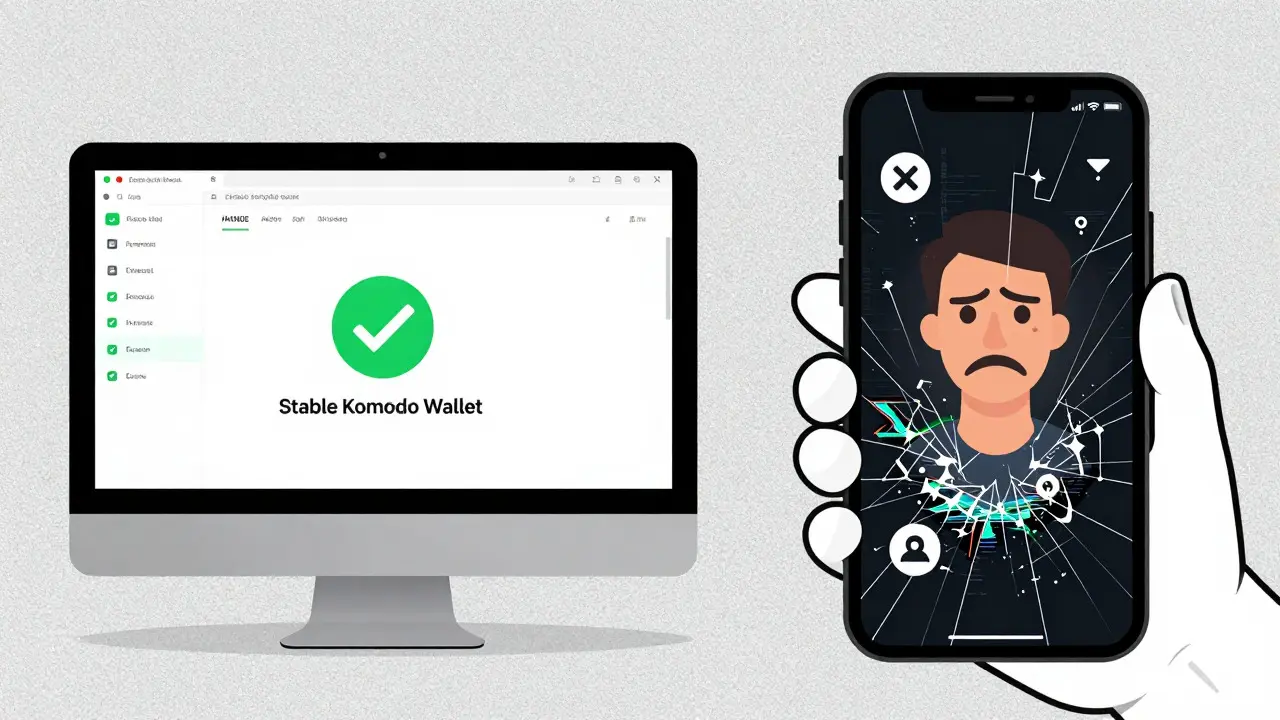
The Desktop App (Komodo Wallet): The desktop version, available for Windows, macOS, and Linux, is generally polished. Users report an intuitive interface where wallet management and DEX trading live side-by-side. Setting up a new wallet involves generating a seed phrase locally. Once you import assets, placing limit orders is straightforward. You can even place multiple sell orders for the same amount against different assets; if one fills, the others cancel automatically. This feature alone saves time for active traders.
The Mobile App: Here is where things get rocky. The Android app, listed as "Komodo Mobile Crypto Wallet," has a rating hovering around 3.8 stars on Google Play. Recent reviews from 2025 and 2026 highlight frequent crashes. Some users report the app closing within seconds of opening, making the DEX features unusable. While it works well as a simple storage wallet for some, relying on it for active trading in 2026 is risky. iOS users generally report fewer crashes but still note a lack of advanced features compared to the desktop version.
Security and Audits: The Elephant in the Room
Security is AtomicDEX’s strongest selling point. Since it is non-custodial, your private keys never leave your device. There is no database for hackers to breach. The HTLC mechanism ensures that even if a counterparty disappears, your funds are safe and refundable.
However, there is a gap. As of mid-2026, there is no publicly available third-party security audit report for the core mm2 engine. Komodo has stated repeatedly since 2022 that they are preparing for external audits, including internal code reviews and dependency refactoring. Yet, unlike competitors who publish PDF reports from firms like Trail of Bits or Quantstamp, AtomicDEX lacks this public proof.
Does this mean it’s unsafe? Not necessarily. The open-source nature of the code allows community scrutiny, and the GitHub repositories show active development with commits as recent as April 2026. But for institutional investors or risk-averse traders, the absence of a formal audit is a red flag.
Liquidity and Supported Assets
You might think that supporting "95% of coins" means you can trade anything instantly. In practice, liquidity is the bottleneck. Because AtomicDEX relies on peer-to-peer matching rather than deep liquidity pools, finding a buyer or seller for obscure tokens can be difficult.
Major pairs like BTC/KMD or ETH/KMD tend to have better activity due to automated market maker bots (makerbots) run by the community or Komodo itself. But if you try to swap a low-cap token, you might wait 15-20 minutes for a match, or worse, find no orders at all. This makes AtomicDEX less suitable for high-frequency trading or large-volume moves where slippage matters.
Currently, the default UI integrates about 25 coins and tokens directly. While the engine can handle hundreds more, you often have to manually configure them, which adds a layer of complexity for beginners.
Who Should Use AtomicDEX?
AtomicDEX isn’t for everyone. Here is who fits best:
- Privacy Advocates: If you hate KYC (Know Your Customer) checks and want to keep your trading history off centralized servers.
- Cross-Chain Traders: Those who frequently move value between Bitcoin, Ethereum, and smaller chains without wrapping assets.
- Self-Custody Purists: Users who refuse to trust exchanges with their private keys.
Who should avoid it?
- Beginners seeking ease-of-use: The setup process and occasional mobile bugs can be frustrating.
- High-Volume Traders: Thin order books will result in poor execution prices.
- Yield Farmers: There are no staking or yield farming integrations here. It is purely a swap engine.
Final Verdict
AtomicDEX remains a unique piece of infrastructure in the crypto world. It proves that non-custodial, cross-chain trading is possible without sacrificing security to a central authority. The technology behind mm2 and HTLCs is solid, and the fee structure is fair.
However, it is still a niche product. The mobile experience needs work, liquidity is shallow for many pairs, and the lack of a public audit leaves a question mark over long-term reliability. If you are comfortable with technical setups and prioritize sovereignty over speed, AtomicDEX is worth a try. Just start small, stick to the desktop app for serious trades, and always verify your seed phrase backups.
Is AtomicDEX safe to use in 2026?
Yes, AtomicDEX is considered safe due to its non-custodial nature and use of Hashed Time-Locked Contracts (HTLCs), which prevent theft by intermediaries. However, users should be aware that as of 2026, there is no publicly published third-party security audit for the core engine, which is a consideration for risk-averse traders.
What is the difference between AtomicDEX and Atomic Wallet?
They are completely different products. AtomicDEX is built by the Komodo Platform team and focuses on decentralized atomic swaps. Atomic Wallet is a separate multi-currency wallet developed by a different company. Do not confuse the two, as their security models and architectures differ significantly.
How much does it cost to trade on AtomicDEX?
AtomicDEX charges a 0.15% fee for takers (those taking liquidity) and 0% for makers (those providing liquidity). Additionally, you must pay the standard network gas fees for the blockchains involved in the swap, such as Bitcoin or Ethereum transaction fees.
Can I trade Bitcoin for Ethereum on AtomicDEX?
Yes, AtomicDEX specializes in cross-chain atomic swaps. You can trade Bitcoin directly for Ethereum, Komodo, Litecoin, and other supported assets without needing to convert them to a common intermediary token first.
Why is the AtomicDEX mobile app crashing?
Recent user reviews indicate stability issues with the Android version of the app, often referred to as Komodo Mobile Crypto Wallet. Crashes may occur due to outdated software or compatibility issues with newer Android versions. For the most stable experience, developers recommend using the desktop application.