Trading crypto doesn't have to mean paying high fees or waiting forever for transactions to clear. If you've been watching the decentralized finance (DeFi) space in 2026, you've likely heard about Uniswap v4, which launched in 2025 with a completely new modular architecture. When you combine this latest version of the world's largest decentralized exchange with Avalanche, a blockchain known for its sub-second finality and low costs, you get a trading experience that challenges even centralized exchanges like Coinbase.
This review breaks down what Uniswap v4 actually brings to the table on Avalanche. We'll look at the new "hooks" feature, compare fees against competitors, and see if this combination is right for your trading style. Whether you are a beginner looking to swap tokens or an advanced trader interested in liquidity provision, here is everything you need to know.
Why Uniswap v4 Changes the Game
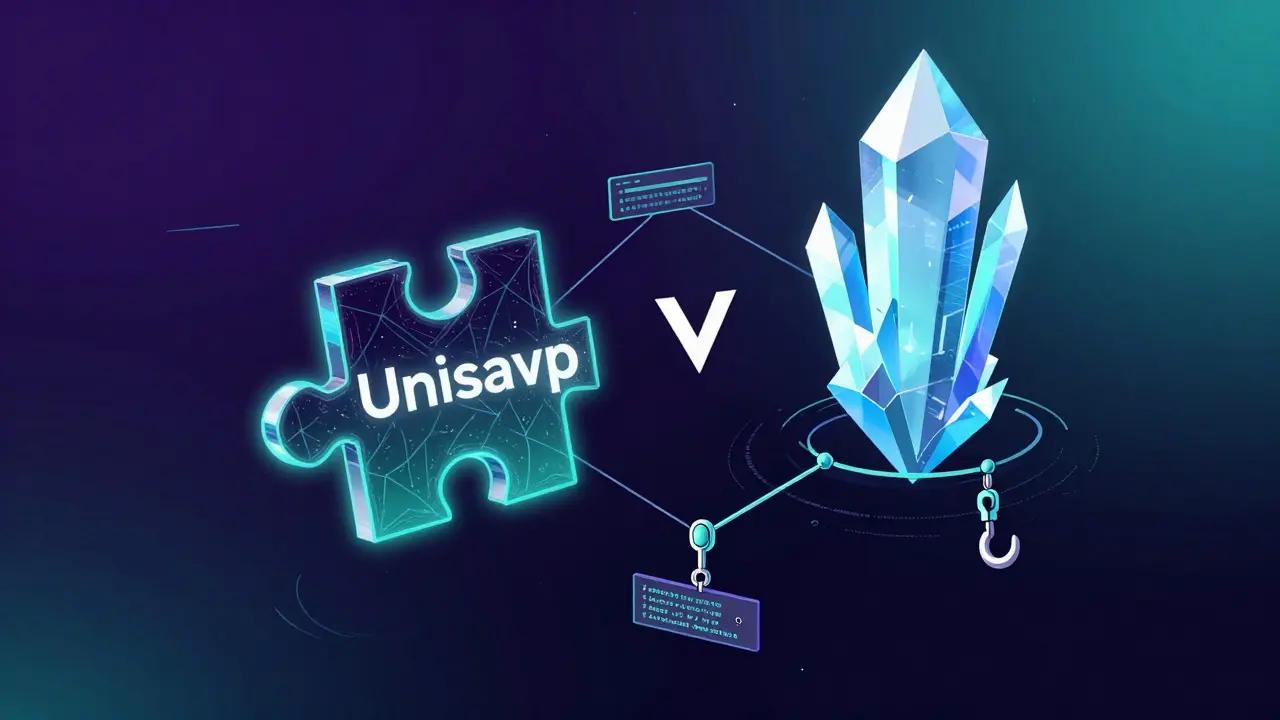
Uniswap started in 2018 as a simple way to trade Ethereum tokens without an intermediary. Today, it processes over $75 billion in swaps monthly. But v4 isn't just a minor update; it's a structural overhaul. The biggest change? Hooks. Think of hooks as plugins for the exchange. Developers can now write custom code that triggers during specific parts of a trade-like adjusting fees based on market volatility or enabling limit orders directly on-chain.
Before v4, creating a new liquidity pool was expensive because each pool required its own smart contract deployment. With v4, pool creation costs dropped by 99.99%. This means anyone can launch a niche token pool without burning through hundreds of dollars in gas fees. On Avalanche, where transaction costs are already low, this efficiency makes experimenting with new trading strategies nearly free.
The protocol also introduced native ETH support and optimized multi-hop swaps. In plain English, if you want to swap Token A for Token B, but there’s no direct pool, Uniswap automatically routes your trade through the most efficient path. This reduces slippage-the difference between the expected price and the actual execution price-which saves you money on larger trades.
Avalanche: The Perfect Host for Uniswap v4
You might wonder why we’re focusing on Avalanche specifically. Uniswap supports 34 chains, including Ethereum, Arbitrum, and Polygon. However, Avalanche offers unique advantages that complement Uniswap v4’s new features.
- Speed: Avalanche achieves sub-second finality. Your trade is confirmed almost instantly, unlike Ethereum mainnet, which can take minutes during congestion.
- Cost: Gas fees on Avalanche are significantly lower than on Ethereum. While Ethereum fees can spike to $50+ per transaction, Avalanche often charges less than $0.10.
- Throughput: The network handles thousands of transactions per second, ensuring smooth operation even during high-volume events.
In 2025, Avalanche released the Alpenglow update, further improving scaling and performance. Analysts predict this will drive fast adoption in North American and European markets. For Uniswap users, this means deeper liquidity pools and more efficient price discovery. You get the security and reliability of a top-tier blockchain with the speed of a Layer 2 solution.
Fees and Costs: How Much Will It Cost You?
Let’s talk numbers. One of the biggest complaints about DeFi has always been hidden costs. Uniswap v4 on Avalanche is transparent about its fee structure.
| Platform | Standard Swap Fee | Network/Gas Fee | Best For |
|---|---|---|---|
| Uniswap v4 (Avalanche) | 0.01% - 1% (usually 0.3%) | < $0.10 | Privacy, self-custody, niche tokens |
| Coinbase Advanced | 0.6% (for volume <$10k) | $0 (included in spread) | Beginners, fiat on-ramps |
| Uniswap v3 (Ethereum) | 0.01% - 1% | $5 - $50+ | Large institutional trades |
Most standard swaps on Uniswap happen at a 0.3% fee. Compare that to Coinbase Advanced’s 0.6% fee for market orders under $10,000 in 30-day volume. If you trade frequently, those savings add up quickly. Plus, you aren’t paying a centralized company to hold your assets. You keep full control via your wallet.
However, remember that variable fees apply depending on the pool. Stablecoin pairs might charge 0.01%, while volatile exotic pairs could charge 1%. Always check the fee tier before confirming your swap.

User Experience: Is It Easy to Use?
If you’ve used Uniswap before, the interface feels familiar. Milk Road’s 2025 review described it as having a "simple user interface" comparable to Google search. You connect your wallet, select the tokens you want to swap, and hit confirm. For beginners, the learning curve is minimal-most first-time users complete their initial swap within 10-15 minutes.
But don’t let the simplicity fool you. Under the hood, powerful tools are available. The NFT aggregator functionality allows you to browse collections from top marketplaces directly within the Uniswap interface. And thanks to hooks, you’ll soon see more advanced features like automated rebalancing strategies appearing in popular pools.
For liquidity providers, things get more complex. You need to understand concepts like impermanent loss-the risk that providing liquidity yields worse returns than simply holding the tokens. Uniswap v4’s concentrated liquidity feature (carried over from v3) lets you allocate capital to specific price ranges, boosting potential rewards but requiring active management. On Avalanche, the speed of transactions makes it easier to adjust your positions quickly if the market moves against you.
Security and Trust
In DeFi, security is paramount. Uniswap has maintained its position as the gold standard among DEXs since 2018. As of 2025, it holds approximately $3.4 billion in total value locked (TVL). This massive amount of capital acts as a strong incentive for the team to maintain robust security protocols.
The UNI token governs the protocol. Holders vote on proposals and manage a community treasury. This decentralized governance model means no single entity controls the platform, reducing the risk of censorship or malicious shutdowns. Avalanche itself has built a reputation as a proven and reliable platform, ranking among the top global blockchains for supporting advanced dApps.
That said, you are responsible for your own security. Never share your private keys, and always verify contract addresses before interacting with new pools. Scammers often create fake versions of popular tokens. Stick to verified pools and use reputable wallets like MetaMask or Rabby.

Who Should Use Uniswap v4 on Avalanche?
Not every tool fits every job. Here’s how to decide if this setup is right for you.
Use Uniswap v4 on Avalanche if:
- You want to trade niche tokens not listed on centralized exchanges.
- You care about privacy and keeping custody of your assets.
- You are sensitive to gas fees and want fast transaction confirmation.
- You are a developer interested in building custom trading logic using hooks.
Stick with Centralized Exchanges if:
- You are a complete beginner who prefers customer support chat bots.
- You need to deposit fiat currency (USD, EUR) directly via bank transfer.
- You don’t want to deal with wallet connections or seed phrases.
Final Thoughts
Uniswap v4 on Avalanche represents a significant leap forward for decentralized trading. By combining Uniswap’s revolutionary hooks and cost-efficient architecture with Avalanche’s speed and low fees, you get a platform that rivals centralized exchanges in usability while offering superior flexibility and control. The 99.99% reduction in pool creation costs opens doors for innovators, while the 0.3% standard fee keeps traders happy.
As the ecosystem grows, expect to see more sophisticated hooks and deeper liquidity. If you’re ready to take control of your trading journey, Uniswap v4 on Avalanche is worth exploring. Just start small, learn the ropes, and always prioritize security.
What is Uniswap v4?
Uniswap v4 is the latest version of the Uniswap decentralized exchange, launched in 2025. It introduces a modular architecture featuring "hooks," which allow developers to customize swap mechanics, fees, and liquidity incentives. It also drastically reduces pool creation costs and optimizes gas fees for multi-hop swaps.
Is Uniswap v4 available on Avalanche?
Yes, Uniswap v4 is deployed on Avalanche. This integration leverages Avalanche's sub-second finality and low transaction costs, making it one of the most cost-effective and fastest environments for using Uniswap's features.
How do Uniswap fees compare to Coinbase?
Uniswap typically charges a 0.3% swap fee for standard pools, whereas Coinbase Advanced charges 0.6% for market orders under $10,000 in 30-day volume. Additionally, Uniswap on Avalanche has negligible network fees (<$0.10), while centralized exchanges often hide costs in spreads or higher tiers.
What are "hooks" in Uniswap v4?
Hooks are customizable smart contracts that trigger at specific points during a swap or liquidity event. They enable advanced features like dynamic fees, on-chain limit orders, and automated rebalancing strategies, giving developers unprecedented flexibility.
Is Uniswap safe to use?
Uniswap is considered one of the safest DEXs due to its long track record, open-source code, and decentralized governance. However, users must practice good security hygiene, such as verifying contract addresses and securing their private keys, as they are responsible for their own funds.
Do I need ETH to trade on Uniswap v4 on Avalanche?
No, you need AVAX (Avalanche's native token) to pay for gas fees on the Avalanche network. While Uniswap v4 supports native ETH on Ethereum, on Avalanche, you will use AVAX for transaction costs and trade other tokens supported on the chain.