Did you miss the boat on Seascape Crowns? If you are looking for a massive payout from a recent airdrop, you might be disappointed. The main distribution event for Seascape Crowns (CWS) is a cryptocurrency token that concluded its primary Token Generation Event and community reward distributions years ago happened back in early 2021. There is no active, high-value "claim" button waiting for new users today. However, understanding what happened, how the remaining tokens work, and whether it’s still worth your time requires digging into the messy reality of niche gaming tokens.
This isn’t just about missing out; it’s about avoiding scams that prey on people searching for "free CWS." Let’s break down the actual history, the current state of the token, and what you need to know if you hold these tokens or want to buy them now.
The Reality of the Seascape CWS Airdrop
First, let’s clear up the confusion. The term "airdrop" in the context of Seascape usually refers to two things: the initial community reward pool distributed during the launch phase, or the ongoing "play-to-earn" mechanics within their games. The big splash-the one where thousands of tokens were handed out for free-ended when the Token Generation Event (TGE) wrapped up on February 1, 2021.
Back then, Seascape Network allocated specific portions of its total supply to early adopters and community members. According to records from ICO Drops, the Community Reward Pool held 500,000 CWS tokens, which is just 0.5% of the total supply. By the time documentation was finalized, about 85.7% of this pool had already been unlocked and distributed. That ship has sailed.
If you are seeing posts today claiming a "new huge CWS airdrop," treat them with extreme suspicion. In the crypto world, especially for smaller projects, fake airdrop sites are common traps designed to drain your wallet. Always verify announcements through official channels like the project’s verified Discord or Telegram, not random tweets or YouTube comments.
How Seascape Crowns (CWS) Actually Works
To understand why the hype died down, you have to look at what CWS actually does. It is an ERC-20 token that operates on the Ethereum blockchain and serves as both a utility and governance tool within the Seascape ecosystem. Its total supply is capped at 100 million tokens. These tokens aren't just for speculation; they are meant to fuel the Seascape Network’s gaming platform.
Here is how the token flows in the ecosystem:
- Governance: Holders can vote on community decisions regarding the platform’s future.
- Utility: Users spend CWS to access premium features in Seascape games.
- Rewards: Players earn CWS through gameplay achievements, part of the "Crowns" reward system.
The idea was to bridge DeFi (Decentralized Finance) with gaming. You play, you earn, you govern. Sounds great on paper. But execution is everything, and here is where things get tricky for the average user.
Buying and Holding CWS in 2026: Is It Worth It?
If you missed the airdrop, you might think, "I’ll just buy some now." Before you do, look at the numbers. As of late 2025, CWS trades at approximately $0.13 per token. The market capitalization hovers around $1.08 million. For context, major gaming tokens like Gala (GALA) or Immutable X (IMX) have market caps in the hundreds of millions or even billions. CWS is tiny.
| Token | Market Cap (Approx.) | Exchange Availability | Liquidity Status |
|---|---|---|---|
| Seascape Crowns (CWS) | $1.08 Million | DEXs Only (KuCoin swap ended) | Low ($47k daily volume) |
| Gala (GALA) | $480 Million+ | Binance, Coinbase, Kraken | High |
| Immutable X (IMX) | $1.2 Billion+ | Major Centralized Exchanges | Very High |
The lack of presence on major centralized exchanges like Binance or Coinbase is a red flag for many investors. CoinDesk analyst Maria Chen noted in 2025 that this absence "severely restricts retail investor access and creates artificial liquidity constraints." What does this mean for you? It means if you want to sell your CWS, you can’t just click "sell" on a friendly app. You have to go through decentralized exchanges (DEXs), which involves higher fees and technical complexity.
The Nightmare of Buying CWS Today
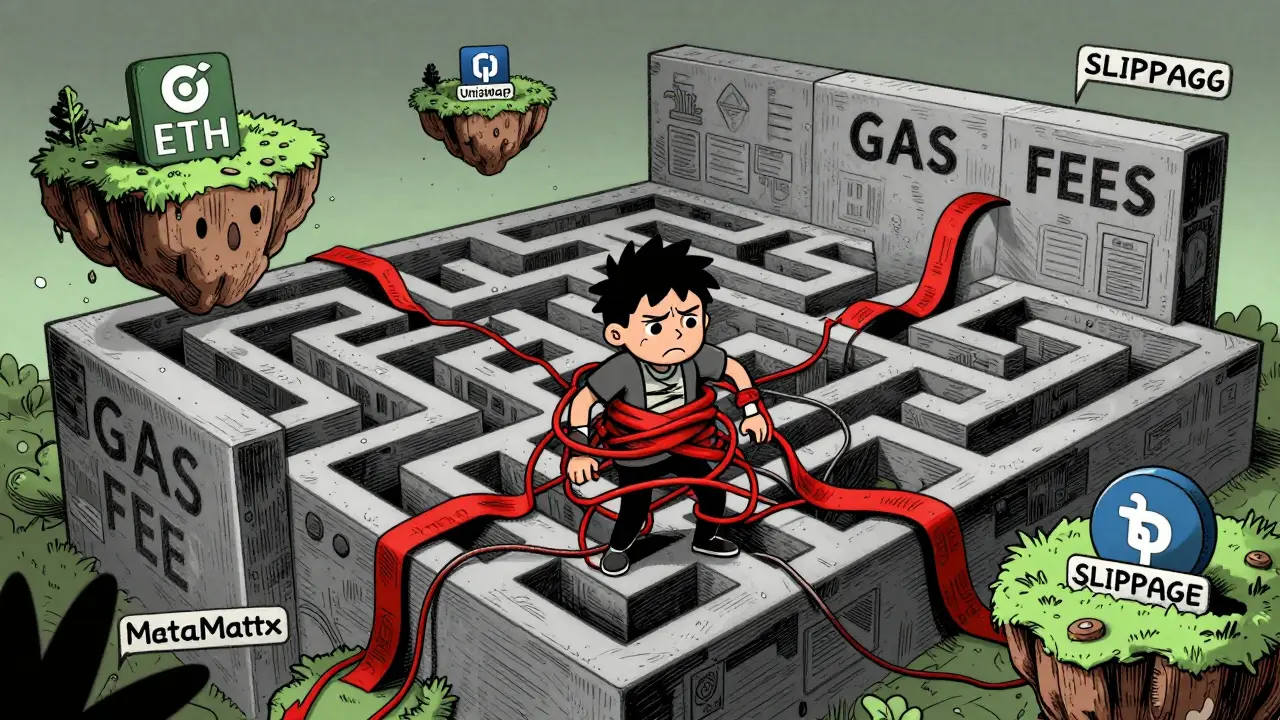
Let’s say you decide to proceed. Here is the unvarnished truth about acquiring CWS right now. You cannot buy it directly with USD or EUR on most platforms. The process is clunky:
- Buy Base Currency: You first need to buy Ethereum (ETH) or Binance Coin (BNB) on a major exchange.
- Transfer to Wallet: Move those coins to a Web3 wallet like MetaMask or Binance Web3 Wallet. This costs gas fees.
- Connect to DEX: Go to a decentralized exchange like Uniswap or PancakeSwap.
- Swap Tokens: Swap your ETH/BNB for CWS. Because liquidity is low, you might face high slippage, meaning you get fewer tokens than expected.
This takes 20-30 minutes even for experienced users. For beginners, it’s a minefield. Common errors include "insufficient liquidity" messages and failed transactions due to incorrect network settings. If you aren’t comfortable managing private keys and paying gas fees, this token is likely not for you.
Security and Trust Issues
Trust is currency in crypto, and Seascape has struggled here. User reviews on Trustpilot average a dismal 2.8 out of 5 stars. Complaints frequently cite "poor token visibility" and "confusing reward redemption processes." On Reddit, users complain about vanishing liquidity and difficulty converting their hard-earned gaming rewards into usable tokens.
Furthermore, security audits are lacking. CertiK, a leading blockchain security firm, noted that while the original smart contract was standard, there has been "no evidence of ongoing contract audits since the 2021 launch." In a space where hacks happen weekly, an unaudited codebase is a significant risk. Are you willing to bet your money on a contract that hasn’t been checked in five years?

Future Outlook: Hope or Hype?
Some analysts offer wildly optimistic predictions. CoinLore’s models suggest CWS could reach $468 by 2041. But let’s be real. These models often ignore fundamental market dynamics. Industry reports from Messari indicate that tokens with market caps below $10 million have a 78% chance of becoming inactive within 24 months. With a $1 million cap, CWS is squarely in the danger zone.
Seascape Network is trying to revive interest. They announced strategic partnerships and revised reward mechanisms in late 2025. Their Discord community remains active with about 8,500 members who genuinely enjoy the games. If you are a gamer who loves the Seascape titles and wants to support the ecosystem, holding CWS makes sense. But if you are an investor looking for quick gains, the risks far outweigh the potential rewards.
FAQ
Is there still an active Seascape CWS airdrop in 2026?
No. The primary community reward airdrop concluded with the Token Generation Event in February 2021. Any claims of new large-scale airdrops are likely scams. Current rewards are limited to small amounts earned through gameplay within the Seascape ecosystem.
Where can I buy Seascape Crowns (CWS)?
CWS is not listed on major centralized exchanges like Binance or Coinbase. You must buy it via decentralized exchanges (DEXs) such as Uniswap or PancakeSwap. This requires you to have ETH or BNB in a Web3 wallet to perform the swap.
Is Seascape CWS a safe investment?
It carries high risk. The token has low liquidity, a small market cap (~$1 million), and lacks recent security audits. Analysts warn that tokens in this category often become inactive. Only invest what you can afford to lose.
What is the total supply of CWS?
The total supply of Seascape Crowns is fixed at 100 million tokens. A small portion (0.5%) was allocated to community rewards, which have largely been distributed.
Why is CWS price so volatile?
Volatility stems from low trading volume and limited exchange listings. With only ~$47k in daily volume, large buys or sells can drastically move the price. Lack of deep liquidity pools on DEXs exacerbates this issue.