
Imagine a world where you don't have to jump between five different apps just to swap tokens, provide liquidity, and trade futures. That is the promise of THENA FUSION, a decentralized exchange (DEX) built on the BNB Chain ecosystem that combines spot trading, perpetual futures, and social features into one interface. Launched in 2023, it aims to solve the fragmentation problem in DeFi by acting as a 'SuperApp' for traders who want centralized-exchange convenience without giving up custody of their assets.
But does it actually deliver on that hype? Or is it just another complex protocol that looks good on paper but fails in practice? I’ve spent time analyzing its architecture, fee structures, and user feedback to see if THENA FUSION is a legitimate upgrade or just more noise in the crowded DeFi space. Here is what you need to know before connecting your wallet.
What Exactly Is THENA FUSION?
At its core, THENA is not just a simple token swapper like early versions of Uniswap. It is an automated market maker (AMM) designed specifically for the BNB Chain and its Layer-2 solution, opBNB. The platform was created to address a specific pain point: traditional DeFi requires users to navigate isolated protocols for every action. You might use one site for swapping, another for lending, and a third for derivatives. THENA tries to unify these experiences.
The ecosystem consists of three main components:
- THENA Spot DEX: Handles standard token swaps with advanced routing technology to reduce slippage.
- ALPHA Perpetuals DEX: Offers leveraged trading on over 270 crypto pairs with up to 60x leverage, powered by SYMMIO’s intent-based model.
- ARENA: Provides gamified trading competitions and social features, allowing users to compete and share strategies.
This structure makes THENA unique because it targets both casual traders and sophisticated liquidity providers under one roof. However, this ambition comes with complexity. If you are looking for a dead-simple interface like Coinbase, THENA will feel overwhelming at first. It is built for people who already understand wallets, gas fees, and basic AMM mechanics.
The Core Technology: FUSION Pools Explained
The real innovation behind THENA lies in its signature feature: FUSION pools, which represent a new type of concentrated liquidity mechanism developed in collaboration with Gamma Strategies and Algebra. Unlike standard Automated Market Makers (AMMs) where your liquidity is spread evenly across all price ranges, FUSION allows for modular design and dynamic fee adjustments.
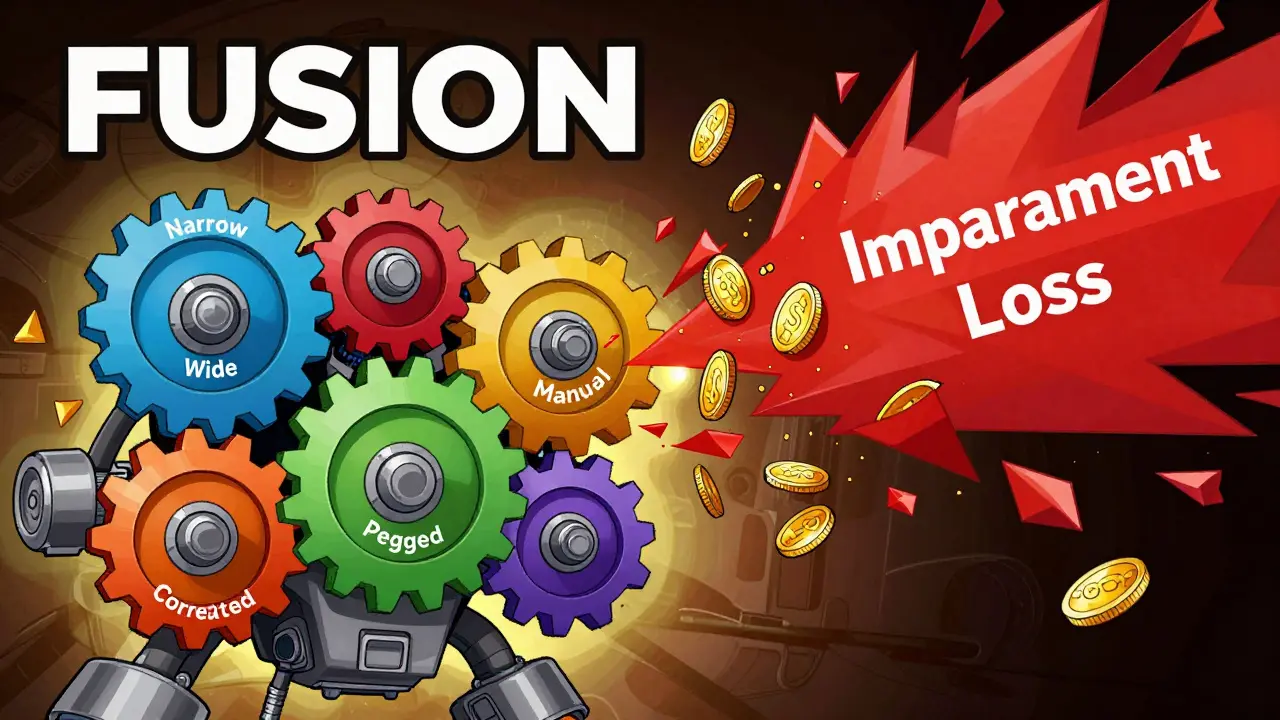
Why does this matter? In traditional concentrated liquidity pools (like those on Uniswap v3), you have to manually manage your position ranges. If the price moves out of your range, you stop earning fees and face impermanent loss. FUSION pools attempt to automate some of this headache by offering six distinct strategies tailored to different asset behaviors:
- Wide: Broad range for volatile assets.
- Narrow: Tight range for stable pairs to maximize yield.
- Manual: Full control for expert LPs.
- Pegged Price: For assets tied to a specific value.
- Correlated: For assets that move together.
- Stable: Optimized for low-volatility pairs.
According to data from Serenity Research, this approach can significantly reduce impermanent loss risk. One Reddit user, 'CryptoTrader89', reported seeing up to 35% better returns on stablecoin pairs after migrating to FUSION pools compared to standard AMMs. This is a compelling argument for liquidity providers who want efficiency without constant monitoring.
Fees, Costs, and Economic Model
Before you start trading, you need to understand the cost structure. THENA uses a dynamic fee model for FUSION and manual range pools, meaning fees can adjust based on market conditions. For legacy V1 pools, the fees are fixed:
- V1 Stable Pools: 0.01%
- V1 Variable Pools: 0.02%
These rates are competitive, especially when compared to Ethereum-based DEXs where gas fees alone can eat up profits. On BNB Chain, transaction costs remain relatively low, making high-frequency trading feasible. However, remember that while the protocol fees are low, you still pay network gas fees. Using opBNB can further reduce these costs, but it requires bridging your assets, which adds a step to the process.
The platform also has its own governance and utility token, THE, which powers the ecosystem. Notably, 44% of THE tokens are allocated to users and protocols, while only 18% go to the team. This distribution suggests a community-focused incentive model, aiming to align long-term interests between developers and traders. As of late 2023, THE listed on major exchanges like MEXC, providing liquidity and accessibility for holders.
Pros and Cons: A Balanced View
No platform is perfect. To help you decide if THENA fits your strategy, let's look at the clear advantages and disadvantages based on user feedback and technical analysis.
| Category | Pros | Cons |
|---|---|---|
| Features | Unified spot, perps, and social trading in one app. | Complex UI; steep learning curve for beginners. |
| Liquidity | FUSION pools reduce impermanent loss; high volume on major pairs. | Liquidity fragmented on smaller pairs; 87% of volume is on BSC-USD/USDC. |
| Costs | Low base fees (0.01%-0.02%); cheap BNB Chain gas. | Dynamic fees can be unpredictable; bridging costs to enter opBNB. |
| Ecosystem | Strong integration with BNB Chain and opBNB; active community (45k+ members). | Limited to BNB Chain; no native Ethereum support yet. |
| Security | Non-custodial; audited smart contracts (implied by institutional partnerships). | Complexity increases attack surface; migration risks for LPs. |
A key concern raised by critics, including Gate.com analysts, is the potential for security vulnerabilities due to the complexity of managing multiple integrated services. While THENA collaborates with reputable firms like Three Sigma, the sheer number of moving parts means any bug could have cascading effects. Always do your own research (DYOR) regarding audit reports before depositing significant capital.
User Experience: Who Is This For?
If you are a complete beginner to cryptocurrency, THENA is probably not your first stop. User surveys conducted by MEXC indicate that complete beginners may require 8-10 hours to become proficient with the full feature set, whereas experienced DeFi users take about 2-3 hours. Compare that to Uniswap, which many users grasp in 30 minutes. The trade-off here is power versus simplicity.
THENA shines for intermediate to advanced traders who want to execute complex strategies. For example, if you want to provide liquidity in a correlated pool while simultaneously hedging your exposure using ALPHA perpetuals, you can do it all within the same dashboard. This saves time and reduces the friction of moving assets between platforms.
However, the user interface (UI) has been criticized for being cluttered. One user, 'DeFiNewbie2023', noted that the initial setup took three hours to fully understand. Documentation is rated 4.2/5, which is decent, but advanced FUSION pool strategies lack detailed guides. The community support on Telegram and Discord is robust, with over 45,000 active members, so you won't be left stranded if you get stuck.

Market Position and Competitors
In the broader context of decentralized exchanges, THENA holds a respectable position. According to CoinGecko statistics, it ranks in the 84th percentile by volume and 59th percentile by combined orderbook depth among DEXs. On the BNB Chain specifically, it is the third-largest DEX behind PancakeSwap and Biswap, capturing approximately 1.8% of the chain's DEX volume.
How does it compare to its rivals?
- PancakeSwap: The dominant force on BNB Chain. It is simpler and has deeper liquidity for common pairs but lacks the advanced FUSION pool mechanics and integrated perp trading that THENA offers.
- Uniswap: The gold standard for Ethereum. It is more established and has broader multi-chain support, but fees are higher, and it doesn't offer the same level of integrated social/gamification features.
- Trader Joe: Strong on Avalanche. Similar focus on yield optimization, but THENA's collaboration with Gamma Strategies gives it a slight edge in automated liquidity management.
THENA's strength lies in its specialization. It is not trying to be everything to everyone; it is trying to be the best tool for serious BNB Chain traders. If you are primarily an Ethereum user, THENA currently has little value for you unless you plan to bridge assets frequently.
Future Outlook: What’s Next for THENA?
The roadmap for THENA includes several ambitious goals. The most notable is cross-chain expansion beyond BNB Chain. Currently, the platform is heavily siloed within the BNB ecosystem. Expanding to Ethereum, Arbitrum, or Base would drastically increase its total addressable market. Reflexivity Research projects that if this expansion succeeds, THENA could capture 5-7% of the total DEX market share by 2025.
Additionally, the team plans to integrate AI-driven trading insights. This could help demystify some of the complex data involved in FUSION pool management, potentially lowering the barrier to entry for less experienced users. The introduction of fiat on-ramps is also mentioned, which would streamline the onboarding process for newcomers who currently have to buy crypto elsewhere before using the platform.
However, competition is fierce. Other DEXs are rapidly adopting similar multi-functional models. Serenity Research cautions that continued innovation will be critical. If THENA fails to differentiate itself through superior technology or lower costs, it risks losing market share to newer entrants or established giants like PancakeSwap evolving their own features.
Final Verdict
THENA FUSION is a powerful tool for traders who live on the BNB Chain. Its FUSION pools offer a genuine improvement in capital efficiency and impermanent loss mitigation, backed by solid technical partnerships. The integration of spot, perps, and social trading creates a sticky ecosystem that rewards frequent users.
However, it is not a plug-and-play solution. The learning curve is real, and the interface can be intimidating. If you are a casual investor looking to buy and hold, stick to simpler platforms. But if you are an active trader or liquidity provider seeking advanced tools and lower fees on BNB Chain, THENA deserves a spot in your toolkit. Just start small, familiarize yourself with the UI, and always verify the security of your connections before committing large sums.
Is THENA FUSION safe to use?
Like any decentralized application, THENA carries inherent smart contract risks. While it collaborates with reputable firms like Three Sigma and Gamma Strategies, no system is immune to bugs or exploits. Users should never invest more than they can afford to lose and should keep their private keys secure. The platform is non-custodial, meaning you retain control of your funds, which reduces counterparty risk compared to centralized exchanges.
Can I use THENA on Ethereum?
Currently, THENA is built exclusively for the BNB Chain and opBNB. It does not natively support Ethereum Mainnet. To use THENA with Ethereum assets, you would need to bridge them to BNB Chain using a trusted bridge service, which introduces additional steps and potential risks. Cross-chain expansion is part of their future roadmap, but it is not available yet.
What are FUSION pools?
FUSION pools are THENA's proprietary concentrated liquidity mechanism. Unlike standard AMMs where liquidity is spread across all prices, FUSION allows liquidity providers to choose from six strategies (wide, narrow, manual, etc.) to optimize yields and minimize impermanent loss. They are designed to be more capital-efficient and easier to manage than traditional concentrated liquidity models.
How much leverage does THENA offer?
Through its ALPHA perpetuals module, THENA offers up to 60x leverage on over 270 crypto pairs. This is suitable for experienced traders who understand the risks of liquidation. Beginners should approach high leverage with extreme caution, as small market movements can wipe out positions quickly.
Is THENA better than PancakeSwap?
It depends on your needs. PancakeSwap is simpler, has deeper liquidity for common pairs, and is more beginner-friendly. THENA is better for advanced users who want specialized tools like FUSION pools, integrated perpetual futures, and social trading features. If you prioritize ease of use, choose PancakeSwap. If you prioritize advanced functionality and yield optimization, choose THENA.






Joshua Alcover
The ontological premise of this 'SuperApp' paradigm is fundamentally flawed because it assumes a homogenization of user intent that simply does not exist in the chaotic marketplace. By attempting to synthesize spot trading, perpetual futures, and social gamification into a singular interface, THENA creates a cognitive dissonance for the trader who requires specialized tools for specialized tasks. The notion that one can seamlessly transition from providing liquidity in a FUSION pool to executing high-leverage perp trades without friction is a marketing fabrication designed to obscure the inherent complexity of these distinct financial instruments. Furthermore, the reliance on the BNB Chain ecosystem introduces a systemic risk vector that cannot be ignored, as the centralization tendencies of the underlying infrastructure contradict the very ethos of decentralized finance. This is not innovation; it is merely packaging existing protocols under a new brand identity to capture market share through superficial convenience rather than technological superiority.