
AZ Token Value Calculator
Calculate Your Azbit (AZ) Value
This tool calculates the value of your Azbit tokens based on the all-time high and current market reality. Note: The token shows significant price discrepancies across platforms. We're using a conservative estimate of $0.0000029 for current price based on CoinLore data.
Azbit (AZ) is a cryptocurrency token built on the Ethereum blockchain as an ERC-20 standard. It’s the native token of the Azbit exchange, a crypto trading platform launched in 2019 and based in Seychelles. Unlike Bitcoin or Ethereum, Azbit isn’t a standalone network-it exists to power a specific exchange. If you’re wondering whether AZ is worth paying attention to, here’s what you need to know: how it works, where it’s used, and why its value has crashed since its peak.
What Azbit (AZ) Actually Does
Azbit isn’t just a coin you buy hoping it goes up. It’s designed to be a utility and governance token for the Azbit exchange. That means if you hold AZ, you’re not just a passive holder-you’re a community member with voting rights. Token holders can vote on platform decisions like new trading pairs, fee structures, or even who sits on the advisory team. It’s meant to give users a say in how the exchange evolves.
On the trading side, AZ is used to pay for fees on the Azbit platform. Holders get discounts on trading fees, withdrawal fees, and access to exclusive features like margin trading and crypto-backed loans. The platform also runs weekly token burns, where a portion of AZ is permanently removed from circulation. The idea? Reduce supply over time to create scarcity. But whether that actually moves the needle on price is another question.
How Azbit (AZ) Was Launched
Azbit was announced in 2018 at the Consensus conference in New York. It raised funds through an Initial Coin Offering (ICO) and got a notable boost from Roger Ver, a well-known early Bitcoin supporter who publicly endorsed the project. That gave it early visibility, especially among crypto investors looking for the next big altcoin.
The token launched publicly on May 16, 2019, with a fixed supply of 69,750,302,117 AZ tokens-all of them already in circulation. No mining. No staking. Just a pre-minted supply. That’s common for exchange tokens, but it also means there’s no mechanism to control inflation beyond token burns. And while the burn program was active in 2020-2021, there’s little public data showing recent burns, raising questions about whether it’s still happening.
Where You Can Trade Azbit (AZ)
You won’t find AZ on Binance, Coinbase, or Kraken. It’s not listed on any major centralized exchange. Instead, it trades almost entirely on decentralized exchanges (DEXs), primarily PancakeSwap (v2) using the AZ/WBNB pair. That’s a red flag for many investors. When a token is only available on DEXs, it usually means low liquidity, high slippage, and less oversight.
Trading volume reflects this. CoinGecko reports a 24-hour volume of around $195, while CoinLore says it’s closer to $19. That kind of discrepancy is rare for legitimate tokens. It suggests either one data source is wrong-or worse, that the token’s market is being manipulated or lacks real buyers.

Price History and Market Performance
Azbit’s price tells a story of hype followed by collapse. Its all-time high was $0.009667 in September 2019. Today, prices vary wildly depending on the tracker. CoinGecko shows AZ trading near $0.05-over 50 times higher than its 2022 low. But CoinLore says it’s at $0.0000029. Which one is right? Neither might be. The massive gap suggests the token has multiple contracts in play, or one of the platforms is tracking a fake or outdated version.
What’s clear is the long-term trend. Since its peak, AZ has lost over 98% of its value. Against Bitcoin, it’s down 76%. Against Ethereum, it’s down 75%. Even over the past year, it’s lost nearly 60%. The recent weekly gain of 2.88% is just noise in a long-term decline. If you bought AZ at its peak, you’d need a 1,700% return just to break even.
Why Azbit (AZ) Struggles Today
The crypto exchange space is brutal. Binance, OKX, and Bybit dominate over 80% of global trading volume. Azbit, with its Seychelles registration and minimal marketing, never stood a chance against them. Even in 2021, when it claimed $240 million in daily volume, that was less than 0.1% of Binance’s volume at the time.
Its user base is tiny. In early 2021, Azbit reported around 8,600 users. That’s not a platform-it’s a small community. No major partnerships, no institutional backing, no media coverage in recent years. The platform still offers spot trading, margin trading, and loans, but without liquidity, marketing, or user growth, those features mean little.
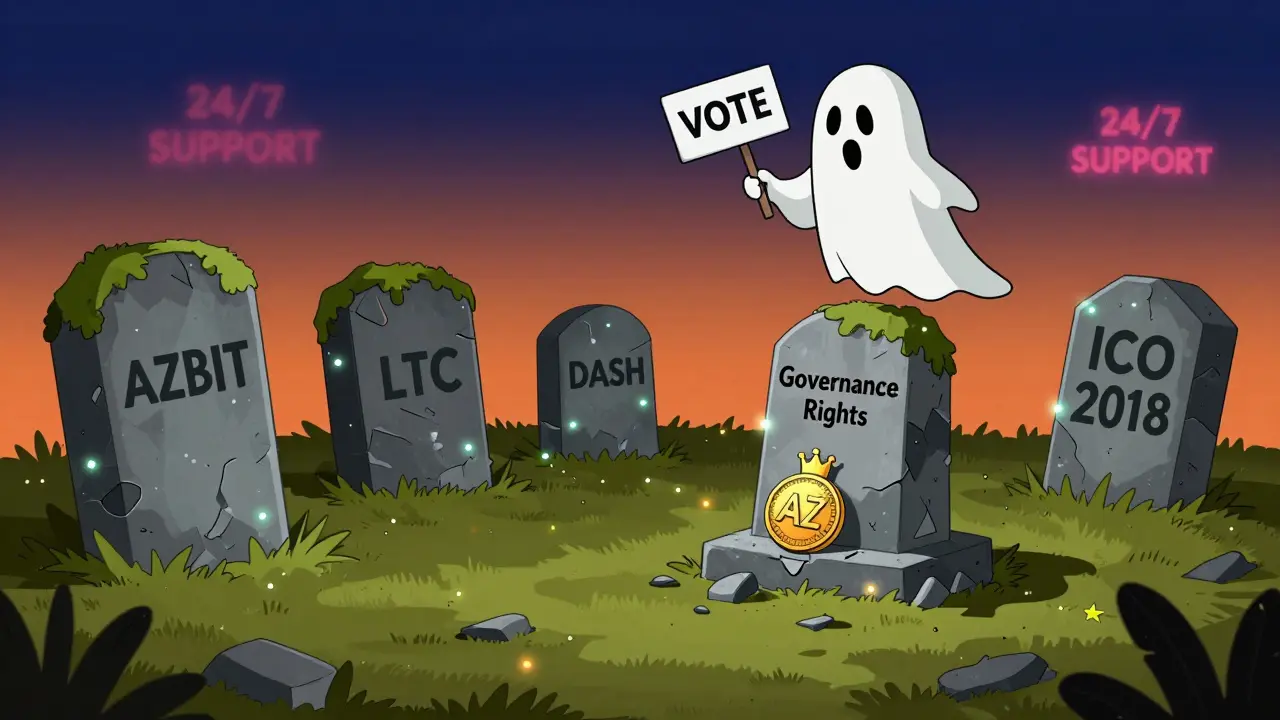
The governance model sounds good on paper: vote, earn bonuses, shape the future. But without active participation, it’s just a slogan. There are no public records of token holder votes, no transparency reports on how decisions were made, and no community forums showing real engagement.
Is Azbit (AZ) Worth Holding or Buying?
If you’re looking for a long-term investment, Azbit isn’t it. The token has no real adoption outside its own exchange. Its price is unstable, its data is inconsistent, and its ecosystem is shrinking. Even if you believe in the concept of exchange tokens, there are far better options-like BNB, OKB, or HT-that have real volume, active development, and global recognition.
If you’re curious and want to experiment with a low-value token, you can buy AZ on PancakeSwap. But treat it like a lottery ticket-not an asset. Only invest what you’re willing to lose. Don’t expect it to recover. Don’t assume the burn program will save it. And don’t rely on governance rights that no one is using.
Technical Details You Should Know
- Blockchain: Ethereum (ERC-20)
- Total Supply: 69,750,302,117 AZ
- Circulating Supply: Same as total supply
- Token Type: Utility + Governance
- Not Mineable: Yes
- Wallet Compatibility: MetaMask, Trust Wallet, and any Ethereum-compatible wallet
- Trading Pairs: AZ/WBNB (PancakeSwap v2)
The fact that it’s ERC-20 means you can store it safely in any Ethereum wallet. But that’s the only advantage. There’s no staking, no yield farming, and no DeFi integration beyond basic trading.
Final Take: A Cautionary Tale
Azbit (AZ) is a reminder that not every crypto project survives. Many launch with big promises, celebrity endorsements, and flashy websites. But without real demand, liquidity, and ongoing development, they fade away. Azbit still operates. It still has a website. It still claims 24/7 support. But the numbers don’t lie: trading volume is microscopic, price is erratic, and interest is gone.
If you’re researching AZ because you already own it, consider whether holding it serves any real purpose. If you’re thinking of buying it, understand you’re betting on a dead project coming back to life-and that’s a long shot with no history of success.
The crypto world moves fast. Azbit was once a name people knew. Now, it’s a footnote in the graveyard of failed altcoins.
Is Azbit (AZ) a good investment?
No, Azbit is not a good investment for most people. Its price has dropped over 98% from its peak, trading volume is extremely low, and it’s not listed on major exchanges. The token’s value is unstable, and there’s little evidence of active development or community growth. Only risk-tolerant traders with a gambling mindset should consider it.
Where can I buy Azbit (AZ) coin?
Azbit (AZ) can only be traded on decentralized exchanges, primarily PancakeSwap (v2) using the AZ/WBNB pair. It is not available on any major centralized exchanges like Binance, Coinbase, or Kraken. You’ll need a wallet like MetaMask and some BNB to trade it.
What is Azbit’s token supply?
Azbit has a fixed total and maximum supply of 69,750,302,117 AZ tokens, all of which are in circulation. There is no mining, and no new tokens will be created. The project has run weekly token burns in the past, but recent burn activity is unverified.
Why is there such a big price difference between CoinGecko and CoinLore?
The huge price gap suggests either a data error, multiple token contracts being tracked, or low liquidity causing wild price swings on small trades. CoinGecko’s price of ~$0.05 may reflect a single large trade, while CoinLore’s $0.0000029 may represent the true average. This inconsistency is a major red flag for any serious investor.
Does Azbit still have active development?
There’s no public evidence of recent development. The last major updates were in 2020-2021, including margin trading and token burns. Since then, there have been no roadmap releases, team announcements, or technical upgrades. The platform still operates, but its growth has stalled, and community engagement appears minimal.
Can I use Azbit (AZ) for anything besides trading?
Yes, but only on the Azbit exchange. Holders can use AZ to pay for trading fees (with discounts), participate in governance voting, and receive community bonuses. However, it has no use outside the platform-no DeFi integrations, no NFT marketplaces, and no third-party partnerships.







Jerry Perisho
AZ is a textbook example of an exchange token with no real utility outside its own platform. The burn program was a nice idea, but without transparency or consistent activity, it's just marketing fluff. And the price discrepancy between CoinGecko and CoinLore? That's not a data issue-that's a red flag waving in a hurricane. If you're holding this, you're not investing, you're gambling with a loaded dice.