Imagine trying to park your Bitcoin in a savings account that actually pays interest. Sounds impossible, right? That’s exactly the gap Kaon (KAON) tries to fill. It’s not just another random coin you see on a chart; it’s positioned as an AI-powered aggregator for Bitcoin-focused decentralized finance (BTCfi). In plain English, Kaon aims to take your locked-up Bitcoin and help you deploy it into various DeFi protocols to earn yield, using artificial intelligence to figure out where the best returns are.
If you’ve been digging through crypto data sites recently, you might have noticed some confusion around this name. Is it Kaon? Is it Koan? Is it Akropolis? The short answer is: it’s messy. But if we look at the specific token with the ticker KAON, we’re talking about an Ethereum-based ERC-20 token launched back in July 2019. Let’s cut through the noise and see what this project actually does, how much risk you’re taking, and whether it has any real utility in 2026.
The Core Concept: Bridging Bitcoin and DeFi with AI
Bitcoin was designed to be digital gold-something you hold, not something you spend or lend. But the decentralized finance (DeFi) world runs on smart contracts, mostly on Ethereum. To get Bitcoin into DeFi, you usually need "wrapped" Bitcoin (like WBTC), which introduces bridge risks and extra steps. This is where Kaon enters the chat.
According to data from aggregators like Gate.io and CoinMarketCap, Kaon functions as a service layer rather than a standalone blockchain. Its main job is aggregation. Think of it like a travel booking site but for crypto yields. Instead of manually checking five different Bitcoin lending platforms to see who offers the best rate, Kaon’s interface claims to unify these protocols. It uses AI models to analyze financial data, compare yields, and suggest optimal strategies for deploying your assets.
- Portfolio Tracking: Monitor your Bitcoin-derived assets across multiple DeFi platforms in one dashboard.
- Yield Comparison: See which protocol is offering the highest return on wrapped Bitcoin at any given moment.
- Liquidity Management: Tools to move funds between protocols automatically or semi-automatically to chase better rates.
The value proposition here is convenience and optimization. If the AI works as advertised, it saves you time and potentially boosts your returns by catching small inefficiencies in the market. However, remember that this is an application-layer tool running on Ethereum, not a new blockchain itself.
The Naming Confusion: Kaon vs. Koan vs. Akropolis
This is the part that trips up most beginners. You’ll often see "Kaon" mentioned alongside "AKRO" or "Akropolis." Here is the critical distinction you need to make before buying anything:
| Entity | Ticker | Blockchain | Primary Function |
|---|---|---|---|
| Kaon | KAON | Ethereum (ERC-20) | BTCfi Aggregator / AI Yield Tool |
| Koan (formerly Akropolis) | AKRO | Bitcoin Layer 1 (EVM Compatible) | Native Bitcoin Smart Contract Platform |
Sources like CoinSpot describe Koan (AKRO) as a Bitcoin Layer 1 blockchain that eliminates the need for bridges by using a UTXO-native architecture. Investing.com sometimes conflates the two, listing Kaon as also being referred to as AKRO Coin. Meanwhile, CoinMarketCap hosts Kaon (KAON) data under a URL path that still references "akropolis," suggesting a historical link or rebranding event.
However, technically speaking, the KAON token is an ERC-20 token created on Ethereum on July 16, 2019. The AKRO token powers a completely different infrastructure-a Bitcoin L1. Unless official documentation explicitly merges them into a single entity with a unified tokenomics model, you should treat them as separate projects. Buying KAON does not give you governance rights over the Koan blockchain, and vice versa. Always check the contract address before swapping.
Tokenomics and Supply Details
Let’s look at the numbers. Tokenomics matter because they tell you how diluted your ownership could become. For Kaon (KAON), the supply figures are consistent across major trackers like Gate.io, CoinMarketCap, and 3Commas, though minor discrepancies exist due to update timing.
- Total Supply: Approximately 15 billion KAON tokens.
- Max Supply: 15 billion KAON tokens (hard cap).
- Circulating Supply: Ranges between 4.43 billion and 4.68 billion KAON.
This means roughly 30% of the total tokens are currently in circulation. The remaining 70% are likely held in treasuries, reserved for team incentives, or locked in vesting schedules. While the exact distribution isn’t fully transparent in public snippets, a large portion of supply being off-market can create selling pressure if those tokens are ever released. Keep an eye on unlock events if you decide to hold long-term.
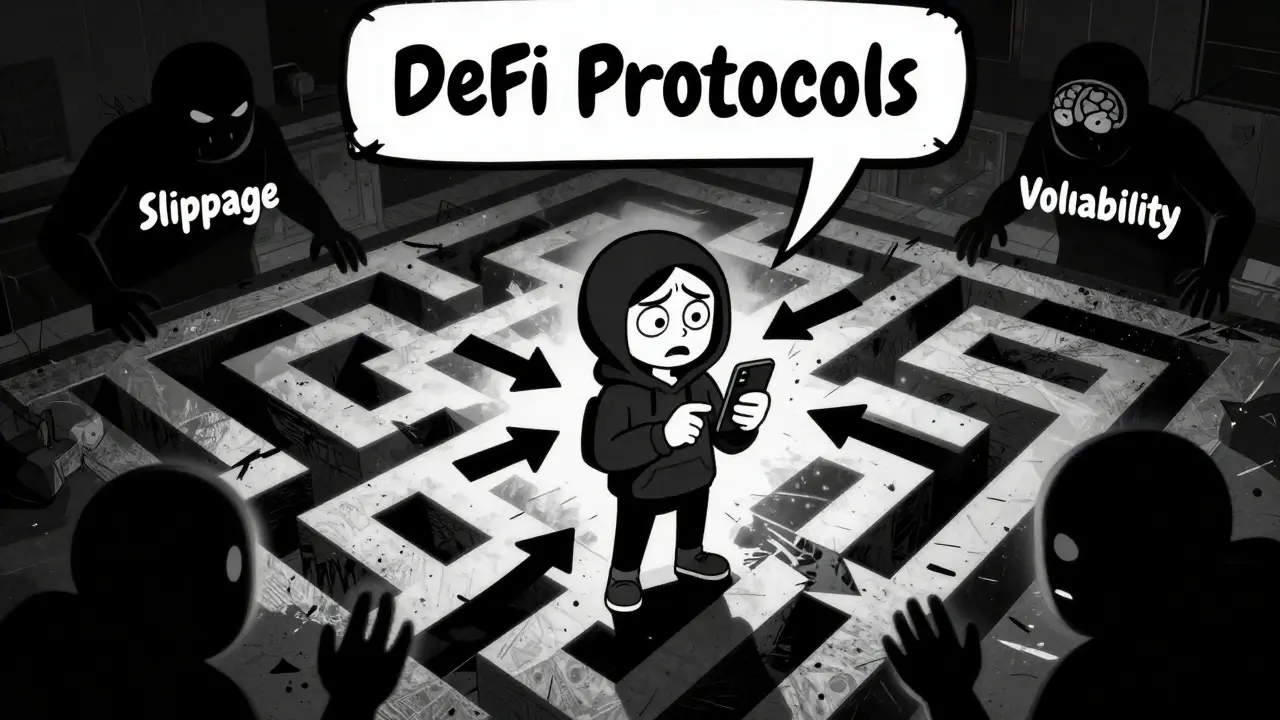
Market Performance and Volatility Risks
Here is the hard truth: Kaon is a micro-cap asset. When we talk about "micro-cap," we mean a market capitalization that barely registers on the radar of institutional investors. As of mid-2026, Kaon’s market cap hovers between $88,000 and $266,000 USD, depending on the data source. It ranks anywhere from #2,992 to #5,990 among all cryptocurrencies.
To put that in perspective, top-tier DeFi projects have market caps in the billions. Kaon is operating in a space where liquidity is thin. What does that mean for you?
- High Slippage: If you try to buy or sell a large amount of KAON, you might significantly move the price against yourself because there aren’t enough buyers or sellers in the order book.
- Extreme Volatility: Daily price swings of ±10% to ±14% are common. One day it’s up 13%, the next it’s down 8%. This isn’t a stable investment; it’s a high-octane trade.
- Deep Drawdowns: CoinMarketCap notes that KAON is down approximately 99.98% from its all-time high. The recorded ATH was $0.000615 USD in February 2025, while recent prices have hovered around $0.000020 USD. Recovering from a 99% drop requires a 100x gain, which is statistically rare.
Trading volume is also low, typically ranging from $2,000 to $111,000 per day. Low volume makes it harder to enter and exit positions quickly without impacting the price. If you’re looking for a place to park serious capital safely, this is not it. If you’re a speculative trader looking for high-risk, high-reward plays, you need to understand that you’re playing with fire.
How to Use Kaon: Wallets and Access
Since KAON is an ERC-20 token on the Ethereum network, the barrier to entry is relatively low in terms of technical setup. You don’t need a specialized wallet. Any standard Ethereum-compatible wallet will work.
- Software Wallets: MetaMask, Trust Wallet, or Rainbow Wallet can store KAON seamlessly.
- Hardware Wallets: Ledger or Trezor devices support ERC-20 tokens via their respective apps (Ledger Live, Trezor Suite).
To interact with the Kaon platform’s supposed features-like yield comparison or portfolio tracking-you would typically connect your Web3 wallet to their dApp (decentralized application). However, detailed user guides or extensive community reviews are scarce. The lack of visible user feedback on major forums suggests the active user base is small. Before connecting your wallet to any third-party interface, always verify the URL and ensure the contract addresses match official sources to avoid phishing scams.

Is Kaon a Good Investment in 2026?
Let’s be direct. There is no clear roadmap, no published whitepaper details on the AI methodology, and no prominent security audits cited in public data. The project is driven by a "KAON Community Team," but individual identities and corporate structures remain opaque. This anonymity is common in early-stage crypto but adds a layer of trust risk.
Algorithmic trading tools like 3Commas have issued "Sell" recommendations for KAON based on short-term momentum models. Their forecasts predict modest upside in the immediate term but nothing that challenges the massive historical drawdown. Without fundamental catalysts-like a major partnership, a verified audit, or a surge in TVL (Total Value Locked)-the price action remains driven purely by speculation and sentiment.
If you are interested in Bitcoin DeFi, there are more established players like Stacks (STX), BadgerDAO, or even larger aggregators like Yearn Finance. These projects have higher liquidity, clearer teams, and proven track records. Kaon occupies a very niche, high-risk corner of the market. It might succeed if its AI aggregation tool gains traction among Bitcoin holders looking for passive income, but right now, the evidence for widespread adoption is weak.
Final Thoughts on Kaon (KAON)
Kaon represents an interesting idea: using AI to simplify the complex world of Bitcoin yield farming. The concept is sound, and the demand for BTCfi solutions is growing. However, the execution and current market reality paint a picture of a struggling micro-cap token. With a 99.98% drop from its highs, low liquidity, and significant naming confusion with the AKRO project, Kaon requires extreme caution.
Treat it as a speculative experiment, not a core holding. Do your own research, verify every contract address, and never invest more than you can afford to lose entirely. In crypto, ideas are cheap; execution and liquidity are everything.
What blockchain is Kaon (KAON) built on?
Kaon (KAON) is an ERC-20 token built on the Ethereum blockchain. It was launched on July 16, 2019. It is important not to confuse it with Koan (AKRO), which is a separate Bitcoin Layer 1 blockchain.
Is Kaon the same as Akropolis (AKRO)?
No, they are distinct entities despite some confusing data overlaps on tracking sites. Kaon (KAON) is an Ethereum-based aggregator token. Akropolis rebranded to Koan (AKRO), which is a Bitcoin Layer 1 network. They have different tickers, blockchains, and utilities.
What is the total supply of KAON tokens?
The maximum and total supply of Kaon is 15 billion tokens. As of recent data, approximately 4.4 to 4.7 billion tokens are in circulation, meaning about 30% of the supply is actively traded.
Why is Kaon’s price so low compared to its all-time high?
Kaon has experienced a severe drawdown of approximately 99.98% from its all-time high of $0.000615 USD. This is typical for many micro-cap altcoins that fail to maintain liquidity, user adoption, or market interest over time. Current prices hover around $0.000020 USD.
Can I use MetaMask to store Kaon?
Yes. Since KAON is an ERC-20 token on Ethereum, it is fully compatible with MetaMask, Ledger, Trezor, and other standard Ethereum wallets. You simply need to add the KAON token contract address to your wallet to view and send it.
What does the AI in Kaon actually do?
According to project descriptions, the AI is used for financial analysis and optimization within the BTCfi space. It helps users compare yields across different Bitcoin DeFi protocols and suggests the best places to allocate liquidity for maximum return. Specific technical details about the AI models are not publicly documented.





mark valmart
man this whole kaon vs koan thing is just a headache waiting to happen. i see people getting rekt because they cant tell the difference between an erc20 token and a layer 1 chain. its wild how many projects just copy paste ideas without adding any real value.